

More news on this day
Travelers heading to Oman and the wider Middle East are beginning to see a more reliable sky, as new aviation data points to a marked decline in flight cancellations alongside a steady post-pandemic recovery in passenger traffic.
Get the latest news straight to your inbox!
Data Points to Global and Regional Improvement
Fresh on-time performance and operations reports for late 2025 and early 2026 indicate that airlines worldwide are cancelling fewer flights, a shift that is also being felt across the Middle East. Industry analytics from firms that track global schedules show that total cancellations in August 2025 dropped by roughly a third compared with the previous month, highlighting a broad-based improvement in reliability and operational resilience.
Within that global picture, Asia Pacific and the Middle East feature among the regions reporting significant operational gains. Analysts attribute the trend to more stable staffing levels, better aircraft availability and refined scheduling practices that were gradually introduced as carriers emerged from the pandemic-era disruption cycle. For travelers, this is translating into fuller schedules that are more likely to operate as planned, particularly on major trunk routes connecting Europe, the Gulf and Asia.
While geopolitical flare-ups have resulted in short, sharp spikes in cancellations on certain days, especially around airspace closures, the broader data suggests that these shocks are temporary rather than structural. After such disruption peaks, airlines in the region have generally restored operations quickly, limiting cascading knock-on cancellations in subsequent weeks.
Travel industry forecasts for 2025 also project relatively stable capacity and modest airfare movements in the Middle East, with some reports describing the region as one of the more balanced markets in terms of demand and supply. That environment makes it easier for carriers and airports to maintain schedules and avoid the chronic over-stretch that contributed to high cancellation rates in earlier recovery phases.
Oman’s Airports Ride Recovery Wave
Oman is emerging as a notable beneficiary of the improving operational backdrop. Passenger traffic at the country’s airports has continued to climb, with recent figures indicating that total passenger numbers across the network rose again in 2025, building on strong growth in 2024. Muscat International Airport remains the main gateway, while Salalah and other regional airports are consolidating their roles as secondary hubs.
Publicly available financial and operational updates from Oman Airports, the company that manages the country’s civil airports, show that revenue and passenger throughput both increased in 2024, reflecting a solid rebound in tourism and business travel. One report highlighted that overall passenger traffic across Omani airports grew by more than 4 percent, supported by an expanding roster of airlines and destinations serving the sultanate.
Although Oman’s traffic numbers in the early months of 2025 show some moderation compared with the previous year, sector analysis interprets this as a sign of normalization rather than weakness. With more than a dozen million passengers handled annually and connections to over 100 destinations, Oman’s airports are operating in a more stable pattern than during the volatile rebound years, a condition that typically coincides with fewer cancellations and more predictable timetables.
The recovery has been underpinned by infrastructure investments and closer coordination between airports and carriers on slot planning and turnaround times. As operations mature, schedules become less vulnerable to minor disruptions that once caused wider waves of delays and cancellations across the network.
Oman Air and Regional Carriers Boost Reliability
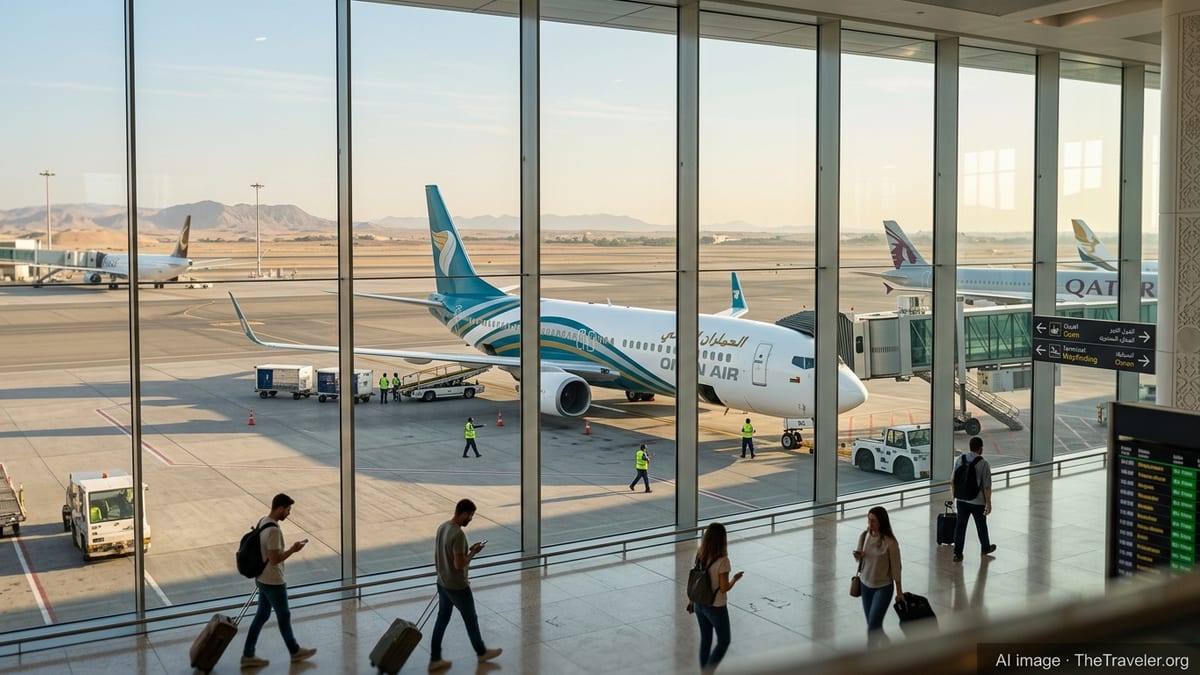
Oman’s national carrier has also been climbing up the global reliability rankings. Cirium’s on-time performance data previously placed Oman Air among the top-performing airlines worldwide, including a second-place global ranking for punctuality at the end of 2024 and recognition as one of the most punctual airlines in the Middle East and Africa. High on-time performance results typically correlate with low cancellation rates, since airlines that manage ground operations closely are better placed to avoid scrapping flights altogether.
Across the wider region, other Middle Eastern airlines are showing similar gains. New punctuality tables for late 2025 compiled by industry data providers highlight carriers such as Qatar Airways and Royal Jordanian among those delivering strong on-time performance with very low cancellation shares, even while handling dense schedules across multiple continents. These outcomes suggest that regional operators have refined their crew planning, maintenance windows and hub-bank structures to keep aircraft moving.
Industry observers note that the Middle East’s major hubs have transformed in recent years from growth-at-all-costs operations into more mature, reliability-focused networks. Gulf and Levant carriers have invested in technology to anticipate disruptions, reassign aircraft and rebook passengers more quickly, reducing the need to cancel entire rotations when problems occur. Travelers flying through Muscat, Doha or Amman are therefore more likely to face minor schedule adjustments rather than outright cancellations.
Oman Air itself continues to navigate financial challenges, with earlier reports of losses in 2024, but operational performance has remained a key point of emphasis. The carrier’s strategy of tightly managing its fleet and concentrating on core routes has helped sustain high completion factors, limiting cancellations even in periods of softer demand or higher fuel costs.
Middle East Resilience Despite Geopolitical Shocks
The recent war involving Iran, Israel and Gulf states has underscored how exposed Middle Eastern aviation remains to geopolitical risk, with several reports documenting sharp spikes in cancellations and reroutings at key moments. At the height of the latest round of hostilities, specialized data firms tracked thousands of flights canceled across the region within just a few days, and some airspaces were temporarily closed or heavily restricted.
Yet subsequent updates from aviation data providers and regional air navigation organizations indicate that traffic flows have rebounded quickly once airspace restrictions eased, with cancellations dropping back toward pre-crisis levels. In their 2025 review, European air traffic analysts pointed to an 11 percent jump in flights between Europe and the Middle East compared with 2024, reflecting both a recovery from earlier disruptions and sustained demand for Gulf hubs as connectors between Europe, Asia and Africa.
This pattern of short-lived disruption followed by rapid normalization has become characteristic of the region. Airlines and airports in Oman and neighboring countries now routinely plan contingencies for potential route closures, alternative routings over Egypt, Cyprus or the eastern Mediterranean, and flexible fleet deployment. Such preparedness helps contain the broader cancellation impact when geopolitical events flare.
For travelers, the message is that while sudden shocks can still cause localized clusters of cancellations, the overall reliability trend is improving. Operators in Oman and the wider Middle East have shown an ability to restore schedules swiftly, keeping longer-term cancellation rates on a downward trajectory even in a challenging security environment.
What the Trend Means for Travelers
The decline in cancellations and the steady improvement in on-time performance across Oman and much of the Middle East translate into a more predictable experience for passengers. Fewer cancelled flights reduce the risk of missed connections at regional hubs and cut down on last-minute itinerary changes that can derail business meetings or holiday plans.
Travel analysts advise that, in the current environment, itineraries routed through Muscat, Doha, Abu Dhabi or other major Middle Eastern hubs are generally offering a higher likelihood of operating as scheduled compared with the volatile recovery years immediately after the pandemic. The combination of upgraded airport infrastructure, more conservative scheduling and a more experienced post-crisis workforce has strengthened the region’s reputation for operational reliability.
That said, experts caution that travelers should still build some flexibility into plans, especially during periods of heightened regional tension. Monitoring airline notifications and checking flight status in the days leading up to departure remain sensible habits. However, the underlying data suggests that the balance of risk has shifted decisively toward smoother operations rather than widespread cancellations.
For Oman, where tourism and aviation are central pillars of economic diversification, the reduction in cancellations is particularly good news. A more dependable flight schedule supports the country’s efforts to position itself as a convenient, stress-free gateway to the Arabian Peninsula and the Indian Ocean, giving travelers added confidence to book trips to Muscat, Salalah and beyond.