

More news on this day
Hundreds of passengers were left stranded in Oman on March 13 after fresh rounds of flight cancellations and schedule cuts by Oman Air and Qatar Airways out of Muscat and Salalah, as regional airspace restrictions and operational constraints continued to disrupt links to Bahrain, Doha, Kochi and other key transit hubs across the Gulf and South Asia.
Get the latest news straight to your inbox!
Grounded Flights From Muscat and Salalah Intensify Regional Disruptions
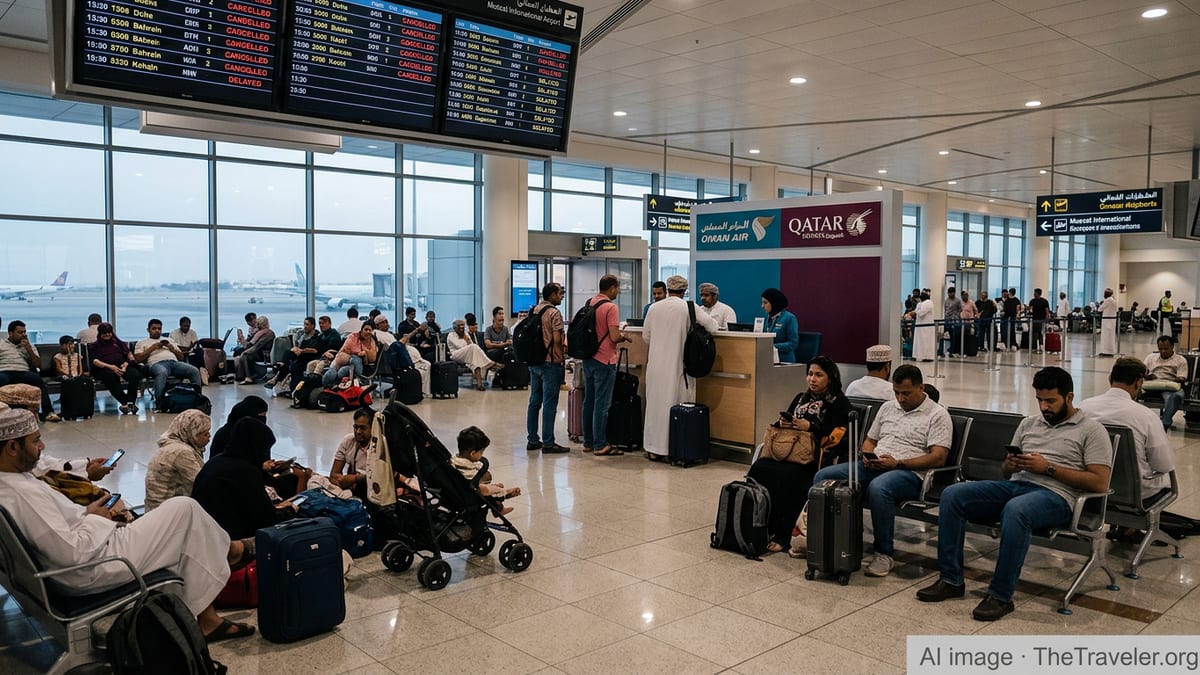
Passengers arriving at Muscat International Airport and Salalah Airport on Thursday reported long queues, packed departure halls and scarce information as multiple departures to Bahrain, Doha, Kochi and other regional destinations disappeared from departure boards. Local aviation staff said that a new wave of schedule adjustments had taken effect overnight, with at least a dozen additional Oman Air and Qatar Airways services removed or retimed as the carriers recalibrated operations in response to constrained air corridors across the Gulf.
The latest disruption follows nearly two weeks of rolling cancellations and diversions affecting services into and out of Doha, with many Qatar Airways flights being rerouted or temporarily operated from Muscat under special contingency permissions. Travelers who had been rebooked via Oman as an alternative to suspended Doha connections found themselves once again stuck in transit, facing days-long waits for replacement seats or forced changes to their itineraries.
Airport staff in Muscat said priority was being given to families with young children, the elderly and passengers with urgent medical needs, mirroring earlier controlled evacuation-style flights operated by Qatar Airways under limited capacity rules. Others were told to await text or email updates or to contact call centers, though many reported jammed phone lines and inconsistent guidance about when normal schedules might resume.
Travelers Report Days-Long Ordeals and Confusing Guidance
Accounts from stranded passengers paint a picture of mounting frustration and uncertainty. Some travelers who had already endured diversions from Doha to Muscat in late February described being marooned for several days with hotel vouchers issued one night at a time and little clarity on onward travel options. Others who had accepted rebookings away from Qatar Airways and onto Oman Air services from Muscat or Salalah this week discovered on arrival that their new flights had also been scrubbed.
On social platforms and aviation forums, travelers recounted last-minute gate changes, cancellations notified only via app alerts and rebookings several days into the future, particularly for heavily trafficked routes linking Oman with India. One family headed to Europe via Doha said their Bangalore to Amsterdam journey had already been pushed back four days and routed through Muscat, with no guarantee that the onward European sector would operate as scheduled.
Passengers booked between Oman and Bahrain reported similar uncertainty, with several Muscat and Salalah departures to the island kingdom removed from online schedules on short notice. While some were able to secure seats on alternative Gulf carriers operating via other hubs, many said same-week options were limited or prohibitively expensive, leaving them to wait for the next available seat from Oman Air or Qatar Airways.
Airspace Limits and Security Concerns Keep Capacity Tight
Aviation analysts say the latest cancellations from Muscat and Salalah are closely tied to the broader operational squeeze in Gulf airspace since late February, when regional tensions prompted temporary route closures and tighter controls over flight paths near Qatar and surrounding states. Qatar’s civil aviation authorities have been gradually reopening limited navigational corridors, primarily for controlled repatriation flights and select cargo operations, but capacity remains sharply below normal levels.
With Doha’s hub constrained, airlines have turned to nearby gateways such as Muscat and Salalah to stage aircraft and move stranded passengers, effectively shifting part of the disruption onto Oman’s airports. Oman Air has also had to juggle its own schedules and crew rosters to accommodate irregular operations, code share commitments and last-minute aircraft positioning, leaving fewer slots for regular commercial departures on popular routes to Bahrain, Kochi and other South Asian cities.
Industry observers note that even when airspace begins to reopen, carriers typically restore services in phases, focusing first on major trunk routes and long-haul connections before rebuilding secondary frequencies. That staggered approach can prolong uncertainty for passengers on regional links such as Oman to Bahrain or Oman to smaller Indian cities, where cancellations or reduced frequencies can persist for days after high-profile long-haul flights have resumed.
What Affected Passengers in Oman Can Do Now
Travel rights specialists say passengers stranded in Muscat or Salalah by short-notice cancellations should first obtain written confirmation of the disruption from their airline, whether as a cancellation notice, amended itinerary or airport-issued disruption letter. This documentation is often required later when claiming refunds, compensation or reimbursement for accommodation and meals under carrier policies or local consumer rules.
Both Oman Air and Qatar Airways have been offering free date changes or refunds in many cases linked to current regional restrictions, but availability of same-week alternatives remains limited. Travelers are being advised to remain flexible with dates, routings and even destination airports, as some have managed to leave Oman by accepting routings via alternative hubs in Europe or Asia rather than via the usual Gulf waypoints.
Experts also urge passengers to keep boarding passes, hotel receipts and records of extra transport or meal costs incurred as a result of being stranded. While policies differ by carrier and jurisdiction, such records can strengthen any later claim for reimbursement or travel insurance coverage. Those with tight visa deadlines or urgent commitments are being encouraged to inform airline staff clearly, as airlines have at times prioritized passengers with expiring permits, critical medical appointments or other time-sensitive needs on scarce outbound seats.
Outlook for Flights Between Oman, the Gulf and India
In the short term, travel planners expect continued volatility on routes linking Oman to Gulf capitals and Indian cities such as Kochi, Mumbai and Delhi, as airlines work around remaining airspace and security constraints. While some carriers serving the wider region have begun adding extra flights from unaffected hubs to help clear passenger backlogs, the combination of aircraft availability, crew duty limits and constrained corridors around Doha and nearby airspace is likely to keep pressure on schedules for several more days.
For now, passengers with upcoming trips through Muscat or Salalah are being strongly advised to monitor their booking status frequently, check for schedule changes in airline apps rather than relying solely on email, and avoid heading to the airport until their flight is clearly confirmed as operating. Travel agents in the region report that last-minute rebookings have become significantly harder to secure, particularly for family groups, and that fares on unaffected routes have spiked as travelers scramble for alternative paths home.
Although airlines and regulators have signaled an intention to restore normal connectivity as soon as it is safe and operationally feasible, the current wave of cancellations underscores how quickly regional events can ripple through tightly interlinked Gulf hubs. For travelers, the new reality around Oman, Qatar and neighboring states is likely to involve closer attention to contingency plans, flexible tickets where possible and a readiness for last-minute changes whenever a journey depends on Muscat, Salalah or Doha as critical transit points.