

More news on this day
With airspace closures and heavily curtailed schedules gripping much of the Gulf, Oman has emerged as the only GCC state maintaining normal commercial flight operations, turning Muscat International Airport into an emergency gateway for thousands of stranded travelers.
Muscat Stays Open as Neighboring Hubs Scale Back
While major Gulf hubs from Dubai to Doha contend with sweeping suspensions and limited relief flights, Oman’s airports are operating close to business as usual. Oman Airports confirmed on Friday, March 6, that Muscat International Airport, Salalah Airport and Sohar Airport remain fully operational, even as regional carriers elsewhere pivot to repatriation-only schedules and emergency charters.
Industry updates from travel and aviation monitors show that Muscat is currently the only Gulf Cooperation Council airport offering a broad slate of regular commercial passenger services, rather than a patchwork of evacuation flights and heavily reduced connections. In contrast, Doha’s Hamad International Airport remains effectively shut to regular traffic, while Dubai and Abu Dhabi are cautiously reintroducing only limited departures after several days of standstill.
The divergence in operational status has put a spotlight on Oman’s relatively uncongested airspace and measured approach to risk management. While authorities continue to track the conflict and related security concerns, they have so far avoided the blanket closures that have rippled across neighboring states.
Omani civil aviation officials have also actively positioned the country as a temporary gateway to the wider region, stressing that existing infrastructure can safely absorb additional airlines and traffic seeking an alternative Gulf entry point.
Travellers Divert by Road and Air to Oman
As cancellations mounted earlier this week in the United Arab Emirates and Qatar, travelers began shifting en masse toward Muscat. Reports from regional media and travel agencies describe convoys of private cars, hired SUVs and intercity buses ferrying passengers from Dubai and other cities to the Omani capital, a drive of roughly four to five hours from the UAE’s northern emirates.
Many of those making the overland journey are transit passengers who had been bound for Europe, North America or Asia via hubs now constrained by airspace closures. Others are residents and business travelers simply seeking any available way out, booking last-minute tickets from Muscat once they cross the border and clear immigration.
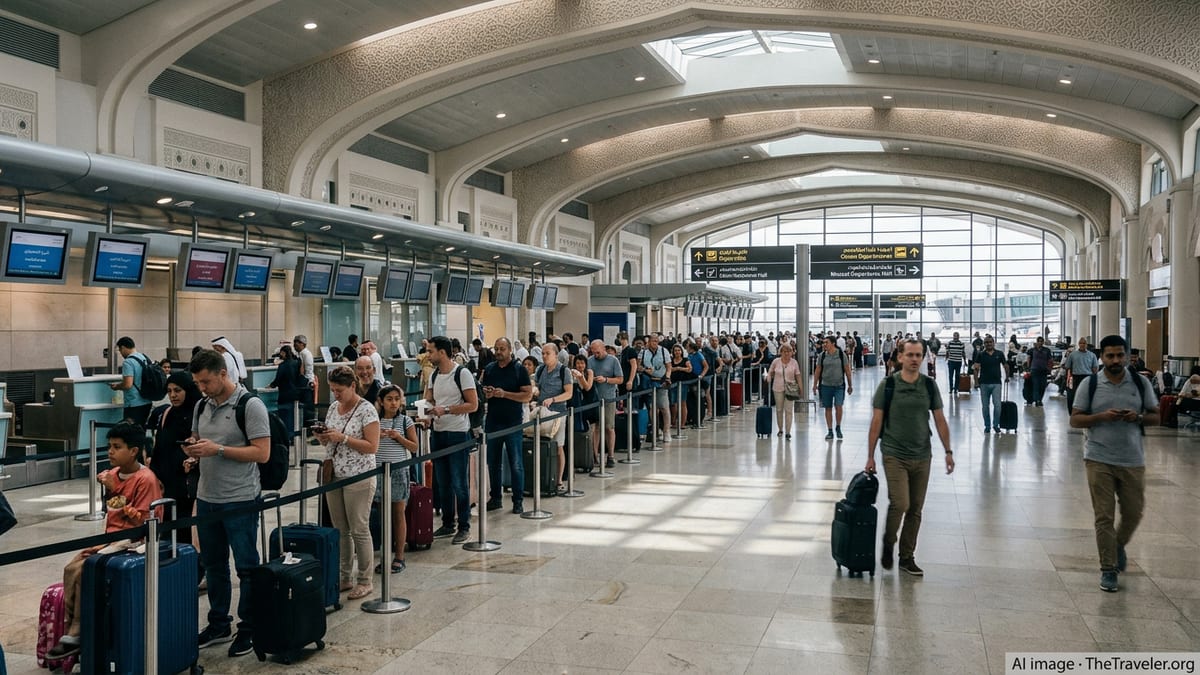
On-the-ground accounts from Muscat International Airport describe unusually long check-in and security queues, with airlines and ground handlers advising passengers to arrive many hours before departure. Yet, unlike at several other Gulf airports where terminal departure boards are dominated by “canceled” notices, flights in Muscat are largely operating, albeit under considerable strain.
In parallel, Fujairah International Airport in the UAE has teamed up with Oman-based SalamAir to run special charter services that route through Muscat, further underscoring the Omani capital’s role as a lifeline node in the region’s disrupted aviation map.
Qatar Airways and Other Carriers Shift Operations to Muscat
The status of Omani airspace has also made Muscat a crucial staging ground for airlines that have been forced to suspend their home-base operations. Qatar Airways, grounded at its Doha hub by airspace closures since late February, has moved a small portion of its network to Muscat, using the airport to operate limited long-haul relief flights to key European destinations.
The reconfigured schedule is only a fraction of the carrier’s usual global operation, but it provides a vital escape route for passengers stranded in the region. Relief flights are being coordinated directly with affected customers, with airlines repeatedly urging travelers not to approach Muscat Airport without a confirmed booking and specific flight instructions.
Other international airlines have added or adjusted services touching Oman as they rework routings around conflict zones and restricted corridors. Some Asian and European carriers have introduced extra Muscat frequencies or upgauged aircraft on existing routes to accommodate displaced passengers who would normally connect through the UAE or Qatar.
Omani aviation authorities have indicated they are prepared to fast-track approvals for airlines seeking short-notice access to Muscat, Salalah or Sohar, in a bid to help restore at least partial connectivity for the wider Gulf region during the disruption.
Spike in Private Jets and Premium Evacuations
The crisis has not only swelled commercial passenger volumes into Oman but also triggered a surge in private jet activity from Muscat International Airport. Flight-tracking data cited by regional business media shows that private flights recently accounted for nearly one-third of all departures from Muscat, a striking jump for an airport typically dominated by scheduled carriers.
Wealthy travelers, corporate executives and high-net-worth families are chartering aircraft out of Oman for cities such as Istanbul and European capitals, often at prices that are double normal charter rates. Brokers report that demand is running ahead of available aircraft, with some travelers paying six-figure sums to secure last-minute departures.
This influx of premium traffic reflects both the severity of the regional shutdown and Muscat’s status as one of the few viable launchpads still accessible by road and air. It has also placed additional pressure on airport slots, ground-handling resources and air traffic management, even as regular holidaymakers and expatriate workers jostle for seats on commercial flights.
For now, authorities have kept a tight focus on safety protocols around Oman’s airspace while signaling that they will continue to accommodate both scheduled and charter operations as long as conditions allow, reinforcing the country’s role as a rare pressure valve in a constrained Gulf aviation system.
What Travelers Need to Know if Rerouting via Oman
With Muscat increasingly functioning as the Gulf’s de facto backup hub, travel experts are urging passengers to plan carefully before attempting to reroute through Oman. The first recommendation is to secure a confirmed flight from Muscat or Salalah before starting any overland journey, as airport and border facilities are operating near capacity and walk-up options are limited.
Travelers are also advised to build in generous buffers for ground transport, border formalities and airport processing, with some carriers suggesting arrival at Muscat International Airport as much as six to twelve hours before departure. Accommodation near the airport is in high demand, and last-minute hotel availability in Muscat may be tight.
For those whose itineraries allow flexibility, routing through Oman can still provide one of the most reliable escape corridors from the region. Airlines continue to warn, however, that schedules are subject to rapid change in response to security assessments and airspace notices, meaning travelers should monitor their bookings closely and stay in close contact with their carriers.
As conflict continues to reshape the Gulf’s aviation landscape, Oman’s unique position as the only GCC state with largely normal flight operations has turned Muscat International Airport into an indispensable bridge between a turbulent region and the rest of the world.