

More news on this day
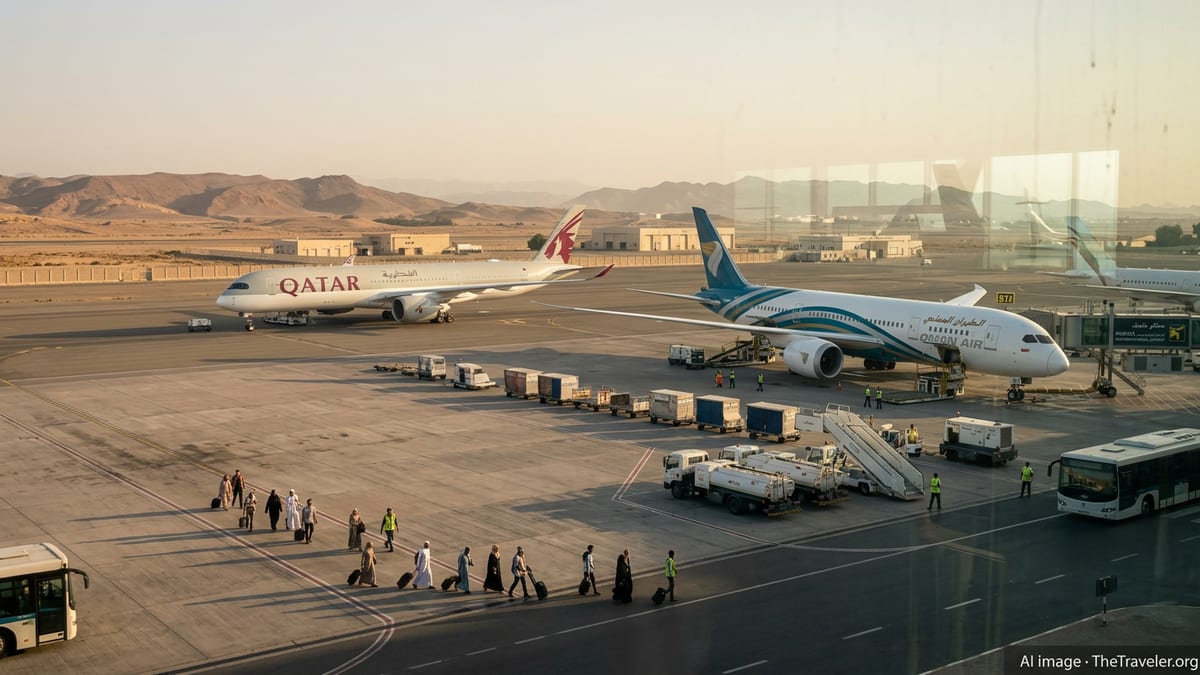
Qatar Airways has moved a limited number of relief flights to Oman as Doha’s airspace remains closed amid escalating regional tensions, leaving thousands of travelers rerouted or stranded across the Gulf.
Doha Hub Falls Silent as Airspace Stays Shut
Qatar’s normally busy Hamad International Airport has fallen quiet after authorities closed the country’s airspace in response to intensifying regional conflict, prompting Qatar Airways to suspend all scheduled passenger services from its Doha hub. The national carrier has confirmed that operations will only resume once regulators announce the safe reopening of Qatari skies, a decision closely tied to evolving security assessments.
In statements issued on 5 and 6 March, Qatar Airways said its teams are “working around the clock” to organize alternatives for stranded passengers while reiterating that routine commercial flights from Doha remain halted. Travelers have been urged not to proceed to the airport unless they receive direct confirmation of a seat on an approved service, reflecting both safety concerns and the sharply reduced number of available departures.
The closure, coming on the heels of missile and drone attacks across the region and heightened tensions involving Iran, Israel and the United States, has disrupted one of the Middle East’s most important aviation hubs. Qatar Airways, which typically connects more than 170 destinations through Doha, has been forced to improvise a temporary network centered outside its home territory.
Muscat Becomes a Temporary Lifeline
Oman has emerged as a critical partner in those contingency plans. Aviation industry outlets and regional media report that Qatar Airways has shifted limited operations to Muscat International Airport, using the Omani capital as a temporary springboard for outbound “relief flights” to key long-haul destinations. Initial services are focused on major European gateways including London Heathrow, Berlin, Copenhagen, Madrid, Rome and Amsterdam, providing a lifeline for some of the airline’s stranded customers.
The move effectively turns Muscat into a stand-in hub, at least for a narrow slate of routes. Aircraft that were previously destined for Doha have been diverted to Oman, while fresh rotations are being mounted from Muscat where airspace and runway capacity remain available. Similar relief services are also being launched from Riyadh in Saudi Arabia, giving Qatar Airways a limited but vital operating footprint beyond its grounded home base.
For Oman, hosting these operations underscores the country’s role as a neutral and pragmatic player within the Gulf. Its aviation authorities have coordinated closely with Qatar Airways and regional partners to enable safe corridors, even as neighboring flight information regions grapple with closures, reroutes and shifting military activity. The arrangement echoes Muscat’s previous role as an alternative gateway during earlier Gulf diplomatic crises, but this time the stakes are shaped more directly by active conflict.
Stranded Travelers Face Complex Detours
While the emergency operations from Oman and Saudi Arabia provide some relief, capacity remains extremely constrained compared with Qatar Airways’ normal schedule. Many passengers are facing days-long delays, complex detours and considerable uncertainty as seats on the limited relief flights are prioritized for those stranded mid-journey or stuck far from home.
Reports from passengers diverted to Muscat describe extended hotel stays arranged at short notice, long queues for rebooking and limited information as the situation evolves hour by hour. Some travelers who began their journeys in Asia or Europe have found themselves unexpectedly routed to Oman, with onward itineraries rebuilt manually by overstretched customer service teams once new relief flights are confirmed.
Travelers currently in Doha face an even more complex picture. With commercial departures from Hamad International Airport suspended, customers cannot simply transfer themselves to Muscat or Riyadh without official coordination. Qatar Airways has said affected passengers will be contacted directly with new flight details where possible, but has also acknowledged that organizing large-scale repatriation in the middle of an airspace shutdown is a slow, logistically demanding process.
Regional Aviation Network Under Strain
The crisis has rippled across the wider Middle East aviation system, exposing how tightly interconnected Gulf hubs have become. Airlines such as Emirates, Etihad, Oman Air and Gulf Air have all been forced to adjust schedules, cancel select services or explore their own limited rescue operations as airspace closures and military activity reshape standard routes.
Industry analysts note that the temporary loss of Doha as a functioning transfer point removes a major node from global connectivity, especially for traffic between Europe, Africa and Asia. Rerouting around closed or high-risk airspace adds flight time, fuel burn and crew duty pressure, while also squeezing capacity at alternative hubs like Dubai, Abu Dhabi and Muscat that are themselves operating under heightened security protocols.
For Oman’s aviation sector, assisting Qatar Airways is both a diplomatic gesture and an operational challenge. Muscat International Airport must accommodate unfamiliar patterns of widebody traffic, last-minute ground handling needs and a surge in transit passengers whose plans have been upended. Local tourism and hotel operators, meanwhile, are seeing a short-term influx of unplanned visitors whose stays are defined more by contingency than leisure.
What Travelers Need to Know Right Now
For passengers with existing Qatar Airways bookings, the core message from the airline and regional regulators is consistent: do not travel to the airport unless you have received specific, updated flight information. With most commercial operations still on hold, turning up at Doha, Muscat or Riyadh without confirmation risks adding pressure to already stretched facilities without improving the chances of travel.
Instead, customers are being advised to monitor official airline channels and wait for direct outreach regarding rebooked itineraries or dedicated relief flights. Where services are operating from Oman, seats are being tightly managed and often assigned to those who were mid-itinerary when the airspace closure took effect, rather than to new bookings.
Travel experts suggest that passengers who are not in immediate distress consider postponing non-essential trips or seeking refunds where policies allow, rather than attempting to piece together complex alternative routings through multiple third-country hubs. With the timing of Doha’s reopening still uncertain and security conditions fluid, Oman’s role as a temporary refuge for Qatar Airways operations remains crucial, but it is no substitute for the full-scale network that normally knits the region together.