

I had been meaning to spend a slow day in a small Dutch town, somewhere that still felt local rather than curated for Instagram. Zierikzee kept coming up in conversations about Zeeland: an old trading port, proud of its monuments, supposedly easy to cover on foot in a single day.
That sounded perfect. What I actually found was a compact and genuinely pretty town center that is ideal for walking, but also more crowded, more car oriented, and more manicured than I expected. It was still a good day, just not quite the quiet, undiscovered maritime backwater I had imagined.
Arriving, Parking, And First Impressions
I drove in on a weekday outside of school holidays, which I naively assumed meant I would have the place more or less to myself. Instead, the ring of car parks around the historic core was already filling up by late morning. The town is very clear that the streets in the inner center are for permit holders or short paid parking. I ended up leaving the car on a free lot by the edge of town, about a five to ten minute walk from the city gates. It was not difficult, but it did feel oddly car heavy for a place that markets itself so heavily on heritage and strolling.
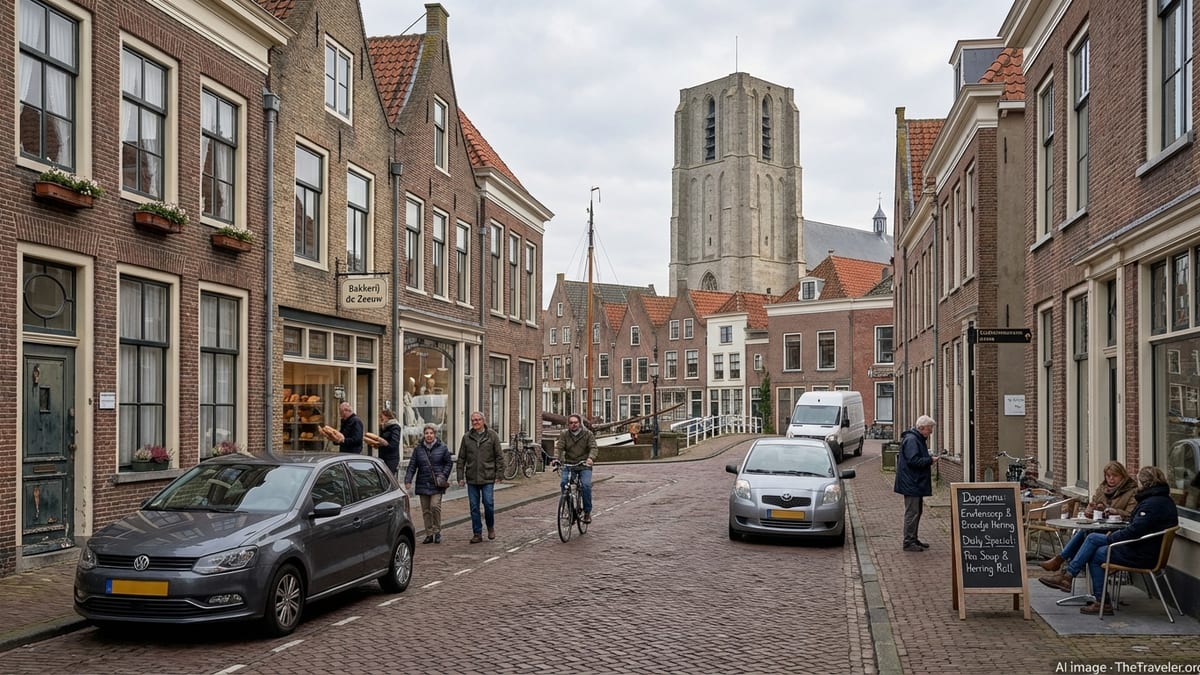
Once I started walking toward the center, the atmosphere improved dramatically. Zierikzee still has sections of city walls and old gates, and as soon as I passed through one of the historic entrances the mood shifted from provincial traffic to something more intimate. Narrow brick streets, gabled houses leaning slightly into the wind, and the distant shape of the Sint Lievensmonstertoren towering over everything. It felt coherent and lived in, not like an open-air museum, although the number of holiday apartments and boutique hotels made it obvious that tourism is now a big part of the local economy.
My first impression was that the town center is small but dense, and that is ultimately what makes it so walkable. Everything I wanted to see in one day was within a fifteen minute radius on foot. At the same time, the cars do not disappear. Delivery vans thread their way along the canals, residents nose into tight parking spots, and some of the main streets double as access routes. It is not dangerous if you pay attention, but it is not the car-free idyll I had half hoped for. I found myself glancing over my shoulder more than I do in some other Dutch historic towns where traffic has been pushed further out.
A Simple Walking Route Through The Historic Core
I decided to do a loose loop rather than follow a formal walking tour. From the car park I entered through one of the western gates, cut into the old town, and let the tall bulk of the Sint Lievensmonstertoren guide me. That is one of the nice things about Zierikzee: you are rarely out of sight of the tower, so you can wander without feeling lost. The streets curve organically, but the layout is not confusing.
My route took me first past modest residential streets and then onto broader, more polished stretches around the main squares. There is a gentle shift from daily life to tourist center: suddenly there are more cafés with multilingual menus, souvenir shops with the usual nautical knickknacks, and ice cream stalls. It did not feel tacky, but there was a clear line where the town starts to perform itself for visitors. I appreciated that this line appears only in a few streets. Ten minutes away, you are back among laundry lines and locals cycling to the supermarket.
If you want to trace a similar loop, it is perfectly doable without a map: start at any outer car park, walk into town through the nearest gate, then aim for the tower. From there, you can drift toward the old harbor, cut across to the Stadhuismuseum, then wander back via smaller side streets. The entire circuit, with stops, comfortably fits in a day. The downside of such an easy route is that you inevitably bump into the same clusters of visitors over and over. By the afternoon, faces started to feel familiar, which slightly chipped away at the feeling of discovery.
The Sint Lievensmonstertoren: Views, Stairs, And Small Annoyances
The tower, locally nicknamed the Dikke Toren, is the centerpiece of Zierikzee’s skyline and now fully open to visitors with regular hours in the main seasons. On the day I visited it operated on a straightforward schedule: open from late morning to late afternoon, closed on Mondays outside school holidays, with the last climb allowed about an hour before closing. Tickets were sold at the entrance, with a small surcharge compared with older guidebooks, but still very reasonable for a major landmark.
Climbing the tower is a commitment. The staircase is a classic narrow stone spiral with 279 steps to the viewing platform. There is no lift, and that is not going to change. I am reasonably fit and still found the ascent mildly punishing, especially when I had to squeeze past people coming down because the stairway is too narrow for two people to pass comfortably. The staff warn you about this and encourage a steady pace, but if you dislike confined spaces or have trouble with knees or balance, this is not something to do lightly.
What you get in return is genuinely impressive. The views over Zierikzee and the surrounding water and farmland are broad and unexpectedly layered. The Zeelandbrug cuts a clean line across the water, the red roofs of the town huddle beneath you, and the pattern of old streets becomes suddenly obvious. It gave me a better sense of how small the historic core really is, and how exposed the town feels to water and wind. I stayed longer than I expected at the top, in spite of the gusts and the chatter of other visitors.
There were annoyances. The interior exhibitions on the lower floors are visually well done but slightly shallow in content if you like detailed history. Panels are brief, and some translations into English felt rushed. It is also not clear before you enter that you can visit the ground floor exhibition for free without climbing, which would be useful for people who cannot manage the stairs. Overall, I was glad I talked myself into the climb, but if I came back in high season with longer queues and hotter weather, I might skip it and enjoy the tower more from the outside.
Old Harbor And Waterfront: Charm With Caveats
From the tower, I followed the streets down to the old harbor. This is where Zierikzee feels most self-consciously picturesque: historic ships, neat quays, brick warehouses reimagined as hotels and restaurants. It is undeniably photogenic. I caught myself taking the same shots as everyone else, trying to frame the masts against the gables and the water. If your idea of a good travel day involves sitting at a terrace with a drink and watching boats moor up, this area is exactly that.
The flip side is that the ambiance depends heavily on the season and the time of day. By early afternoon, the terraces were busy and noisy, mainly with Dutch families and retirees. Service was friendly but slightly overwhelmed at the café where I sat. I waited longer than I expected just to order a coffee and a simple lunch, and when it arrived it was fine, not memorable. Prices were noticeably higher than in less touristed towns, especially for anything with seafood, which is ironic given the maritime setting. I left feeling that I had paid a harbor premium for an average meal.
Walking along the quays and side canals helped restore some of that lost charm. The further I went from the central harbor basin, the more I stumbled on quieter corners: a solitary fisherman mending gear, an elderly couple smoking and chatting on a bench, laundry lines fluttering behind modest houses. These little scenes felt more honest than the polished harbor terraces. Still, there is no getting around the fact that the waterfront is now a stage set built equally for visitors and locals, and you feel that tension in the mix of historic boats and new development.
Stadhuismuseum And The Sense Of History
Earlier in the day I ducked into the Stadhuismuseum, housed in the former town hall. The building itself is almost worth the price of admission alone: creaking floors, a proud tower topped with Neptune, and a sequence of rooms that show off the wealth and self-confidence Zierikzee once had as a trading port. The museum keeps consistent hours most of the year, typically opening late morning and closing mid or late afternoon, with earlier closing on Sundays and closures on certain holidays. I appreciated that the schedule is clearly posted and actually kept. In smaller Dutch towns, that is not always a given.
The exhibitions are a mixed bag. Some sections are thoughtfully curated, with ship models, maps, and artifacts that really help you understand the town’s maritime history and the constant struggle with water. Others feel dated, especially where older display cases have been kept more for tradition than clarity. English texts are present but sometimes less complete than the Dutch versions, and a couple of the multimedia installations were out of order when I visited, which staff acknowledged but could not fix on the spot. None of this ruined the experience, but it did stop it from being a truly immersive history lesson.
On the plus side, the staff were genuinely engaged. One attendant took the time to walk me through the story of a particular painting and how it related to a historic sea battle. That personal interaction did more to bring the town’s past to life than several of the static displays. I left with a fuller picture of Zierikzee as a once significant, now modest, maritime town that has had to reinvent itself repeatedly. If you are only in town for a day, the museum is worth an hour or two, but I would not schedule your whole visit around it.
Between Squares, Side Streets, And Everyday Life
What I enjoyed most about Zierikzee was not any single attraction but the in-between spaces: the short walks from square to square, the occasional detours into alleys that clearly were not meant for tourists. The town center is small enough that you are never more than a few minutes from a bakery, a grocery store, or a café. It reminded me that this is still a working town, not just a preserved shell.
At the same time, the gentrification pressure is obvious. Several ground floors that might once have housed small workshops or modest bars are now concept stores, interior boutiques, or high end clothing shops. There is nothing inherently wrong with that, but it does mean that if you are looking for rough edges or a sense of grit, you will have to look hard. I found a few older cafés and a decidedly unpolished snack bar tucked near the edges of the center, but the heart of town feels increasingly curated.
As a walking environment, the historic core is pleasant but not perfect. Pavements are often narrow and uneven, and the mix of pedestrians, cyclists, and cars in the same space can be a little chaotic at busier times. I noticed several older visitors hesitating at crossings or hugging walls when cars squeezed past. If you have mobility issues or rely on a wheelchair, you should be ready for slopes, cobblestones, and some awkward curbs. There are smoother routes, but you have to seek them out rather than assume they will be there.
Practicalities: Food, Timing, And Logistics
In terms of eating, my day in Zierikzee was steady rather than memorable. The café culture around the main squares and harbor guarantees that you will not go hungry, but it also means you will pay for the location. Menus skew toward familiar Dutch café staples, with some seafood and seasonal specials. I did not find anything that felt like a uniquely Zierikzee dish, and the places that looked more inventive were either fully booked or closed on the day I visited. If eating well is central to your trips, you may want to research and reserve ahead, especially in summer and on weekends.
The timing of a one day visit matters. The tower, museum, and many shops open late morning and close by late afternoon or early evening. That compresses your options if you arrive late or want a relaxed start. I arrived just before lunch and had to choose between eating first or rushing to fit in the museum and tower before closing. I chose sights over food and ended up grabbing a very late lunch and a simple early dinner. If I did it again, I would arrive earlier and start with the tower while my legs were still fresh, then slow down for the rest of the day.
Public transport is possible but requires some planning. Buses connect Zierikzee with larger towns and train stations, but they are not especially frequent outside peak times. For a one day trip, traveling by car is simply easier, as long as you accept that you will park outside the core and walk in. Once you are inside the old town, you will not need any additional transport. I walked everything, including several detours, without any trouble beyond slightly sore feet by the end.
The Takeaway
By the time I left Zierikzee in the early evening, the town had quieted. Day trippers thinned out, terrace chairs were stacked, and the historic streets felt more like a place to live than a destination. That quieter hour was actually when I liked the town most. It was easier to imagine its past as a working port and its present as a small community on the edge of the sea, rather than just a pretty day trip stop in Zeeland.
If I am honest, some aspects did not fully meet my expectations. I had pictured a more unspoiled harbor town, less shaped by tourism and second homes. In reality, Zierikzee has embraced its role as a monument city and day trip magnet. The tower climb, while spectacular in view, is not for everyone and could be communicated more clearly to people with mobility issues. The waterfront is attractive but pricey and a bit generic in its food offerings. The museum is solid but has rough spots that keep it from being outstanding.
Still, I would not call the day a disappointment. For a compact, walkable introduction to Zeeland’s historic towns, Zierikzee delivers a lot in a small area. It suits travelers who like to wander slowly, enjoy architecture, and piece together a sense of place from small details rather than chase must see icons. If you come with realistic expectations, avoid the very busiest summer weekends, and plan your timing around opening hours for the tower and museum, a day here can be quietly rewarding.
Would I repeat the experience the same way? Probably not. Next time I would arrive earlier, climb the tower as soon as it opens, reserve a table somewhere less central for a proper meal, and spend more time in the side streets rather than lingering at the main harbor terraces. Zierikzee is not a secret, but it is still worth a day of your time if you are in Zeeland and want to see how history, tourism, and everyday life now coexist in one small, walkable town.
FAQ
Q1: Is one day really enough to see Zierikzee on foot?
Yes, one day is enough to cover the main sights in the historic center at a relaxed walking pace, including the tower, the Stadhuismuseum, and the old harbor, as long as you arrive by late morning and keep an eye on closing times.
Q2: How difficult is the climb up the Sint Lievensmonstertoren?
The climb is physically demanding but manageable if you are reasonably fit: there are 279 narrow stone steps and no lift, and you share the same spiral staircase with people coming down, which can feel cramped and tiring.
Q3: Can I visit Zierikzee without a car?
Yes, you can reach Zierikzee by regional bus from larger towns and train stations, but frequencies are limited outside peak times, so traveling by car is often more convenient for a flexible one day visit.
Q4: Is the historic center pedestrian friendly?
The center is compact and walkable, but cars and delivery vans still use many streets, pavements are narrow and often uneven, and there are cobblestones, so it is pleasant for most walkers but not ideal if you have serious mobility issues.
Q5: Are the main attractions open year round?
The tower and museum operate mainly during the main seasons and school holidays, with reduced hours or closures on some Mondays and holidays, so it is important to check current opening times before you plan your day.
Q6: Is Zierikzee very crowded?
It depends on when you go: on sunny weekends and during school holidays the main squares and harbor terraces can feel crowded, while weekdays outside peak season are noticeably quieter, especially in the early morning and late afternoon.
Q7: How expensive is food and drink in the center?
Food and drink around the main squares and harbor are a bit more expensive than in non tourist towns in the region, with prices reflecting the location rather than exceptional quality, though you can find more modest options slightly away from the waterfront.
Q8: Is Zierikzee suitable for children?
Yes, children who enjoy boats, tower views, and short walks will likely be happy, but younger kids might find the long stair climb exhausting, and there are limited specifically child focused attractions beyond the general historic setting.
Q9: What should I wear for a one day walking visit?
Comfortable walking shoes are essential because of cobblestones and stairs, and it is wise to bring a windproof layer, as Zierikzee is exposed to sea breezes and the top of the tower can be noticeably colder and windier than the streets below.
Q10: Who is Zierikzee best suited for as a day trip?
In my experience it is best for travelers who enjoy small scale history, architecture, and slow wandering, who do not mind a bit of tourist polish, and who are content with decent but not outstanding food and a gentle rather than thrilling pace.