

Few countries are as easy to explore by rail as the Netherlands. Frequent trains, compact cities, and walkable historic centers make it simple to base yourself in a handful of hubs and see far more than you could by car. This one week itinerary focuses on Amsterdam, Rotterdam, and Utrecht, three very different cities connected by short, fast train rides and reliable schedules, with no need to drive or navigate motorways.
Why Trains Are the Best Way to See the Netherlands
The Dutch rail network is dense, well signposted, and designed for everyday commuters as much as visitors. For travelers, that means frequent departures, straightforward transfers, and short journey times between major cities. Amsterdam, Rotterdam, and Utrecht sit on the main intercity corridors, so trains between them typically run several times per hour throughout the day.
On the core routes, intercity trains link Rotterdam and Amsterdam in around 40 to 60 minutes on the faster Intercity Direct services, and Utrecht to Amsterdam in roughly half an hour depending on the stopping pattern and current timetable. Domestic timetables are adjusted each December and can change temporarily during engineering works, so it is wise to treat exact times and frequencies as approximate and check close to departure in the national rail app or at station information screens.
For most visitors, the key decision is whether to buy point to point tickets or to load credit on a contactless card or an OV chip style card. Standard second class tickets are adequate for short hops, and seat reservations are generally not required on domestic NS trains. A small supplement is charged on the Intercity Direct high speed section between Schiphol Airport and Rotterdam, although some international tickets and rail passes are exempt. Because pricing and conditions are updated regularly, check the latest details when you buy.
Beyond the trains themselves, Dutch stations are easy to navigate. Amsterdam Centraal, Rotterdam Centraal, and Utrecht Centraal all act as multimodal hubs where you can step straight onto trams, buses, or metro lines. Wayfinding uses clear pictograms and bilingual Dutch and English information, and all three stations have been modernised with wide concourses, escalators, lifts, and barrier free routes, which makes rail travel practical even with luggage or a stroller.
Overview of the One Week Itinerary
This itinerary is designed for a first time visitor who wants a balance of big city energy, contemporary architecture, and traditional canal side charm, without changing hotels every night. It assumes you will arrive and depart through Amsterdam, but it works equally well if your flight uses Rotterdam The Hague Airport or if you arrive overland from Belgium or Germany and adjust the starting city.
A typical week might look like this: two full days based in Amsterdam to get over jet lag and see headline sights; a transfer to Rotterdam with two nights in the city and time for its modern waterfront, museums, and a detour to Delft or Kinderdijk; and finally two nights in Utrecht, a lively university city that often feels like a more relaxed, compact version of Amsterdam, with excellent rail connections for final day trips before looping back to Amsterdam for departure.
Because train journeys between the three cities are so short, you can shift days around easily. Travelers who prefer fewer hotel changes can also choose a single base. For example, staying all week in Utrecht or Amsterdam and treating Rotterdam as a day trip works comfortably; Utrecht in particular sits almost in the geographic and rail center of the country, with direct services to both cities.
The itinerary outlined here keeps daily rail legs under about an hour and focuses on realistic walking times between stations and city centers. It is written with the assumption that you will rely primarily on public transport and walking, using taxis only occasionally at night or with heavy luggage. Seasonal crowd patterns are factored in where relevant, particularly in Amsterdam, which can feel very busy on spring and summer weekends and during holidays.
Days 1 and 2: Arrival and Exploring Amsterdam
Most international visitors arrive via Amsterdam Airport Schiphol or by intercity or high speed trains that terminate at Amsterdam Centraal. From Schiphol, frequent trains reach Amsterdam Centraal in around 15 to 20 minutes, and there are also direct trains to other stations like Amsterdam Zuid. Once you step off the train at Centraal, the historic center unfolds in front of you, with canal belts and narrow streets only a few minutes on foot.
On your first afternoon, focus on orienting yourself rather than rushing through museums. Drop your bags at your accommodation, then stroll the Jordaan or canal belt to get a feel for the city’s scale. The key point for the rail portion of your trip is that you are within a short tram or metro ride of Amsterdam Centraal and Amsterdam Zuid, both of which will be gateways for your onward trains later in the week. Learning the tram routes that link your neighborhood with those stations will save time over the coming days.
Day two is ideal for the Rijksmuseum, the Van Gogh Museum, or a canal cruise. These activities are clustered around Museumplein and the central canals, which are well served by trams rather than trains. However, keeping rail in mind, you may want to scout your departure platform and signage at Centraal at some point during the day. Platforms for intercity trains to Rotterdam and Utrecht are generally clearly labeled, but Centraal is undergoing phased upgrades, and there can be temporary changes to platform allocations or passenger routes inside the station during construction work.
Ticket wise, if you expect to make several tram, bus, and metro trips inside Amsterdam alongside your rail journeys, look into combined regional tickets such as Amsterdam area travel cards. These products are updated regularly and often bundle unlimited local transport for one or more days, sometimes alongside airport transfers. If you will mainly be walking and only using intercity trains between cities, simple point to point tickets or contactless payments at the gates are usually sufficient.
Day 3: Amsterdam to Rotterdam by Rail
The move from Amsterdam to Rotterdam is one of the easiest rail legs in the country. Direct intercity and Intercity Direct trains typically run multiple times per hour between Amsterdam and Rotterdam, with journeys averaging under an hour on the faster services. Departure times vary slightly with each timetable change, so plan to check a rail planner app the day before and aim for a mid morning train to avoid commuter peaks.
If you depart from Amsterdam Centraal, you may find both regular intercity trains on the classic line and Intercity Direct services that use high speed tracks via Schiphol Airport. The Intercity Direct option offers a slightly shorter journey time on the Schiphol to Rotterdam segment but usually requires a supplement for domestic passengers on that stretch. The supplement is a relatively small flat amount and can be added to your ticket in machines or apps. Exact prices change periodically, so verify costs and whether your ticket type or rail pass is exempt before boarding.
Rotterdam Centraal is a destination in its own right, with its striking angular roof and spacious concourses. Once you arrive, you can walk straight out into the modern city center. Hotels near the station are convenient if you want minimal transfers, but even waterfront districts around the Erasmus Bridge and Wilhelminapier are only a short tram or metro ride away. The city’s public transport network integrates metro, tram, and bus lines, all of which accept contactless payment and OV chip style cards.
After settling in, spend the afternoon exploring the area around the Markthal, the cube houses, and the old harbor at Oude Haven. None of these require further train travel, and the city’s flat terrain makes it easy to cover them on foot. If you are curious about onward regional trains, you might stop by Rotterdam Blaak station under the Markthal to see how local stations differ from major hubs like Centraal. Platforms are usually signed in Dutch and English, and digital boards show upcoming services.
Day 4: Rotterdam, Day Trips, and High Speed Options
Rotterdam makes a flexible base for exploring parts of South Holland by rail. One of the most popular nearby cities is Delft, a historic town with canals and a compact old center. Trains from Rotterdam Centraal to Delft generally take about 15 minutes, with several departures per hour, though precise frequencies depend on the current timetable. Because the journey is so short, you can easily spend a half day in Delft before returning to Rotterdam for dinner.
Another classic outing is to Kinderdijk, known for its historic windmills. Reaching Kinderdijk relies more on waterbus and local buses than on trains, but the starting point is often Rotterdam’s riverfront, which you can access by tram or metro from Centraal. If you prefer to keep the day fully rail based, consider venturing to The Hague instead. Direct intercity and sprinter trains link Rotterdam Centraal with The Hague Central Station in roughly 20 minutes, with up to several trains per hour on busy corridors.
If you are interested in high speed rail, Rotterdam is also an important stop for international services to Belgium, France, and the United Kingdom. Trains branded as Intercity Direct or Eurocity Direct use the high speed line north to Amsterdam and south towards Brussels. Even if you are not leaving the country, it is helpful to understand that some domestic tickets require a supplement on these trains between Schiphol and Rotterdam, and that some services may be more crowded near peak holiday periods such as King’s Day in late April and school vacations.
Round out your day with a sunset walk across the Erasmus Bridge or a harbor tour. When you return to your hotel, take a moment to check the next day’s trains to Utrecht. Travel times between Rotterdam Centraal and Utrecht Centraal are normally under one hour on direct intercity trains, and services are frequent across the day, though exact intervals can vary with timetable adjustments or temporary engineering works.
Days 5 and 6: Utrecht as Central Hub
On day five, board a direct intercity train from Rotterdam Centraal to Utrecht Centraal. Under normal conditions, this trip takes around 40 to 50 minutes. Utrecht Centraal is the busiest station in the Netherlands by passenger volume and has been extensively modernised in recent years, with a distinctive wave like roof, broad concourses, and seamless access to the adjacent Hoog Catharijne shopping center and the historic city center beyond.
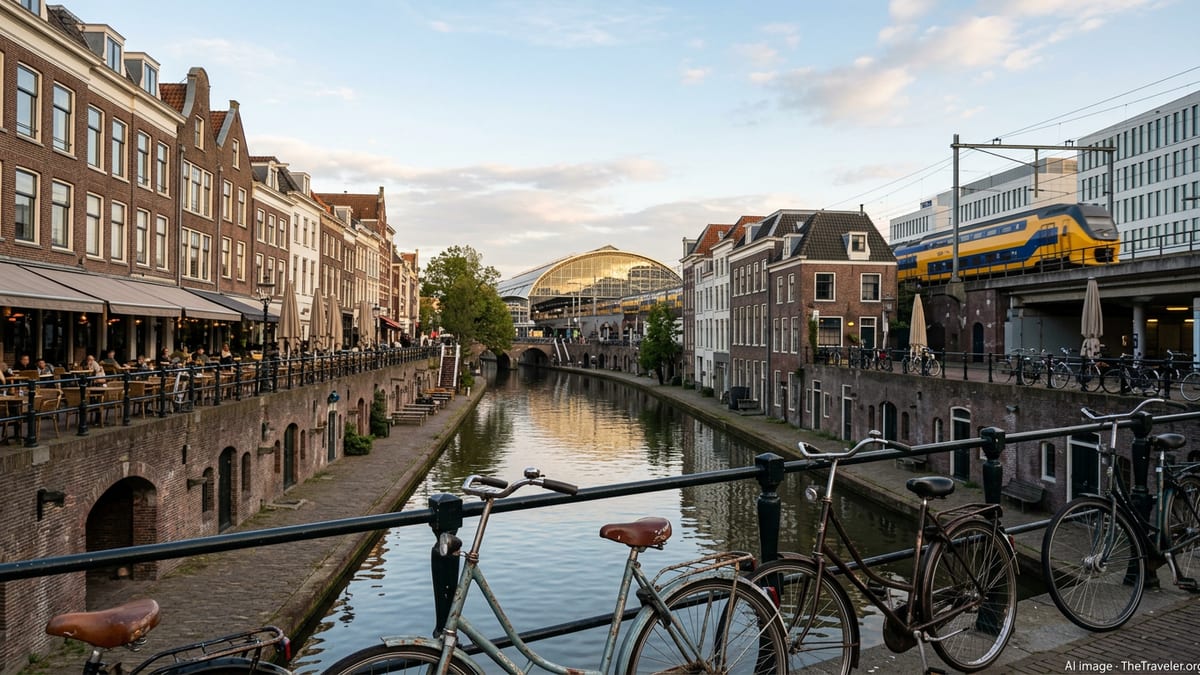
The walk from the station to Utrecht’s old town and canals is short, usually under ten minutes. Once you emerge from the mall complex, you will quickly find yourself beside the Oudegracht canal, lined with cafés, warehouses, and wharf cellars converted into restaurants and bars. Utrecht has a younger, more local feel than Amsterdam in many neighborhoods, thanks in part to its large student population, yet it retains traditional canal architecture and a famously tall cathedral tower.
One of the advantages of basing yourself in Utrecht is its position at the heart of the network. Direct intercity trains link Utrecht not only with Amsterdam and Rotterdam but also with cities such as The Hague, Arnhem, and Amersfoort, and with international routes towards Germany and beyond. For a rail focused visitor, this means you can choose day trips almost spontaneously, depending on weather and energy levels, without worrying about long travel times.
Day six could be devoted entirely to Utrecht itself. Climb the Dom Tower if it is open during your visit, explore the Museum Quarter, or simply wander the canals. Within the city, you will rely more on walking and buses than on trains, although suburban rail services do link outlying districts. If you prefer another day trip, you might use Utrecht’s direct trains to reach smaller towns, remembering that exact journey times and frequencies should be confirmed in a live timetable, especially during periods of planned work around Utrecht and Amsterdam that sometimes reduce services or replace them with buses for short stretches.
Day 7: Returning to Amsterdam and Departure Logistics
On your final day, you will likely return to Amsterdam for a last evening or to connect to an onward flight or train. Utrecht Centraal to Amsterdam Centraal is one of the busiest domestic corridors, with intercity and sprinter trains that normally take around 25 to 35 minutes depending on route and stops. In ordinary weeks there are several services per hour, but during major upgrade projects around Amsterdam and Utrecht, frequencies can be temporarily reduced or journey times extended by diversions.
If you are flying out of Schiphol, you may choose to travel directly from Utrecht Centraal to Schiphol Airport, which is also typically a direct intercity journey of around half an hour. Alternatively, you can travel into Amsterdam Centraal for a last stroll and then catch an airport train from there. Both routes work, so choose based on luggage, flight time, and whether you want one more look at Amsterdam’s canals.
Build in extra time on departure day. Dutch trains are generally punctual, but busy corridors can feel crowded in peak hours, and large stations may route passengers along revised walking paths during construction phases. Arriving at Schiphol or Amsterdam Centraal earlier than strictly necessary reduces stress if there are any last minute platform changes or if you need time to locate the correct check in areas or international platforms.
As you wrap up the week, review how much you have used rail beyond the core Amsterdam, Rotterdam, and Utrecht triangle. Many visitors find that a simple combination of intercity tickets and occasional local transit provides enough flexibility without needing a more complex rail pass, especially for a single week in one country. If you are continuing by train into Belgium or Germany, you may begin to look at international ticketing and reservation rules that differ slightly from domestic NS practice.
Practical Rail Tips for First Time Visitors
Understanding a few basics about Dutch train categories will make this itinerary smoother. Intercity trains connect major cities with fewer stops and higher average speeds, while sprinter trains stop at more local stations. On the Amsterdam, Rotterdam, and Utrecht triangle, you will mostly be using intercity services, but a sprinter can be useful if there is a disruption or if you are based near a smaller station on the edge of one of the cities.
Boarding is straightforward. Platforms display the train type, destination, and major intermediate stops on electronic boards, usually in Dutch with clear abbreviations and line numbers. Audio announcements often repeat key information in English. If you miss your intended train, the next one is usually close behind, but during late evenings or on certain regional branches, frequencies can fall to two trains per hour, so it is still worth checking the last return times from any day trip destination.
When it comes to seating, most intercity trains have both first and second class coaches, with first class marked by a large number one near the doors and often a slightly quieter environment. Seat reservations are not common on domestic services; you simply board and sit where there is space. Luggage racks above seats and at carriage ends are standard, but they are sized for regular suitcases rather than oversize sports gear. If you are traveling during peak rush hours, try to avoid the busiest commuter departures or be prepared to stand for a short stretch between cities.
Digital tools are indispensable. The official national rail app and a handful of widely used third party journey planners provide live updates on delays, platform changes, and engineering works. Around major works, news outlets and expat information sites often report that there will be fewer trains on certain routes on particular dates, and replacement buses may be arranged for segments near Utrecht or Amsterdam. These changes are usually planned well in advance, but they are easiest to navigate if you check your route the night before each travel day.
The Takeaway
A one week itinerary linking Amsterdam, Rotterdam, and Utrecht by train offers an efficient, low stress way to experience three distinct sides of the Netherlands. Compact distances, frequent services, and pedestrian friendly city centers mean you spend less time in transit and more time on waterfront promenades, in museums, and along tree lined canals.
By structuring your days around a handful of short rail legs and leaving room for spontaneous side trips, you gain the benefits of a well planned route without the rigidity of a packaged tour. You can shift a Rotterdam day trip to The Hague instead, linger an extra afternoon in Utrecht’s cafés, or duck into a smaller town like Delft, all while relying on the same intercity network.
Most importantly, this style of travel keeps logistics simple. With no car to park, no unfamiliar road rules to master, and no long drives, you can treat the train as an everyday tool rather than an event. It is a practical, sustainable way to see a country that has long built its identity around water, trade, and connection, and that today continues to refine high frequency, electrified rail as the backbone of how people move.
FAQ
Q1. How long does it take to travel by train between Amsterdam, Rotterdam, and Utrecht?
The journeys are short under normal conditions. Amsterdam to Rotterdam typically takes about 40 to 60 minutes on direct intercity trains, and Amsterdam to Utrecht or Utrecht to Rotterdam usually takes around 25 to 50 minutes depending on route and stops. Always confirm exact times in a live timetable before you travel.
Q2. Do I need to book seats in advance on Dutch intercity trains?
For domestic journeys on NS intercity and sprinter trains, seat reservations are generally not required and often not available. You buy a ticket, board any service for your route within its validity, and take any free seat in the correct class. Only certain international trains use mandatory reservations.
Q3. Is first class worth it for this one week itinerary?
First class offers slightly wider seats and a quieter atmosphere, which some travelers appreciate at busy times. However, for short hops of under an hour between Amsterdam, Rotterdam, and Utrecht, most visitors find second class entirely adequate and more economical.
Q4. How do I pay for trains and local transport?
You can buy individual tickets from machines or ticket counters, or you can tap in and out with a contactless bank card or an OV chip style card at station gates. In cities, trams, buses, and metros usually accept the same forms of payment. Combined regional or city tickets may be useful if you plan many local trips in a short period.
Q5. Do I have to pay a supplement for the Intercity Direct train?
A small supplement is normally required for domestic journeys on the Intercity Direct high speed section between Schiphol Airport and Rotterdam. The exact amount and the rules on who must pay can change over time, and some international tickets and passes are exempt, so check current conditions when purchasing your ticket.
Q6. How early should I arrive at the station before my train?
For domestic trains, arriving 10 to 15 minutes before departure is usually enough, as there are no security checks similar to airports. At busy times or in larger stations like Amsterdam Centraal and Utrecht Centraal, allowing a little extra time is sensible so you can navigate concourses and find your platform without rushing.
Q7. What happens if there is engineering work on my route?
During planned works, rail operators publish adjusted timetables and sometimes replace sections of the route with buses. Services between Amsterdam, Rotterdam, and Utrecht can be slightly less frequent or follow diverted paths, which may extend travel times. Using the national rail app or checking station information screens on the day will show the latest options.
Q8. Is rail travel in the Netherlands accessible for passengers with limited mobility?
Major stations such as Amsterdam Centraal, Rotterdam Centraal, and Utrecht Centraal have lifts, ramps, and step free routes. Train doors are generally level or near level with platforms, though small gaps remain. If you require assistance, you can arrange it in advance through the national rail operator so staff can help with boarding or transfers.
Q9. Can I use this itinerary as a base for day trips beyond the three cities?
Yes. From Amsterdam you can reach places like Haarlem or Zandvoort aan Zee by train, from Rotterdam you can access Delft or The Hague, and from Utrecht you can connect to towns across the central Netherlands. Always check last return train times and allow a margin for delays when planning evening excursions.
Q10. What is the best season to follow this one week train itinerary?
Spring and early autumn often offer mild temperatures and pleasant daylight hours, which pair well with city walking and rail travel. Summer brings longer days but can be busier, especially in Amsterdam. Winter is quieter and colder, with shorter daylight, but trains usually continue to run frequently, and cities feel more local and less crowded.