

More news on this day
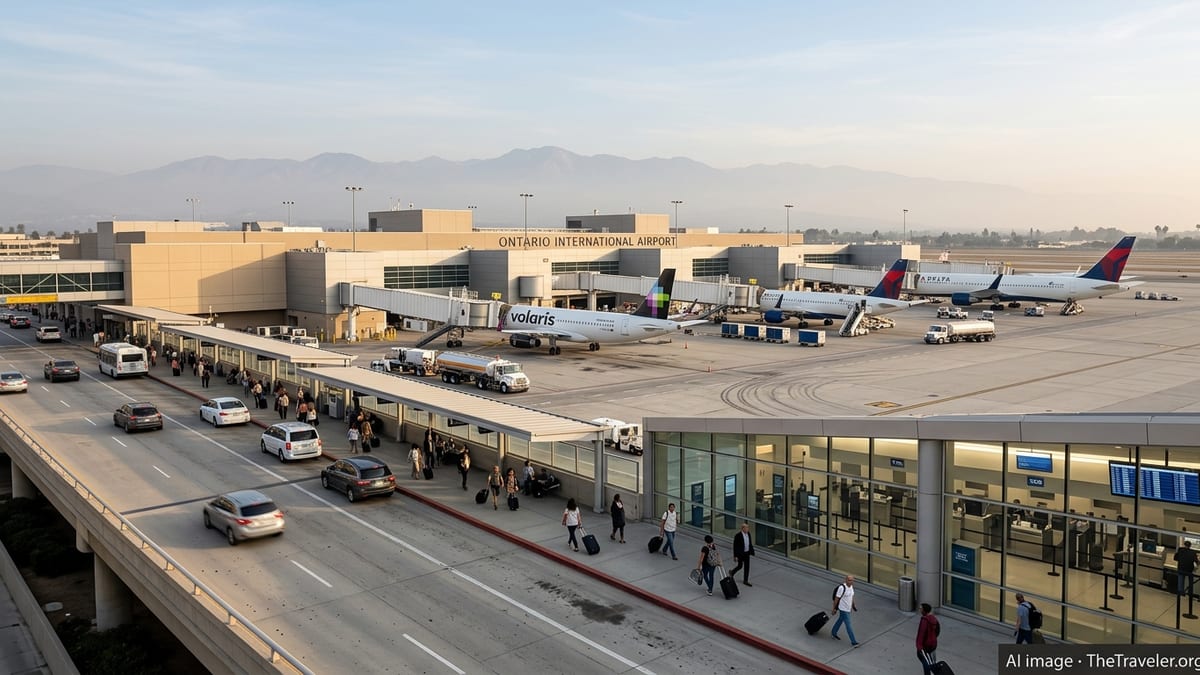
Ontario International Airport in Southern California is entering 2026 with a fresh milestone, reporting a 6% year-over-year increase in passengers and the highest international traveler volumes in its history, according to recently released traffic data and public reports.
Get the latest news straight to your inbox!
New Growth Benchmark for a Rising Inland Empire Hub
The latest figures position Ontario International Airport as one of the strongest growth stories among mid-sized U.S. airports, building on several consecutive years of rising traffic. Publicly available airport statistics for late 2025 and early 2026 show overall passenger numbers up about 6% compared with the same period a year earlier, marking a new benchmark for the facility.
The 6% jump follows a period in which Ontario International repeatedly outperformed many regional peers in percentage growth, even as national air travel volumes largely normalized after the pandemic era. Industry analysts note that this sustained momentum suggests Ontario is solidifying its role as a primary alternative to larger, often congested Southern California hubs.
Airport traffic reports indicate that the gains are not confined to a single month but reflect a broader upward trajectory through 2025 and into 2026. While precise annual totals for 2026 will not be available until year-end, early indicators point to another record-setting year if trends continue.
Record International Volumes Reshape Ontario’s Profile
Perhaps the most striking element in the new data is the performance of international markets. Public information from 2024 and 2025 showed international passenger counts already setting new highs for Ontario International. Updated reports for the start of 2026 now point to another step change, with international traveler numbers reaching their highest level yet and outpacing domestic growth in percentage terms.
This record international performance reflects a mix of expanded long-haul offerings and additional near-haul services to Mexico and other destinations. Airlines have gradually increased capacity at Ontario International, including larger aircraft on select routes and more frequent service on established international corridors.
The shift is reshaping the airport’s profile from a primarily domestic operation into a more rounded international gateway for the Inland Empire and eastern Los Angeles County. Travel industry observers indicate that growing outbound leisure demand, coupled with stronger visiting friends and relatives traffic, has supported the rapid rise in cross-border travel.
Airline Capacity, Network Strategy and Competitive Positioning
The 6% overall growth rate is closely tied to airline scheduling decisions that favor Ontario International as a practical alternative to Los Angeles International Airport. Over the past two years, several carriers have increased seat capacity at Ontario, taking advantage of comparatively lower congestion, shorter taxi times and a catchment area with strong population and employment growth.
Route maps for 2025 and early 2026 show a gradual deepening of Ontario’s domestic network, particularly to major hubs in the Mountain West, Midwest and Texas, which in turn support international connectivity through carrier alliance partners. This strategy allows airlines to funnel long-haul demand from the Inland Empire through their primary hubs while still offering some nonstop international options from Ontario itself.
Industry reports suggest that Ontario’s ability to attract and retain capacity has been aided by its operational reliability and relatively stable on-time performance. For airlines, the combination of growing local demand, predictable operations and lower operating complexity compared with major coastal hubs makes Ontario an increasingly attractive point in their broader network strategies.
Economic Ripples Across the Inland Empire
The acceleration in passenger traffic is also being framed as a broader regional economic story. Publicly available planning and financial documents for the airport describe passenger growth as a driver of employment in aviation services, hospitality and ground transportation, as well as a catalyst for new commercial development around the airport’s perimeter.
Higher international volumes are seen as particularly important for local businesses with cross-border supply chains and international customer bases. Travel analysts note that improved global connectivity can support everything from logistics and manufacturing to tourism, helping diversify the Inland Empire economy beyond its traditional warehousing and distribution strengths.
Local tourism and convention stakeholders have also highlighted Ontario International’s growth as a key asset in attracting events that once defaulted to coastal venues. With more nonstop options and shorter travel times for many visitors, the airport’s expansion is increasingly viewed as a competitive advantage for the broader region.
Infrastructure, Service Experience and the Road Ahead
Ontario International’s rapid growth is putting a spotlight on its infrastructure and customer experience, as the airport works to balance capacity needs with traveler expectations. Public documents detailing capital plans and board agendas indicate ongoing investments in terminal modernization, technology upgrades and airfield improvements designed to accommodate higher passenger throughput.
Travelers have recently reported relatively efficient security processing and manageable wait times, even during peak periods, though discussions in public forums point to pressure points during late-night international departure banks. Observers note that continued growth at or above the current 6% pace could eventually require more substantial terminal expansion to maintain service levels.
Aviation forecasters suggest that Ontario International’s trajectory in 2026 will depend on several variables, including airline fleet plans, broader economic conditions and competitive dynamics in Southern California. For now, however, the airport’s latest numbers portray a facility in ascendance, setting fresh records in international traffic while establishing a new benchmark for overall passenger growth at the start of 2026.