

More news on this day
Regional airline Originair will end its Wellington to Westport service in May 2026, with publicly available information indicating that a deepening aviation fuel crisis and rising operating costs have made the route unsustainable for the small carrier.
Get the latest news straight to your inbox!
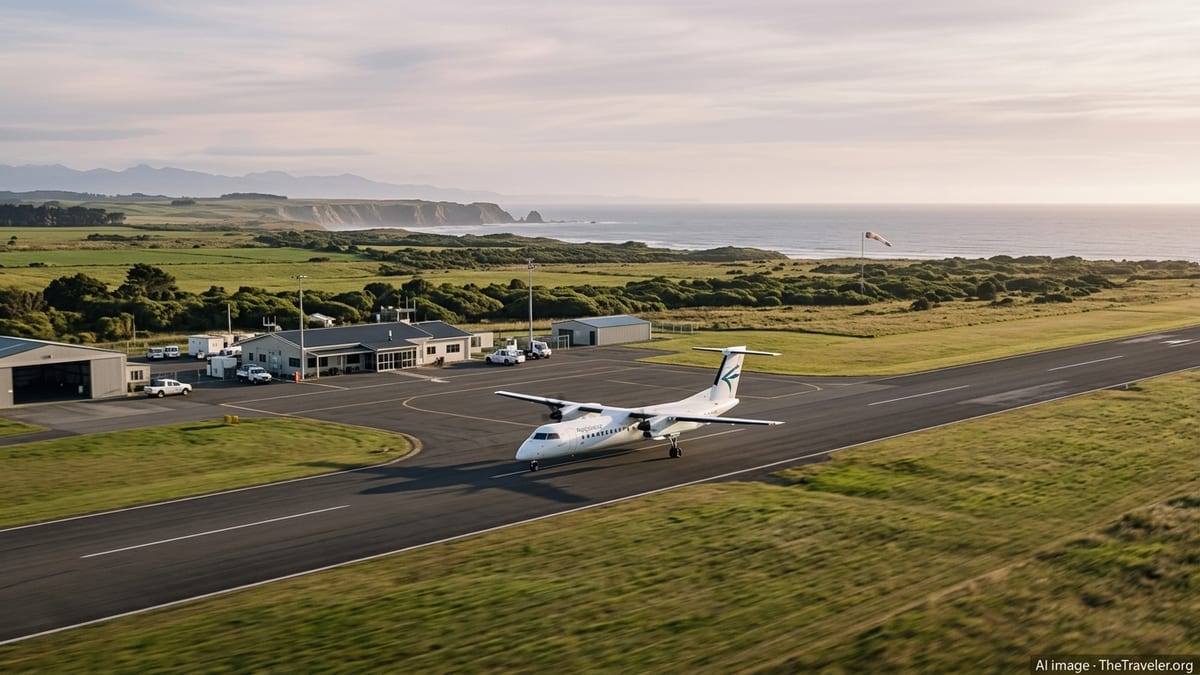
Final Flights Mark the End of a Short-Lived Lifeline
The Wellington–Westport service was launched by Originair as part of a broader effort to restore Buller District’s air connectivity after previous operators withdrew from the market. The route linked the West Coast town directly with the capital, offering connections to government, health services, and onward domestic and international flights.
Timetables show that the current schedule will continue into early autumn 2026, before regular services are withdrawn in May. The decision is expected to leave Westport once again without a direct link to Wellington, unless another carrier steps in or national network changes create new options.
Passenger numbers on regional services are typically sensitive to fare increases, and rising fuel and compliance costs have pressured airlines serving small markets across New Zealand. The end of the route highlights how quickly fragile links can unravel when operating conditions tighten.
Local businesses and frequent flyers had viewed the Originair service as a symbolic and practical reconnection after years of uncertainty. Its planned withdrawal now raises fresh questions about how permanent, reliable air access can be secured for remote communities.
Fuel Crisis Pushes Regional Airlines to the Brink
New Zealand’s aviation sector is grappling with a volatile global fuel environment, intensified by conflict in the Middle East and disruptions across energy supply chains. Recent reporting on national carriers shows jet fuel prices swinging sharply over short periods, triggering capacity cuts, suspended financial guidance, and a renewed focus on network rationalisation.
Industry data and government briefings describe a system that does not currently face an outright national shortage of aviation fuel, but is under mounting cost pressure. For larger airlines, the response has included hedging strategies, modest network reductions, and greater use of sustainable aviation fuel to manage emissions obligations while trying to protect core routes.
For a small regional operator such as Originair, however, the scale and volatility of fuel costs are far more difficult to absorb. Ticket prices on thin regional routes cannot be raised indefinitely without dampening demand, yet aircraft must still uplift fuel that is priced on global markets and subject to sharp currency movements.
The result is a squeeze that falls hardest on marginal services. When fuel prices spike or stay elevated, short-haul routes with modest passenger volumes and limited freight opportunities become especially vulnerable, as operators seek to concentrate aircraft and crews where revenue is more predictable.
Rising Operating Costs Undermine Regional Connectivity
Fuel is only one part of the cost structure that shapes regional aviation in New Zealand. Publicly available financial reports and policy papers highlight a steady rise in airport charges, maintenance expenses, regulatory compliance costs, and carbon-related obligations under schemes such as the New Zealand Emissions Trading Scheme and international frameworks.
These pressures are magnified on turboprop aircraft and smaller regional fleets, which spread fixed costs over fewer seats. On a route like Wellington–Westport, every empty seat represents lost revenue against largely inflexible expenses, from engineering and safety requirements to insurance and navigation charges.
Documents on regional air connectivity policy also outline how smaller airlines contend with limited bargaining power when negotiating access to infrastructure and services. While some regional airports offer discounted fees or local support to retain flights, such measures rarely offset the combined impact of global fuel volatility and domestic cost inflation.
In this context, Originair’s retreat from Wellington–Westport reflects a broader pattern that has affected numerous small communities across the country in recent years. As operators prune their networks to protect financial stability, the most remote and least profitable links are often the first to go.
Impact on Westport and the Wider West Coast
The end of Wellington–Westport flights will be felt well beyond the departure lounges. Air links to the capital are crucial for Westport residents needing specialist medical care, students and professionals commuting for work or study, and businesses dependent on face-to-face contact with partners and clients.
Tourism operators on the West Coast have also relied on air access to attract visitors who are short on time or averse to long road journeys. A direct flight from Wellington provided an efficient gateway to local attractions and helped position Westport as more than just a distant stop on a South Island itinerary.
Without a replacement service, travellers will likely be forced to route through larger South Island centres or rely on lengthy road connections. This adds cost and complexity, potentially discouraging short trips and undermining efforts to diversify the local economy beyond resource industries.
For local authorities and economic development agencies, the loss of the route complicates long-term planning. Reliable air connectivity is often a precondition for investment, particularly in sectors such as professional services, technology, and higher-value tourism that depend on easy access to national and international markets.
Calls Grow for a Long-Term Strategy on Regional Routes
The scheduled end of Originair’s Wellington–Westport flights is likely to fuel renewed debate about how New Zealand supports essential regional air services during periods of market stress. Policy reviews already in circulation discuss a mix of tools, from targeted infrastructure funding and route support schemes to more coordinated planning between central government, councils, and airlines.
Analysts note that fuel price volatility and climate-related obligations are unlikely to ease in the near term, suggesting that small carriers will continue to face difficult trade-offs when serving low-density regions. In the absence of structural support or new technology, more communities could see services reduced or withdrawn as operators refocus on their strongest routes.
Emerging aircraft technologies, including lower-emission and electric planes, are often cited as potential game changers for short regional sectors. However, these options remain several years away from widespread commercial deployment, and will still require supportive infrastructure, regulation, and investment.
Until such solutions mature, the fate of Westport’s air link to Wellington serves as a cautionary case study in the fragility of regional connectivity. It illustrates how global fuel markets and rising operating costs can decisively reshape local travel choices, even in communities that have fought hard to retain their place on the national air map.