

More news on this day
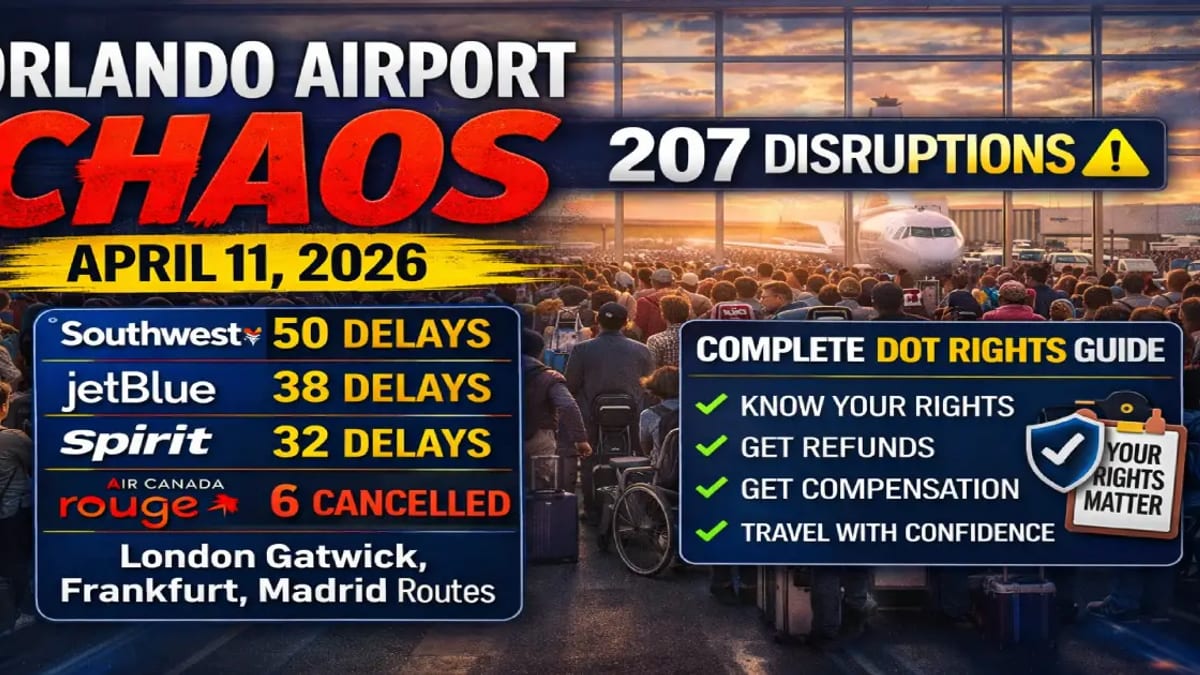
Orlando International Airport is facing a fresh bout of travel turmoil as flight-tracking data and travel-industry reports indicate 207 combined delays and cancellations in a single day, leaving families with children stranded across the terminals at one of the nation’s busiest holiday gateways.
Get the latest news straight to your inbox!
A Sudden Spike in Disruptions at a Key Family Hub
Publicly available flight-tracking dashboards show that Orlando International Airport, known by its code MCO, has endured a sharp spike in operational disruption, with 207 flights delayed or canceled in a compressed window of time. For an airport that serves tens of millions of passengers annually and anchors Florida’s theme-park tourism economy, that scale of interruption is significant, especially during a period of heavy family travel.
Reports from aviation analytics firms suggest that the bulk of the problem lies in extended delays, with a smaller but still disruptive number of outright cancellations. Even when a majority of aircraft eventually depart, long ground holds, rolling departure times and missed connections can leave travelers functionally stranded for hours, especially those with young children or tight international itineraries.
The disruption comes as Orlando continues to rank among the busiest airports in the United States by passenger volume, with traffic figures in recent years reflecting both a strong rebound from the pandemic and sustained demand for domestic leisure trips. That growth has made the airport particularly sensitive to any breakdown in the broader air-traffic system, from storms in distant hubs to technical bottlenecks in airline operations.
Travel observers note that Orlando’s heavy concentration of leisure and family traffic can intensify the sense of crisis when irregular operations hit. Compared with business-oriented hubs where many passengers travel solo and can more easily rebook, MCO often handles large family groups, strollers and vacation itineraries built around nonrefundable park tickets and hotel reservations, leaving less room to absorb sudden changes.
Weather, Network Strain and Systemic Pressures
Analysts tracking the latest wave of U.S. flight disruption point to a familiar combination of catalysts behind Orlando’s difficult day: unsettled spring weather patterns, a tightly wound national airline schedule and lingering structural weaknesses that have surfaced repeatedly across the global aviation system in 2025 and early 2026. When storms, ground stops or airspace constraints hit key hubs, knock-on effects can quickly reach Florida, even if local skies remain mostly clear.
Recent reporting on airports across the East Coast and Gulf regions describes similar turbulence, with hundreds of delays and cancellations in cities such as Miami and major Northeastern hubs. Those events, layered on top of international disruptions in Europe, the Middle East and Asia-Pacific, illustrate how quickly modern airline networks can seize up once a few critical nodes slow down.
In practice, that means a flight meant to bring an aircraft and crew into Orlando can be delayed hours or canceled outright by a problem hundreds of miles away, with the pain ultimately felt by families at MCO who see their departure time slip deeper into the evening. Once missed connections, crew-duty limits and de-icing or rerouting delays are factored in, those disruptions can compound, turning an already crowded terminal into an overnight holding area.
Industry research into recent global flight turmoil has highlighted that major hubs operate close to capacity even on ordinary days, particularly during peak leisure periods. When stress hits the system, airports like Orlando, which depend heavily on complex domestic and international feed, have limited slack to absorb schedule shocks before passengers begin to experience cascading queues at check-in counters, security lanes and customer-service desks.
Families Stranded as Holiday Plans Unravel
Social media posts and traveler accounts describe families camped on terminal floors at MCO, leaning against carry-on bags and crowding around departure boards as they wait for updated information. Many journeys appear to involve children returning from theme-park vacations or heading to visit relatives, adding emotional weight to every delay announcement.
Parents report scrambling to manage meals, entertainment and sleep for toddlers and school-age children in noisy gate areas, while also trying to negotiate new itineraries through airline apps that at times struggle under heavy demand. For those whose flights have been canceled outright, options can narrow quickly, with remaining seats on later departures sold out or priced beyond reach.
Travel forums and consumer-rights resources note a rise in frustration among passengers who see long lines at customer-service counters and difficulty getting through phone support. Many families have described splitting up to cover multiple options at once, with one adult waiting in a physical queue while another works online rebooking tools in search of a connection that can salvage at least part of a vacation or get children home in time for school.
These scenes echo earlier episodes at U.S. airports in recent years, when system-wide airline meltdowns and severe storms left travelers sleeping in terminals for nights at a time. While the current disruption at MCO is smaller in scale than those national crises, travel observers argue that the lived experience for an individual family missing a long-planned trip can feel just as acute.
Passenger Rights, Rebooking Challenges and Costly Workarounds
Consumer advocates and travel-law resources emphasize that passengers facing major delays or cancellations should review their airline’s published policies on rebooking, refunds and meal or hotel vouchers. In the United States, carriers are generally required to provide refunds when a flight is canceled and the traveler chooses not to be rebooked, but compensation for delays is more variable and often depends on whether the disruption is deemed within the airline’s control.
Information compiled by passenger-rights organizations stresses the importance of documenting the disruption, including screenshots of delay notices and boarding passes, in case future claims or complaints are necessary. Travelers are also urged to verify whether their credit card offers built-in trip-interruption coverage, which can sometimes reimburse expenses such as overnight accommodation, meals or replacement tickets during severe irregular operations.
At Orlando, many stranded families appear to be turning to costly workarounds, including last-minute one-way rentals of cars or vans for long overnight drives home. Others are searching nearby airports in Tampa or Jacksonville for open seats that might allow them to bypass the backlog at MCO. These choices can add hundreds of dollars in unplanned costs to trips that may already have stretched household budgets.
Compounding the difficulty, hotel availability near major airports often tightens quickly during large disruption events, pushing families toward accommodations farther from the terminals and adding transportation challenges. Some travelers report opting to stay in the airport itself rather than risk missing an early-morning rebooked departure if traffic or shuttle delays build on surrounding roads.
What Travelers Can Do as MCO Turbulence Continues
With Orlando’s disruption unfolding amid a broader pattern of volatile operations across the U.S. and international air networks, travel experts and industry bulletins are renewing a set of practical recommendations for passengers. Chief among them is to build more margin into itineraries, particularly for trips involving connections, cruises or time-sensitive events such as weddings and school returns.
Advisories compiled by travel groups suggest that travelers departing from MCO in the coming days should monitor their flights closely, make use of airline mobile apps for real-time alerts and consider checking aircraft “where from” information on flight-tracking platforms to see whether an incoming plane is already delayed. Early-morning departures often prove more resilient on disruption-heavy days, before knock-on effects accumulate.
For families already caught in the current backlog, publicly available guidance encourages calm but proactive engagement with airlines, including politely asking about alternative routings through secondary hubs and inquiring about protections on partner carriers where interline agreements exist. At the same time, observers caution against abandoning confirmed reservations without a clear substitute, as seats across the network can be scarce during mass disruption events.
As Orlando navigates this latest crisis of 207 flight disruptions, the episode is likely to feed into a larger debate over airport capacity, airline scheduling practices and passenger protections in an era of increasingly frequent operational shocks. For now, the immediate reality is measured in hours spent under fluorescent lights, as families at MCO wait for the system to reset and for long-delayed vacations and homecomings to resume.