

More news on this day
Travel disruption across the United States intensified today as widespread delays and cancellations at Orlando International Airport triggered knock-on chaos in major cities including Boston, Austin, Milwaukee and Pittsburgh, with publicly available tracking data pointing to around 483 delayed and 400 canceled flights linked to the Florida hub.
Get the latest news straight to your inbox!
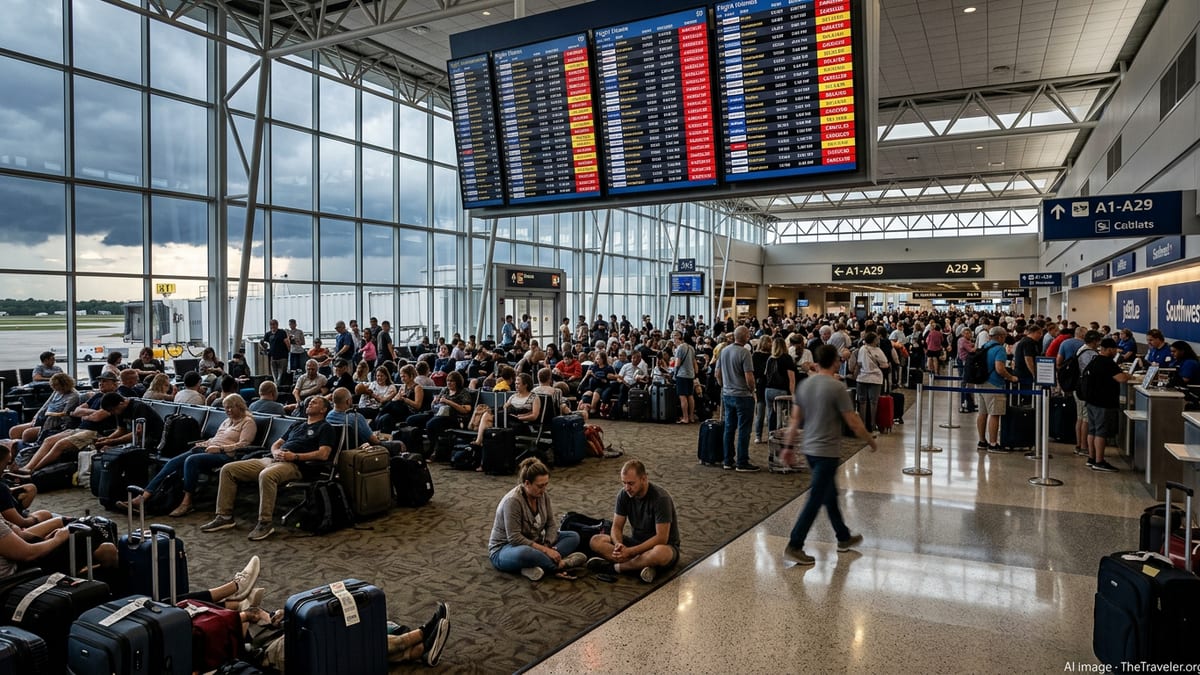
Major Disruptions Centered on Orlando International Airport
Orlando International Airport, one of the busiest tourism gateways in the country, has again emerged as a focal point of air travel disruption. Flight-tracking dashboards and airline status pages show a sharp spike in operational problems, with hundreds of departures and arrivals either significantly delayed or canceled. The scale of disruption is large enough to affect aircraft rotations and crew schedules across multiple regions.
According to publicly available information from live flight-status platforms, roughly 483 flights associated with Orlando are currently delayed, while about 400 have been canceled. These figures, which fluctuate throughout the day as schedules are updated, underline the severity of the situation for both domestic and international travelers. The operational strain is particularly acute for airlines that rely on Orlando as a key leisure and connecting market.
The latest disruption builds on an already challenging period for the U.S. aviation system, which has been grappling with congested airspace, staffing constraints and periodic bouts of severe weather. Industry observers note that when an airport with Orlando’s volume encounters large-scale delays, the impact is rarely confined to Florida. Instead, it ripples outward as aircraft and crews fail to arrive where they are needed next.
While the immediate cause of today’s disruption varies by airline and flight, schedule data indicates a combination of operational constraints and network imbalances. Some carriers appear to be consolidating services, reducing frequencies and prioritizing certain routes, which can result in sudden cancellations and extended rebooking times for passengers caught in the middle of the disruption.
Knock-on Effects for Boston, Austin, Milwaukee and Pittsburgh
The turbulence at Orlando International Airport is being felt sharply in other parts of the country as cities with strong leisure and family-travel links to Florida absorb the shock. Departures and arrivals in Boston, Austin, Milwaukee and Pittsburgh show a pattern of rolling delays, as aircraft originating in or bound for Orlando arrive late, depart late or are pulled from service entirely.
In Boston, publicly accessible airport boards show shifting departure times on flights to and from Florida, with some services moved back in stages before ultimately disappearing from schedules as cancellations. These rolling changes complicate travel planning, particularly for passengers relying on tight connections to international or transcontinental flights that cannot easily be reprotected.
Austin, which has seen rapid growth in both business and leisure traffic, is also experiencing strain as Orlando-linked flights fall behind schedule. Travelers transiting through Austin on connections involving Florida routes may face longer waits, overnight stays or rebookings onto alternative airports. Changes are not uniform across airlines, leaving some carriers relatively stable while others appear to be making more aggressive schedule adjustments.
In the Midwest, Milwaukee and Pittsburgh are recording scattered delays and cancellations tied to aircraft and crews that cycle through Orlando and other Florida destinations. Publicly shared flight-status information shows instances where a delay on one leg cascades into multiple subsequent sectors, leaving passengers in secondary markets without easy same-day alternatives and forcing some to accept rerouting through distant hubs.
Passengers Stranded as Rebooking Options Tighten
With hundreds of flights delayed or canceled in a compressed time frame, rebooking options for stranded passengers have grown increasingly limited. Airline reservation systems show many remaining later-day or next-day flights departing close to capacity, narrowing choices for travelers who must be reaccommodated from multiple canceled services at once.
Publicly available information from airline and airport channels indicates long wait times at customer service counters and over the phone as passengers seek new itineraries. Many travelers are being shifted to early-morning or late-night flights, often involving additional stops or longer routings as carriers attempt to work around aircraft and crew shortages created by the disruption.
At Orlando itself, images and reports circulating through social platforms describe crowded gate areas and busy baggage halls as passengers wait for updated information. Similar scenes are being described at affected airports in Boston, Austin, Milwaukee and Pittsburgh, where travelers arriving from or expecting to depart to Orlando face uncertainty about final departure times or onward connections.
Industry commentators note that in such situations, passengers whose flights are canceled outright generally have stronger rights to refunds compared with those who experience long delays. However, accessing those remedies can still be time consuming when large numbers of travelers are seeking assistance at the same time.
Weather, Staffing and Network Complexity Behind the Turmoil
Although the immediate day’s disruption patterns can shift quickly, aviation analysts point to a familiar mix of weather, staffing and network complexity behind these recurring episodes of travel turmoil. Live air-traffic management advisories and recent public discussions about the national airspace highlight how even short-term constraints at a busy hub can force airlines to rapidly reduce or reshuffle schedules.
Weather remains a central factor, particularly in Florida’s volatile climate and along the densely trafficked corridors between the Northeast and the Southeast. Even when conditions at Orlando appear manageable, storms elsewhere in the region can force ground stops, reduce arrival rates or trigger rerouting, which then affects the timing and availability of aircraft throughout the network.
Staffing challenges in air traffic control and airline operations add another layer of complexity. Publicly available commentary from pilots, controllers and travelers in recent months has emphasized how thin staffing levels can magnify the impact of any spike in demand or localized disruption. When combined with near-capacity summer and holiday schedules, that fragility can cause small problems to escalate into systemwide headaches.
The hub-and-spoke nature of many U.S. airline networks further amplifies the impact of a disruption at Orlando. Aircraft often operate multiple segments per day, touching several cities on each rotation. When one leg is significantly delayed, subsequent flights rarely recover fully, resulting in the kinds of rolling delays and same-day cancellations that are now affecting Boston, Austin, Milwaukee and Pittsburgh.
What Travelers Should Watch for Today
Given the fluid nature of the situation, travel experts and consumer advocates emphasize the importance of real-time monitoring. Publicly accessible tools such as airline mobile apps, airport status boards and national flight-tracking services provide the most current view of whether flights are on time, delayed or canceled.
Passengers scheduled to fly through Orlando, or on routes that often share aircraft with Florida services, are being encouraged in public advisories to check their flight status repeatedly, rather than relying on a single early-morning update. In some cases, flights that initially appear only modestly delayed can see their departure times repeatedly revised, while others may be canceled after prolonged holds at the gate.
Travelers with flexible plans may find it helpful to explore alternative routings that bypass Orlando or switch to less affected hubs, though such options may carry additional cost or require coordination with airlines. For those already at the airport, staff at customer service desks and digital self-service rebooking tools remain key avenues for securing seats on remaining departures.
With delays and cancellations at Orlando continuing to reverberate across the country, passengers in Boston, Austin, Milwaukee, Pittsburgh and beyond face the prospect of a difficult travel day. How quickly operations stabilize will depend on whether airlines can reposition aircraft and crews efficiently and whether further weather or airspace complications emerge as the day progresses.