

More news on this day
Orlando International Airport, one of the busiest gateways for U.S. leisure travel, is experiencing severe disruption as airlines cancel and consolidate flights in response to a sharp spike in jet fuel prices linked to the escalating global crisis in the Middle East.
Get the latest news straight to your inbox!
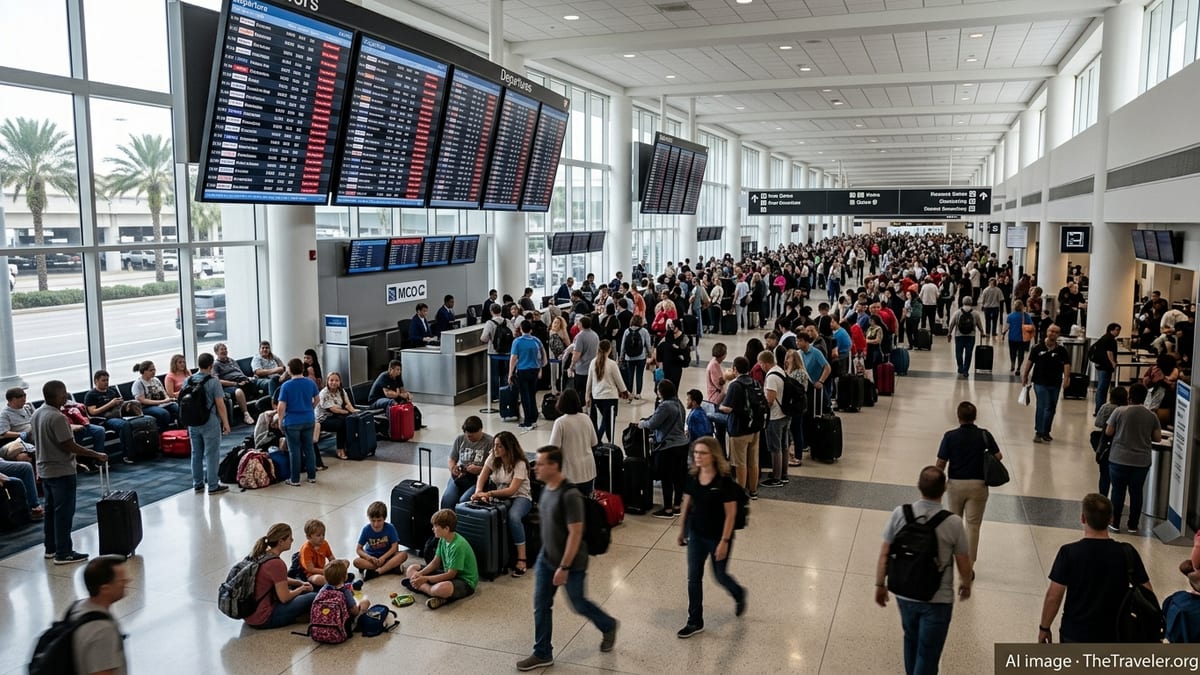
Wave of Cancellations Hits Major Florida Hub
Reports from airline tracking platforms and passenger accounts indicate that Orlando International Airport has seen hundreds of combined cancellations and significant delays in recent days, with disruptions building through the week of March 16. The knock-on effects of earlier weather issues have merged with mounting operational pressures, creating long lines, crowded terminals and limited rebooking options for travelers.
Publicly available flight boards show that low-cost carriers with dense schedules at Orlando, including large domestic operators, have cut multiple departures within short time windows, often at short notice. Commentary from affected passengers suggests that some evening and overnight periods have seen clusters of cancellations stretching into the early morning, stranding travelers in the terminal and contributing to unusually heavy crowds well past midnight.
Travel discussion forums focused on Orlando report that the airport has been “backed up for days” following an initial wave of mass cancellations earlier in the week, with the schedule still struggling to recover. While some earlier disruptions were tied to weather, recent accounts point increasingly to economic and network decisions by airlines rather than local storm systems as the primary driver of new cancellations.
The timing is particularly sensitive for Orlando, which handles large volumes of family and theme-park travel in the run-up to spring break and Easter. Any prolonged reduction in available seats could leave visitors with fewer options and higher prices, potentially rippling into the region’s tourism-dependent economy.
Fuel Price Shock Intensifies Airline Cost Pressures
The turmoil at Orlando is unfolding against a steep rise in global oil and jet fuel prices triggered by the 2026 Strait of Hormuz crisis and the wider Iran war. The near-halt of tanker traffic through the key energy chokepoint has removed a large share of oil and liquefied natural gas from global markets, driving benchmark crude prices above 100 dollars per barrel for the first time in years and to even higher recent peaks.
Economic assessments of the conflict describe its impact as one of the most abrupt energy supply shocks since the 1970s, with cumulative regional production cuts reaching several million barrels per day. Analysts tracking aviation costs note that jet fuel prices have surged more quickly than during many previous conflicts, with some industry commentary pointing to increases on the order of 50 percent over recent months in certain wholesale markets.
Industry research circulated in early March highlights how airlines worldwide are grappling with both the direct jump in fuel prices and the added cost of rerouting around closed airspace in the Middle East. While Orlando is far from the conflict zone, U.S. carriers serving the airport buy fuel in a globalized market, meaning their underlying costs reflect the same price shocks affecting airlines in Europe and Asia.
Several aviation analysts quoted in recent coverage expect fuel surcharges, capacity reductions and selective route cuts to accelerate if prices remain elevated. For highly price-sensitive leisure routes common at Orlando, axing lightly booked flights can become a faster way to stem losses than adding surcharges that travelers may be unwilling to pay.
Airlines Consolidate Routes and Capacity
According to industry commentary and traveler reports, some carriers operating at Orlando appear to be increasingly consolidating flights, combining passengers from several lightly booked departures onto a smaller number of services. This strategy allows airlines to improve load factors on the flights that do operate while reducing overall fuel burn, airport fees and crew costs.
Posts from recent Orlando travelers describe last-minute cancellations of specific departures alongside offers to rebook on later or next-day flights on the same route. In some cases, passengers report that flights with many empty seats were canceled entirely, while busier departures remained on the schedule. Such patterns are consistent with airlines making dynamic decisions based on real-time demand and fuel expenses.
Broader research on the economic impact of the Iran war notes that airlines worldwide are trimming frequencies, particularly on marginal routes, as fuel bills climb and rerouting erodes profitability. At major hubs like Orlando, where several carriers may compete on similar city pairs, this can translate into a thinning of the timetable rather than the loss of entire destinations, though the effect for travelers on a given day can still be severe.
In addition to cancellations, airlines are also facing higher costs for spare parts, financing and insurance in an increasingly uncertain global environment. With balance sheets still recovering from the pandemic years, the combination of rising expenses and softening consumer confidence is leaving carriers with limited room to absorb a prolonged fuel shock without adjusting schedules.
Global Crisis Reshapes Air Corridors and Travel Demand
The disruption in Orlando is only one local manifestation of a broad global travel shock linked to the crisis in the Gulf. The closure or restriction of airspace over parts of the Middle East, together with Iranian strikes on energy infrastructure in Qatar and other Gulf states, has forced many long-haul airlines to reroute flights, lengthening journey times and increasing fuel burn. Several key airports in the region, which serve as major transfer hubs between continents, have experienced significant slowdowns or partial shutdowns.
Economic analyses of the conflict’s impact on aviation estimate that even single-day disruptions at large Middle Eastern hubs can generate hundreds of millions of dollars in lost revenue from grounded flights, reduced cargo movements and weaker airport retail activity. Over time, these shocks feed back into airline network planning, with carriers reassessing growth plans, delaying new routes and prioritizing their most profitable city pairs.
Reports from tourism and aviation conferences in early March describe widespread concern that the present crisis represents the largest global travel disruption since the Covid pandemic, albeit driven this time by energy and security conditions rather than public health restrictions. Rising ticket prices, tighter capacity and mounting uncertainty over future schedules are already affecting traveler behavior, with many passengers reconsidering or postponing long-haul trips.
For destinations that depend heavily on discretionary leisure travel, such as central Florida, a sustained global downturn in air connectivity could weigh on hotel occupancy, theme park attendance and broader visitor spending. The current wave of cancellations at Orlando may therefore be an early warning of more structural pressures facing the region’s tourism ecosystem if the conflict and energy shock drag on.
Travelers Face Higher Fares, Longer Delays and Planning Headaches
For individual passengers passing through Orlando, the combination of airline cost-cutting and global upheaval is translating into higher fares, fewer choices and longer waits. Online discussions among travelers in March point to sudden price jumps on a range of routes touching Orlando, with some users observing that tickets which recently sold for under 500 dollars have risen dramatically in a matter of days.
At the airport, disrupted passengers describe terminal concourses that are “shoulder to shoulder” during peak disruption periods, with long lines forming at airline customer service desks as travelers attempt to secure new itineraries. Overnight crowds have reportedly swelled as evening cancellations leave passengers waiting until early morning for alternative flights, straining available seating and amenities.
Travel experts quoted in recent coverage advise passengers to build in additional buffer time, monitor flight status closely and consider more flexible booking options, given the heightened risk of last-minute changes. Some commentators suggest that travelers with tight connections or critical events, such as cruises or international trips, may want to arrive at their departure city a day earlier than usual to reduce the risk of missed departures.
With energy markets unsettled and the broader geopolitical crisis still developing, there is little immediate sign that jet fuel prices or airline operating conditions will normalize in the near term. For Orlando International Airport and its millions of annual passengers, the current wave of disruptions may be the beginning of a more turbulent chapter for global air travel rather than a brief, isolated episode.