

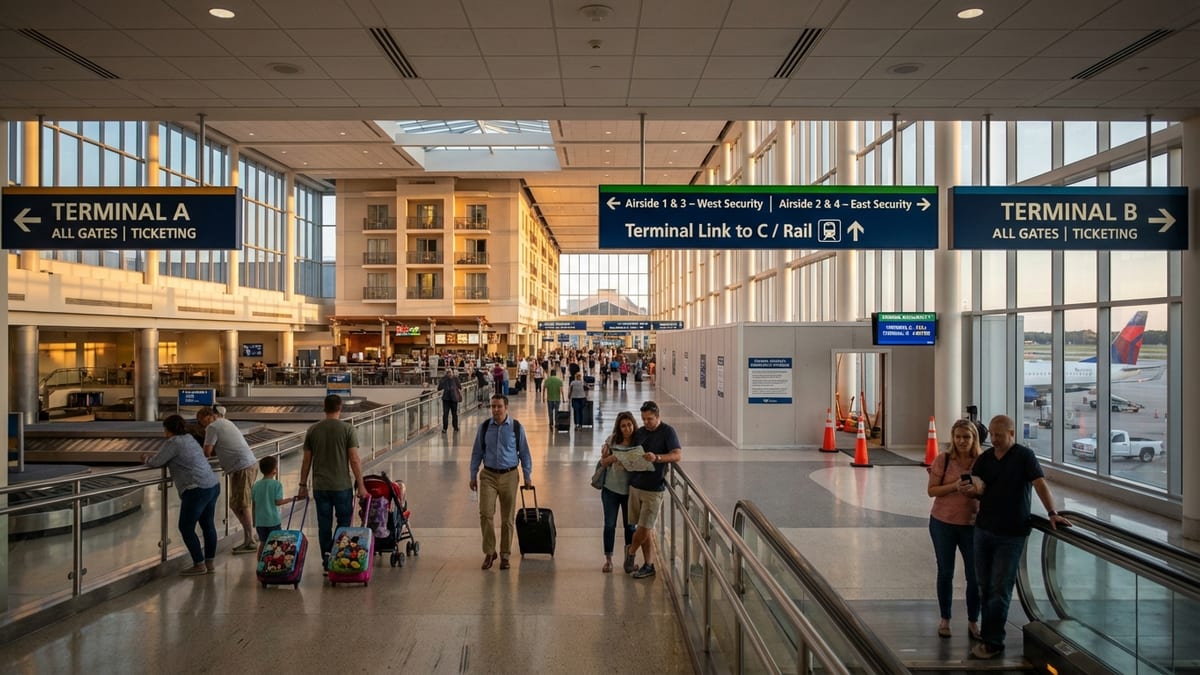
Orlando International Airport is one of the busiest gateways in the United States, a major arrival point for theme park visitors and business travelers alike. Yet for many passengers, the airport’s layout can be confusing at first glance. Tickets may list Terminal A, B, or C, boarding passes refer to numbered airsides, and ground transportation options differ by side.
Understanding how these pieces fit together is the key to a smooth arrival or departure. This guide explains Orlando’s terminals A, B, and C in plain language, highlights what has changed recently, and offers practical tips on navigating the airport efficiently in 2025 and beyond.
How MCO Is Organized: One Airport, Three Terminals
Orlando International Airport is built around a central landside building known as the North Terminal Complex, which is split into Terminal A on the north side and Terminal B on the south side. These are not separate buildings; rather, they are different “sides” of the same structure, connected by a vast atrium and food court on Level 3. Most legacy airlines and many domestic carriers still operate from this main complex, and many travelers will never need to venture beyond it.
Within the A and B building are four remote concourses called airsides. These are where the actual gates are located, and passengers reach them by riding automated people mover trains from the main terminal. Airside 1 serves gates 1 to 29, Airside 2 serves gates 100 to 129, Airside 3 serves gates 30 to 59, and Airside 4 serves gates 70 to 99. Airsides 1 and 3 are on the west side of the complex, reached through the west security checkpoint, while airsides 2 and 4 are on the east side, reached through the east checkpoint.
South of the main building sits Terminal C, a newer, separate complex that serves a mix of domestic and international airlines, including many transatlantic and long-haul routes. Terminal C has its own check-in hall, security checkpoint, and U.S. Customs area, and it connects to the main airport via the Terminal Link automated people mover and a pedestrian bridge and parking structure. For passengers, Terminal C can feel like a different airport entirely, with more modern design and technologies.
When you see Terminal A, B, or C on your itinerary, think of it as the landside area for check-in, baggage claim, and ground transportation. Your gate, by contrast, will be in one of the airsides linked to that terminal. A clear sense of this structure goes a long way toward reducing last-minute stress as you look for the right security checkpoint or parking garage.
Terminal A: North Side of the Main Complex
Terminal A forms the north-facing side of the original main building and is heavily used by domestic carriers along with some international airlines. Inside, it shares the central food court and atrium with Terminal B, but has its own ticketing zones, baggage claim areas, and ground transportation lanes. Airlines operating on Side A are generally assigned to either the west pair of airsides (1 and 3) or the east pair (2 and 4) depending on their gate ranges.
Level 3 of Terminal A is the departures level, where you will find airline check-in counters, kiosks, and the entrances to the security checkpoints. The central atrium hosts a cluster of restaurants, grab-and-go options, shops, and access points to the hotel that sits above the terminal. From this level, you can also cross directly into Side B in just a few minutes, which is helpful if you are meeting a traveler arriving on a different airline or if your party is split across carriers.
One level below, Level 2, is home to the baggage claim carousels associated with Terminal A, along with ride-share pickup, some food and beverage outlets, and a pet relief area. Ground transportation, including rental car counters, hotel shuttles, taxis, and local buses, is mostly concentrated on Level 1. Signage pointing to ride-share zones and rental car pick-up can be dense and occasionally confusing during peak periods, so it is worth confirming your pickup point in advance, particularly late at night when traffic flows change.
Recently, Orlando’s aviation authority has begun rolling out modernization projects for Terminals A and B. These include upgraded concessions and an automated parking guidance system in the surrounding garages, designed to make it easier to find open spaces and navigate the terminal approaches. Work on the guidance system is slated to unfold in phases from mid-2025 through 2027, with garages remaining open, so passengers should watch for construction zones and temporary signage shifts on the approach roads and within Garages A and B.
Terminal B: South Side and Hub for Major Domestic Carriers
Terminal B mirrors Terminal A in design but faces south and has its own set of airline check-in areas, baggage claim zones, and ground access points. It is a major base for several large domestic airlines and serves both domestic and international operations. Like Terminal A, it shares the main atrium and food court on Level 3, which means travelers can easily walk from one side to the other without exiting the building.
On Level 3, passengers departing from Side B check in with their airlines and proceed to either the west or east security checkpoint depending on which airside their flight uses. Airlines serving Airside 3 will use the west side checkpoint, while those departing from Airside 4 will direct passengers to the east checkpoint. After security, travelers board people mover trains to reach their gates. This setup allows the terminal to handle very high volumes, but it also means passengers should plan buffer time for both the security queues and the short train ride to the concourse.
Level 2 of Terminal B accommodates baggage claim carousels and ride-share pickups, while Level 1 is the main hub for buses, resort and hotel shuttles, and some rental car traffic. Because Orlando serves a high proportion of leisure visitors headed to resorts, the curb lanes and shuttle zones on Terminal B’s lower levels can be crowded during major arrival and departure waves. First-time visitors often find the mix of signage for hotel buses, cruise transfers, and theme park transportation overwhelming, so build in extra time to find the correct pickup point, especially if you are traveling with children or large groups.
Terminal B will also benefit from the same parking and facility upgrades approved for the North Terminal Complex. The automated parking guidance system planned for Garages B and the Terminal Top deck is intended to address some of the most common complaints from recent years: circling for open spaces, unclear entry and exit flows, and difficulty remembering where a car is parked after a long vacation. While installation will stretch over roughly two years, the garages are expected to remain available, with phased work zones and updated signs guiding traffic.
Terminal C: Orlando’s New South Terminal
Terminal C, located to the south of the original complex, is Orlando’s newest terminal and a showcase for contemporary airport design. It serves a mix of domestic and international carriers, with a particular emphasis on long-haul and transatlantic services. Many passengers flying from Europe or Latin America now use Terminal C, and for them the experience is noticeably different from the older A and B sides.
The departures hall in Terminal C sits on Level 2, where passengers find airline check-in counters and self-service kiosks. After check-in, travelers pass through a dedicated security checkpoint that leads directly into Palm Court, an expansive post-security plaza with restaurants, bars, shops, and a modern common-use lounge. Food and beverage options here are more contemporary than in the older terminals, and the open layout provides ample seating and natural light, which frequent travelers have praised compared with the often crowded gate areas in the North Terminal.
Arriving international passengers in Terminal C clear U.S. Customs and Border Protection in a sleek, upper-level arrivals hall designed for high volumes. Baggage claim, customs, and immigration are integrated into a single flow, with advanced baggage systems and digital signage to direct passengers to connecting flights or ground transport. While the architecture and technology have been widely applauded, some travelers have reported longer-than-expected waits for baggage at peak times, something the airport has acknowledged and is working to improve through process adjustments and additional equipment.
On the landside, Terminal C connects directly to Parking Garage C and the integrated rail station that serves the intercity Brightline trains. A pedestrian bridge links the terminal to the garage and station complex, and moving walkways are in the process of being added to improve circulation between the security checkpoint, Palm Court, and the bridge. Construction on these enhancements is underway, with the bridge walkways scheduled to open in 2025. During this period, passengers should expect occasional detours and pay close attention to wayfinding signs and staff instructions.
Getting Around Between A, B, and C
One of the most common questions visitors have is how to move between terminals, especially when flights arrive on one side and ground transportation or onward connections depart from another. Within the A and B complex, the answer is straightforward: you can walk. Level 3 of the North Terminal is continuous between Side A and Side B, so anyone who has cleared baggage claim or is heading to ticketing can simply cross the atrium to the other side. The walk takes only a few minutes and is fully indoors, making it easy even with luggage.
Getting to and from Terminal C is slightly more involved, but still manageable. The airport operates the Terminal Link automated people mover between the east side of Terminal B and the rail station and parking garage complex adjacent to Terminal C. From the station, it is a short indoor walk through Parking Garage C and across the pedestrian bridge into Terminal C. The system runs around the clock, and the total transfer time is typically 10 to 15 minutes from one terminal to the other, not including any wait time for the next train.
In addition to the train connection, the airport offers a free shuttle bus between Terminal B and Terminal C, running from Level 1 ground transportation areas. This can be a useful fallback if the Terminal Link is out of service or if you are traveling with an oversized load of luggage that makes station escalators and elevators less convenient. Roadside signs and airport staff direct passengers to these shuttle stops, but if you are on a tight connection, the train is usually faster and less prone to traffic delays.
Once you have cleared security, keep in mind that there are no pedestrian walkways between the separated concourses. If you are departing from Terminals A or B, all flights leave from one of the four airsides, and each airside is only accessible by its dedicated people mover after security. Connecting between different airlines that use different airsides or terminals generally requires exiting the secure area, walking or riding the Terminal Link, and re-clearing security in the new location. When booking self-made connections, it is prudent to allow a wide margin of time for this process.
Parking, Drop-Offs, and Ground Transport by Terminal
Orlando International offers a wide array of parking options, and the best choice often depends on which terminal your airline uses. For Terminals A and B, the closest options are Parking Garages A and B, which sit on either side of the North Terminal Complex, plus the Terminal Top garage above the main building. These facilities provide short-term and long-term parking, with covered spaces and direct access into the terminal via elevators and walkways. The Terminal Top garage in particular is convenient for quick business trips or for those who prioritize the shortest possible walk to check-in.
Economy parking lots, situated farther from the building, serve all terminals via frequent shuttle buses. These lots are usually the best value for longer trips, though the savings come with added transfer time and reliance on shuttle circulation. During peak holiday periods, shuttles can become crowded, and wait times may lengthen, so factor that into your schedule if you are traveling with a family or large group. Many rental car facilities are clustered near the North Terminal as well, which can be particularly convenient if your flight operates out of Terminal B where many long-term parking and rental car returns are concentrated.
Terminal C has its own large Parking Garage C directly opposite the building, connected by the pedestrian bridge and elevator cores. This garage is designed for both short-term and longer stays and provides a particularly smooth experience for travelers connecting to the Brightline station or arriving on rail before catching a flight. The same multi-year parking guidance upgrade program being rolled out at Garages A and B is planned for Garage C as well, with intelligent sensors and color-coded lights guiding drivers to available spaces and digital signs displaying real-time counts by level and lane.
At curbside, each terminal has separate arrival and departure levels with marked zones for private vehicles, ride-share pickups, taxis, shuttle buses, and hotel or resort transportation. Security procedures at the curb can be strict, and vehicles are not allowed to wait unattended, so coordinating real-time with your driver via phone or app is advisable. In Terminals A and B, ride-share pickups typically occur at designated zones on the baggage claim level, while Terminal C offers ride-share access near the arrivals hall and parking connections. Because configurations can change as construction progresses, it is wise to check the latest terminal maps or app updates on the day of travel.
Security, Check-In, and Moving Through the Airport
Security and check-in at Orlando International are organized by terminal and by concourse. In Terminals A and B, there are two main security checkpoints, one on the west side of the main atrium and one on the east side. The west checkpoint serves flights departing from Airside 1 and Airside 3, covering gates 1 to 59 in total. The east checkpoint serves Airside 2 and Airside 4, covering gates 70 to 129. Your boarding pass will list which gate or airside your flight uses, and airline signage at check-in will direct you to the correct checkpoint.
Terminal C has a separate, modern security checkpoint located just beyond the Level 2 check-in area. Once you pass through screening, you emerge directly into Palm Court and then proceed to the C concourse gate areas. Security lines at Terminal C benefit from newer equipment and lane designs, and frequent travelers often report a smoother flow compared with the older checkpoints in the North Terminal, although conditions can vary widely depending on the time of day and season.
TSA PreCheck lanes are available at all three checkpoints, and many airlines also participate in Clear or offer premium lanes for first and business class passengers. Wait times are highly variable, especially during school breaks and major convention periods, so using the airport’s official app or website to check current estimates can help you decide when to leave for the airport. Remember that after clearing security in Terminals A or B, you must still take a short train ride to the correct airside, which can add several minutes and may involve waiting for the next train if crowds are heavy.
Check-in counters in all three terminals are generally located on the top departures level. Most major airlines provide self-service kiosks for bag tag printing and boarding pass retrieval, with staffed counters nearby for full-service check-in and special services. To avoid delays, many experienced travelers recommend checking bags and printing tags at kiosks whenever possible, then using dedicated bag drop lanes. At peak times, roped queues can extend well into the atrium, especially near airlines heavily used by vacationers, so building in extra time is essential.
The Takeaway
Navigating Orlando International Airport becomes far less daunting once you understand how Terminals A, B, and C fit together. The A and B sides form two halves of a shared North Terminal building, each with its own ticketing, baggage, and ground transport zones, but linked by common security checkpoints feeding four remote airsides. Terminal C, by contrast, is a purpose-built south terminal with its own check-in hall, security, and arrivals systems, connected to the rest of the airport by train, bridge, and shared parking infrastructure.
For travelers, the most important steps are to confirm which terminal your airline uses, arrive with enough time to account for security and the people mover rides, and choose parking and drop-off options that match your departure side. During the current period of upgrades to parking systems, signage, and pedestrian links, it is also wise to stay alert to detours and construction notices. Armed with a clear mental map of how A, B, and C operate, you can spend less time worrying about wayfinding and more time focusing on the trip ahead.
FAQ
Q1: How do I know whether my flight uses Terminal A, B, or C at Orlando?
Airlines assign each flight to a terminal based on their operating agreements with the airport. Your reservation and boarding pass should list the terminal, and airline websites and apps generally confirm whether your departure is from A, B, or C. If you are unsure, check directly with your airline on the day of travel, as occasional changes can occur.
Q2: Can I walk between Terminals A and B without going outside?
Yes. Terminals A and B are two sides of the same North Terminal building. On Level 3, where ticketing and the central atrium are located, you can walk freely between the A and B sides in just a few minutes without leaving the building or re-clearing security, as long as you remain in the public, pre-security area.
Q3: What is the fastest way to get from Terminal B to Terminal C?
The quickest option is usually the Terminal Link automated people mover. From the east side of Terminal B, you board the train to the rail station and Parking Garage C complex, then walk through the garage and across the pedestrian bridge into Terminal C. Under normal conditions, this takes about 10 to 15 minutes, not including any wait time for the train.
Q4: Do I have to go through security again if I change from a flight in Terminal A to one in Terminal C?
In most cases, yes. Terminals A and B share a secure area with their own airsides, while Terminal C has a separate checkpoint and gate complex. If you arrive in A or B and then connect to a flight in C, you will need to exit the secure area, travel to Terminal C via the train or shuttle, and pass through security there before boarding your onward flight.
Q5: Which terminal should I park near if I do not yet know my airline’s side?
If your airline assignment is unclear, parking in the Terminal Top garage above the North Terminal can be a flexible choice, as it provides quick access to both A and B. From there, you can walk to either side in a few minutes. If you later learn you are using Terminal C, you can still reach it from the North Terminal by riding the Terminal Link train, though Parking Garage C is more convenient for flights that definitely use Terminal C.
Q6: Are security wait times shorter in Terminal C than in Terminals A and B?
Terminal C uses newer screening technology and a dedicated checkpoint, and many travelers report smoother experiences there. However, wait times depend heavily on time of day, season, and flight schedules. During busy travel periods, all checkpoints at Orlando can experience significant queues, so it is wise to use the airport’s app or website to check current wait estimates and allow ample time regardless of terminal.
Q7: How do the airsides relate to Terminals A and B?
Airsides are the remote concourses where gates are located, reached by automated trains after security. Airside 1 and Airside 3 are on the west side of the North Terminal and are accessed via the west security checkpoint. Airside 2 and Airside 4 are on the east side and are accessed via the east checkpoint. Your airline and flight number determine which airside you will use, even though your check-in and baggage claim are on either Side A or Side B of the main building.
Q8: Is there a hotel inside Orlando International Airport, and which terminal is it in?
Yes. A full-service hotel is integrated into the North Terminal Complex, accessible from the Level 3 atrium shared by Terminals A and B. Some rooms overlook the central atrium, while others face the airfield. This location is particularly convenient if you have an early morning departure from A or B or a late-night arrival and prefer to stay on-site.
Q9: Are there different ground transportation options depending on the terminal?
All terminals offer access to taxis, ride-share services, rental cars, and various hotel and resort shuttles, but the exact pickup points differ. In Terminals A and B, most shuttles and buses operate from Level 1, while ride-share zones and baggage claim pickups are on Level 2. Terminal C has similar layers, with its own designated areas for ride-share, buses, and private vehicles near the arrivals and departures halls. Checking your transportation provider’s instructions for terminal and level will help you find the correct location quickly.
Q10: How will ongoing construction affect my experience at Orlando’s terminals?
Over the next several years, Orlando International is rolling out upgrades including an automated parking guidance system in Garages A, B, C, and the Terminal Top, as well as new moving walkways and pedestrian improvements around Terminal C. While these projects aim to improve the passenger experience long term, they may temporarily alter traffic patterns, reduce available parking in certain sections, or require detours inside the terminals. Allowing extra time for parking and wayfinding, and paying close attention to temporary signs and staff directions, will help minimize disruptions during this transition period.