

More news on this day
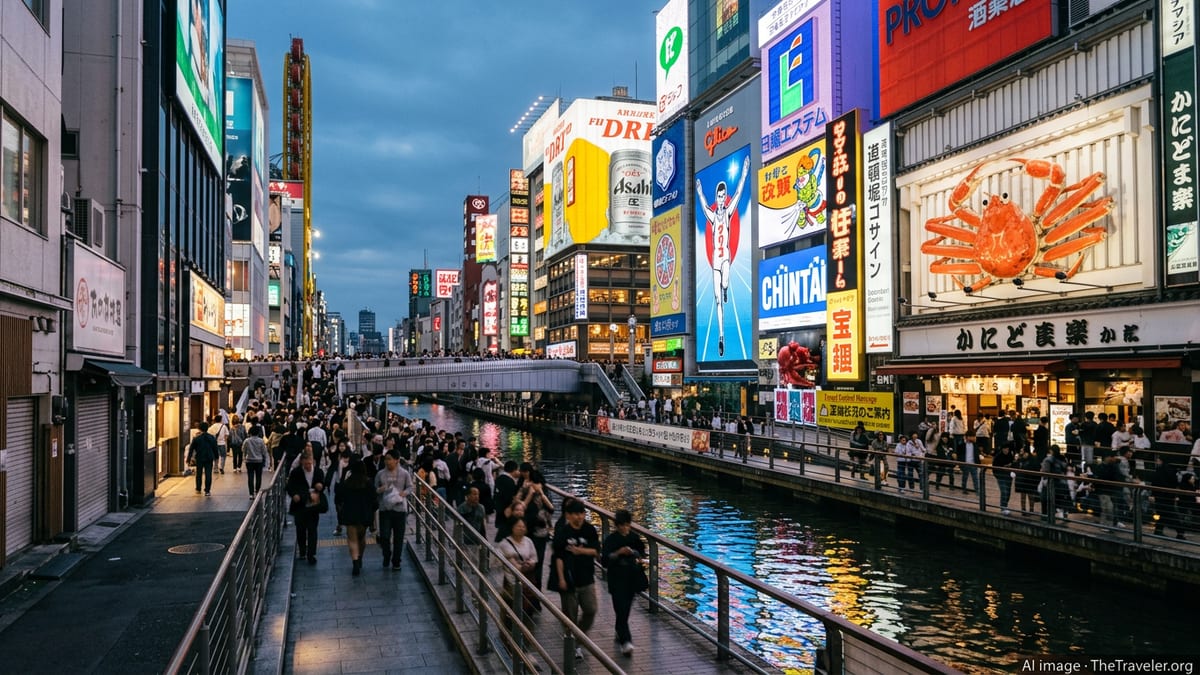
As crowds once again surge through Osaka’s neon-bright Dotonbori district, city planners and private partners are experimenting with a new toolkit of “smart avenues” and digital crowd-management systems in an attempt to keep Japan’s most famous entertainment strip both walkable and welcoming.
Get the latest news straight to your inbox!
A Tourism Boom Tests Osaka’s Most Famous District
Japan’s tourism rebound is reshaping Osaka more quickly than many residents and visitors expected. Publicly available data from the Japan National Tourism Organization indicates that international arrivals to the country surpassed 36 million in 2024, exceeding the previous 2019 record. Osaka, home to the Dotonbori and Shinsaibashi districts, has been one of the main beneficiaries of this boom, with new hotels, attractions and airline routes concentrating visitor flows in the city’s compact center.
Travel coverage and traveler reports describe Dotonbori as consistently packed from late afternoon into the night, with visitors clustering around the Glico running man sign, canal-side promenades and dense street-food alleys. While these scenes help power Osaka’s global image, they have also amplified concerns about congestion, late-night noise, and the strain on local infrastructure in the run-up to Expo 2025 Osaka, Kansai, Japan.
Policy discussions around overtourism in Japan have historically focused on Kyoto and parts of Tokyo, but recent analyses of tourism concentration patterns show Osaka joining the list of high-pressure hotspots. Economic and planning studies point out that a large share of visitor nights remain concentrated in just a few prefectures, with Osaka now ranked among the most intensely visited urban areas in the country.
In this context, city and prefectural strategies are shifting from simple promotion toward what officials describe in public documents as “urban attraction development,” combining capacity management, neighborhood diversification and technology-enabled crowd control in districts such as Dotonbori.
Inside Osaka’s Emerging “Smart Avenue” Strategy
The term “smart avenues” in Osaka generally refers to a mix of tools deployed along major pedestrian corridors such as Midosuji Boulevard, the Namba and Shinsaibashi shopping arcades, and the streets framing the Dotonbori canal. Planning documents and transport reports highlight several core components: dense digital signage networks, real-time passenger and pedestrian flow analysis, and targeted messaging designed to nudge visitors away from bottlenecks.
Digital advertising operators, working with rail and metro companies, are expanding high-resolution screens in hub stations such as Osaka-Umeda and Namba. These displays were initially installed for commercial campaigns, but recent announcements show an increasing focus on data-driven impressions and location-based analytics. By estimating how many people actually view a given screen at a given moment, these systems can also serve as informal crowd sensors along key tourist routes.
On the streets above, Osaka’s long north-south axis, Midosuji, has become a test bed for integrating illuminated street furniture, coordinated traffic signals and controlled outdoor advertising. International transport studies describe pilot projects on Midosuji that explore how signage, lighting and regulated billboards can guide flows more smoothly between Umeda in the north and Namba and Dotonbori in the south, especially during festivals and peak visitor seasons.
Some of these tools are subtle. Enhanced wayfinding signs, multilingual instructions at crossings, and carefully placed information boards around station exits are designed to shorten dwell times at choke points where first-time visitors often hesitate. Together, they form the physical backbone of Osaka’s evolving smart avenue concept around its busiest entertainment quarter.
Digital Signage, Drones and Expo-Driven Innovation
Expo 2025 on the artificial island of Yumeshima has accelerated investment in digital guidance technologies across Osaka. Expo organizers and partner associations have promoted the event as a “fully cashless” showcase, and public announcements describe widespread deployment of digital signage in major Osaka Metro stations to explain payment systems and direct flows of international visitors. These same corridors feed directly into central districts such as Namba and Dotonbori.
Beyond the underground networks, Osaka has also been a testing ground for more experimental crowd-control tools. Demonstrations before large concerts and Expo preview events have featured swarms of illuminated drones forming floating exit symbols and directional arrows in the night sky. Technology-focused reporting notes that these trials allowed operators to adjust patterns in real time as people left venues, suggesting a future in which aerial guidance could supplement static signs along busy riverside promenades and bridge approaches in central Osaka.
The Dotonbori area itself is already saturated with light, from animated advertising panels to LED-equipped boats cruising the canal. Recent descriptions of new boats and building-mounted screens in Namba and Dotonbori emphasize how digital displays are becoming part of the district’s identity. City planners now face the challenge of harnessing this glow not only for marketing but also for wayfinding, directing visitors toward quieter side streets, alternative viewpoints and less crowded dining areas.
Expo-related transport research underlines the importance of accurate attendance forecasting and responsive routing to prevent gridlock between Yumeshima and the downtown core. Lessons from those models are expected to inform how Osaka calibrates pedestrian guidance, train headways and signage in Dotonbori once the world’s fair is in full swing and afterwards, when visitor interest is likely to remain high.
Balancing Nightlife Energy With Local Livability
While smart avenues promise smoother circulation, they are only one part of a broader response to overtourism. Surveys and commentary from local stakeholders frequently mention concerns about noise, litter and escalating commercial rents in and around Dotonbori as visitor numbers rise. Analysts warn that, without careful management, the district risks becoming an outdoor theme park detached from everyday Osaka life.
Policy debates in recent years have included proposals for new levies on foreign visitors to help fund public services in popular districts. Media coverage indicates that Osaka Prefecture explored such an idea but ultimately moved away from it after legal and practical concerns were raised. This has placed more emphasis on non-fiscal tools such as zoning, licensing, and public-space design to address the downsides of crowding.
Urban strategy documents for Osaka through 2025 highlight goals such as dispersing visitors to less-known neighborhoods, encouraging stays in wider Kansai, and developing cultural and business attractions beyond the Dotonbori corridor. Promoting alternative districts while simultaneously improving the experience in the main entertainment zone is seen as crucial to keeping both residents and tourism-dependent businesses supportive of continued growth.
Smart avenues fit into this approach by aiming to preserve the lively, neon-lit atmosphere that draws visitors while making it easier to navigate, find services and move on to other parts of the city. By smoothing the flow through Dotonbori rather than trying to suppress it altogether, planners hope to protect local quality of life without undermining the area’s economic role.
Will “Smart” Streets Be Enough to Curb Overtourism?
Whether Osaka’s smart avenue experiments can meaningfully reduce overtourism pressures remains an open question. Technology-based crowd management can shorten queues, reduce confusion and spread people more evenly across streets and time slots, but it does not directly limit total visitor numbers. If international arrivals continue to rise and Expo 2025 boosts Osaka’s global profile, Dotonbori may simply remain busy at a higher baseline.
Urban analysts often point out that technology works best when paired with clear policy frameworks. For Osaka, that may mean combining digital guidance with rules on short-term rentals, targeted support for local businesses that serve residents year-round, and incentives for tourism operators to package visits that include lesser-known districts beyond the usual canal and shopping strip.
For travelers, the changes on the ground may feel incremental rather than dramatic. They might encounter more multilingual instructions at ticket gates, clearer arrows steering them from station concourses to river walks, or visual prompts nudging them toward adjacent alleys where the crowds thin out. Over time, these small adjustments could shift how visitors experience Osaka’s core, distributing selfies and street-food stops over a wider area.
As Osaka navigates its historic tourism moment, Dotonbori is likely to remain the city’s brightest stage. The success of smart avenues and related initiatives will be measured less by empty sidewalks than by a district that still hums with energy, yet feels manageable for both first-time visitors and the residents who call central Osaka home.