

More news on this day
Hundreds of air passengers were left stranded in Norway on February 21, 2026, after severe disruption at Oslo Gardermoen Airport delayed 105 flights and cancelled a further 9, unleashing a wave of missed connections and rolling chaos across major European hubs in Sweden, Poland, the United Kingdom, Spain, Italy and beyond.
Storm-Struck Oslo Becomes Epicenter of European Disruption
Oslo Gardermoen, Norway’s largest international gateway, entered the weekend under intense operational strain as heavy snowfall, low visibility and biting winds combined with capacity bottlenecks on the ground. Airport operators and airlines scrambled to keep runways clear and aircraft de iced, but the volume of traffic scheduled through the hub meant even short suspensions quickly cascaded into widespread delays.
By late evening, a total of 105 flights had been pushed back from their planned departure times, while 9 services were cancelled outright. What began as a local weather and handling challenge in southeastern Norway rapidly evolved into a pan European disruption story, affecting passengers not only departing Oslo but also those awaiting inbound aircraft and onward connections across the continent.
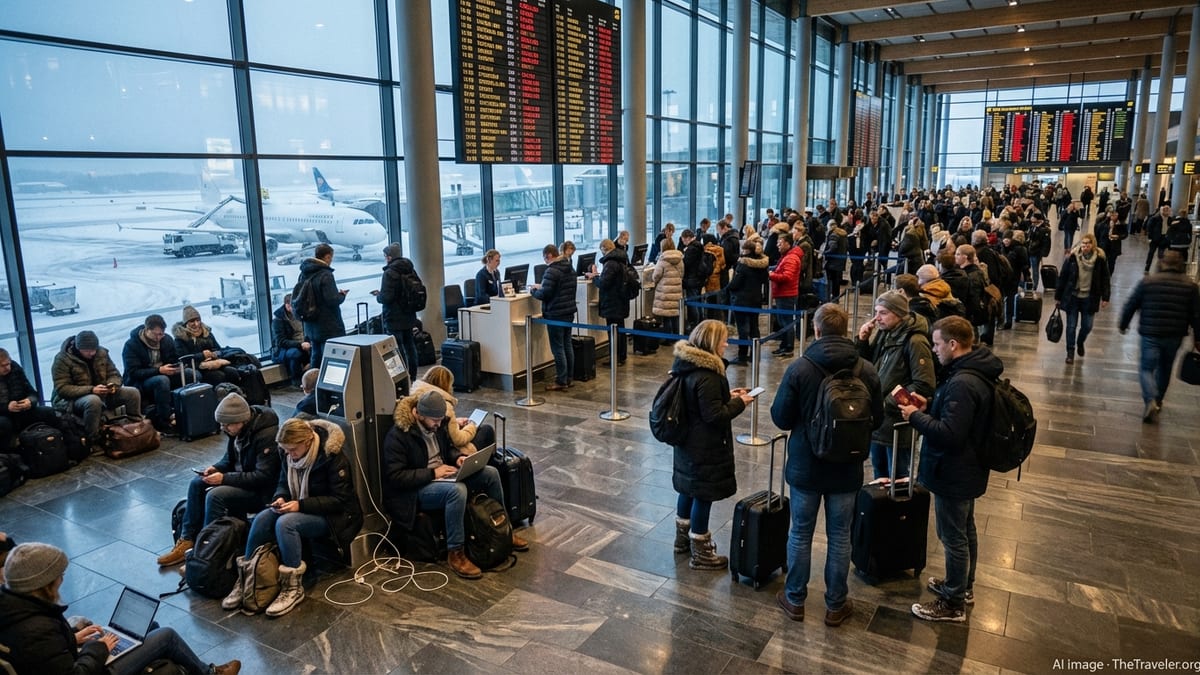
Terminal halls at Gardermoen filled with frustrated travelers hunched over phones and laptops, searching for rebooked itineraries and scarce hotel rooms. Airline customer service desks were met with long queues as carriers attempted to reshuffle aircraft, reposition crew and protect long haul rotations while absorbing the brunt of the storm related chaos on shorter intra European sectors.
Airport staff worked extended shifts to mitigate the breakdown in normal operations, but the combination of weather, congested airspace and ground handling delays left many passengers facing overnight stays in or near the terminal, with limited certainty about when they could resume their journeys.
Ripple Effects Hit Stockholm, Krakow, Munich and Other Key Hubs
The shockwaves from Oslo’s bad weather and schedule disruption were felt most immediately across Scandinavia and northern Europe. Flights between Oslo and Stockholm Arlanda were among the first to feel the strain, as delayed departures from Norway knocked inbound arrival times off schedule in Sweden. Turnaround times stretched, and aircraft that would normally cycle swiftly between capitals were instead held on the ground awaiting de icing, crew legality checks or new slots.
Further south and east, services linking Oslo to Krakow and other Polish cities faced similar issues. Aircraft arriving late from Norway forced airlines to compress turnaround procedures or delay onward departures, pushing congestion further down the evening schedule and reducing flexibility to recover as the day wore on. Passengers in Poland reported long waits at boarding gates and repeated schedule revisions as operations teams attempted to rebuild disrupted rotations.
In central Europe, Munich and other German hubs experienced pressure on their own weather sensitive networks. While these airports are accustomed to operating in harsh winter conditions, the knock on effect of late inbound flights from Norway and other northern points added to existing strains from a broader regional cold snap that has already led to higher than normal delay rates this season.
Across the continent, the shared nature of aircraft and crew resources meant that a single delayed rotation in Oslo could undermine the reliability of multiple subsequent flights, even on routes with no direct connection to Norway. That left travelers in Sweden, Poland and Germany dealing with uncertainty that originated hundreds of kilometers away.
UK, Spain and Italy See Connections Unravel
Disruption from the Oslo meltdown was not confined to northern Europe. Popular leisure and business routes linking Norway with the United Kingdom, Spain and Italy also suffered, with late running aircraft from Gardermoen missing critical connecting banks at major European hubs. This was particularly acute for passengers traveling via Amsterdam, Geneva and other transit points for flights into southern Europe.
In the United Kingdom, services to and from London and regional airports saw pockets of delay as carriers struggled to keep northbound and southbound rotations aligned. Passengers bound from Oslo to British cities on evening departures faced missed last train connections, overnight stays and tight turnarounds when rebooked on early morning flights.
Spain and Italy, already dealing with residual knock on effects from earlier February weather systems elsewhere in Europe, experienced additional strains as aircraft and crews scheduled to overnight on the Iberian Peninsula or in Italian gateways were held back or rerouted. Holidaymakers connecting from Oslo via northern hubs to Mediterranean destinations found themselves either forced to break their trip or diverted to secondary airports with limited ground transport options in late evening hours.
Low cost and network carriers alike faced difficult choices between protecting long haul and high yield routes and providing recovery options for short haul passengers. Many opted to run core trunk services and consolidate thinner routes, leaving some travelers with lengthy rebookings or complex reroutes through alternative cities.
Amsterdam and Geneva Struggle to Absorb Knock-On Congestion
Amsterdam Schiphol and Geneva Airport both played outsized roles in the unfolding disruption, acting as critical interchange points for traffic attempting to flow around the bottlenecks in Norway. Those hubs, however, were already operating close to capacity following a week of weather related challenges across Europe, leaving limited spare runway and gate availability to accommodate additional late arrivals and last minute re routings.
At Amsterdam, passengers arriving from or bound for Oslo encountered crowded transfer zones, with departure boards showing long strings of delayed flights and scattered cancellations. Airlines were forced to reassign aircraft between routes at short notice, triggering a wave of seat re allocations and boarding gate changes that further frayed tempers among already tired travelers.
Geneva, serving both business travelers and winter sports tourists, also struggled to digest extra disruption. As aircraft from northern Europe arrived behind schedule, some onward sectors into alpine and Mediterranean destinations suffered timing knockbacks that pushed operations beyond airport night time curfews or crew duty limits. Where flights could not be operated legally within those constraints, cancellations became inevitable, placing additional pressure on hotel availability in and around the city.
Both airports have been at the center of a broader pattern this month in which successive storms and operational constraints have pushed European air traffic control networks to the limit. The Oslo episode added a fresh layer of complexity just as carriers and airports were attempting to stabilize their schedules.
Why One Airport’s Crisis Quickly Becomes Europe’s Problem
The events at Oslo Gardermoen highlight the structural vulnerability of Europe’s highly interconnected air transport system. Most large carriers, including Scandinavian Airlines, Norwegian Air Shuttle and their European partners, operate hub and spoke or multi hub models that rely on aircraft cycling through several cities each day. When a winter storm or ground handling issue causes significant disruption at one of those nodes, the ripple effects can extend far beyond local weather conditions.
A single narrowbody aircraft might start the morning in Spain, fly a midday service into Oslo, continue to Stockholm, then finish the day back in western Europe. If that aircraft is held on the ground in Norway for several hours because of de icing queues or runway capacity limits, every subsequent sector on its schedule will either operate late, be reassigned to another aircraft or be cancelled. Multiply that by dozens of aircraft and dozens of routes and the scale of network fragility becomes clear.
Airports such as Oslo, Amsterdam, Munich and Geneva also share common resources in the form of air traffic control sectors, shared ground handling contractors and regional weather systems. During intense winter conditions, the same storm fronts that produce heavy snow in Norway can generate fog, icing or crosswinds in central Europe, increasing the likelihood that several airports will be simultaneously operating at reduced capacity.
That interconnectedness allows Europe’s air network to offer frequent services and extensive connectivity under normal circumstances, but it also means that localized problems can cascade quickly, leaving passengers in cities far from the original disruption point struggling with delays they may not fully understand.
Stranded Passengers Face Long Queues and Patchy Information
For travelers caught up in the Oslo centered disruption, the practical reality was prolonged waiting and uncertainty. As flight departure times slid back repeatedly, many passengers reported limited real time updates on gate screens and mobile apps, reflecting the difficulty airlines faced in predicting turnaround times while contending with changing weather and slot allocations.
Within Gardermoen’s terminals, queues grew quickly at airline service counters and self service kiosks as passengers sought rebooking, meal vouchers or hotel accommodation. Families traveling with young children and elderly passengers were particularly exposed, with some facing hours in crowded waiting areas before alternative arrangements could be secured.
At downstream airports in Stockholm, Krakow, Munich, Amsterdam and Geneva, arriving passengers discovered onward connections already closed or boarding, despite their inbound flights touching down only minutes late. Others found their connecting flights removed from departure boards entirely as cancellations mounted. Those without checked baggage sometimes opted to abandon air travel altogether, switching to overnight trains or long distance buses where available.
Airports and airlines issued general advisories urging passengers to check their flight status before traveling to the airport and to use digital channels for rebooking where possible. However, high call volumes and overloaded apps meant that many customers still had to rely on in person assistance, further stretching the resources of ground staff on duty.
Airlines Juggle Safety, Crew Limits and Customer Expectations
Behind the scenes, operations control centers at Scandinavian Airlines, SAS Link, Norwegian Air Shuttle and other carriers spent the day balancing three often competing priorities: flight safety in difficult weather, adherence to strict crew duty time regulations and the need to move as many passengers as possible to their destinations.
Safety considerations were non negotiable. Heavy snowfall and low visibility required extended de icing procedures, careful runway inspections and increased spacing between departures and arrivals, each of which reduced the number of movements airports could handle per hour. Airlines also had to ensure that crews did not exceed legal duty hours, which in some cases meant cancelling later rotations even after weather conditions had started to improve.
Customer expectations, meanwhile, remained understandably high. Many travelers questioned why flights were still being cancelled after skies appeared to clear, not always realizing that aircraft and crews were out of position from earlier disruptions. Airlines attempted to prioritize flights with large numbers of connecting passengers, essential business traffic or limited alternative transport options, but such triage inevitably created winners and losers among affected travelers.
The complex task of reassembling a broken schedule is rarely visible to passengers watching departure boards, yet it shapes their experience profoundly. The Oslo disruption underscored how thin the margin is between a well functioning European network and a system strained to breaking point by winter weather and operational bottlenecks.
What Travelers Can Do When Europe’s Skies Grind to a Halt
With Europe in the grip of a volatile winter, travel experts say passengers can take several practical steps to reduce risk and respond more effectively when disruptions like the Oslo incident occur. Booking earlier flights in the day, where possible, can provide a buffer if schedules begin to slip, while allowing additional connection time between flights may help travelers avoid missed links when hubs experience congestion.
Passengers are also advised to keep airline apps installed and notifications enabled, as digital tools are often the first channel through which carriers push schedule changes, gate updates and rebooking options. Keeping boarding passes, receipts and any written communication from airlines can prove useful later for claims related to meals, accommodation or compensation where regulations apply.
When severe weather is forecast, checking flight status before leaving for the airport and monitoring local news about conditions at key hubs such as Oslo, Amsterdam, Munich and Geneva can help travelers make more informed decisions, including whether to adjust plans or request voluntary rebooking before flights become severely overbooked.
As the latest wave of storms passes, airports and airlines across Europe will again focus on rebuilding confidence in the reliability of their winter operations. For many passengers stranded in Norway and across the continent after Oslo’s 105 delays and 9 cancellations, however, the experience will serve as a stark reminder of how quickly modern air travel can be upended when weather, capacity and complex networks collide.