

More news on this day
Hundreds of air passengers were left stranded across Europe on February 21, 2026, after severe disruption at Oslo Gardermoen Airport delayed 105 flights and cancelled 9, triggering a cascade of missed connections and travel chaos stretching from Scandinavia to the United Kingdom, Spain, Italy, Poland and key hubs such as Amsterdam, Geneva, Krakow, Stockholm and Munich.
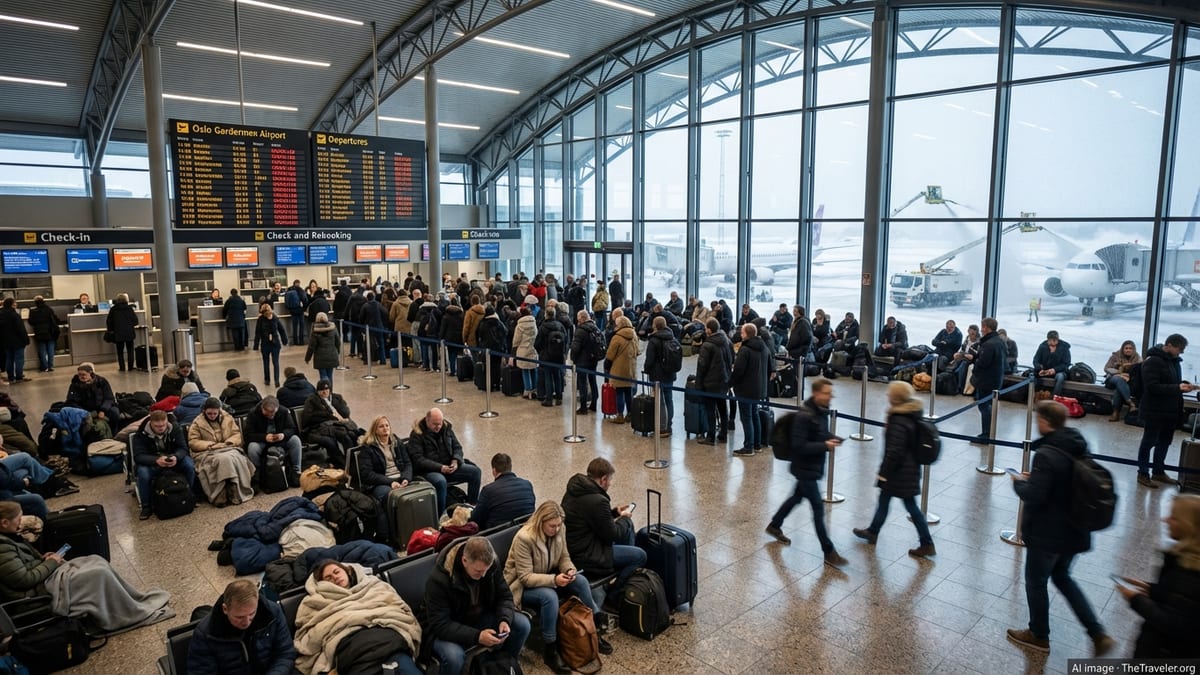
Severe Winter Weather Paralyzes Norway’s Busiest Airport
Oslo Gardermoen, Norway’s main international gateway, was hit by a combination of heavy snow, freezing temperatures and poor visibility that sharply reduced runway capacity and slowed ground operations throughout Saturday. Snowfall intensified in the early hours of February 21, forcing repeated de-icing cycles and intermittent runway sweeps as visibility around the airfield dropped below standard safety thresholds.
Airport authorities were compelled to lengthen separation between aircraft on approach and departure, which immediately squeezed flight schedules. With only a reduced number of movements possible per hour, departures quickly fell behind plan and arriving aircraft were pushed into holding patterns or diverted. What began as minor morning delays soon grew into widespread disruption as the weather pattern persisted over eastern Norway.
Ground handling teams struggled to keep pace with the volume of aircraft needing attention. Baggage loading, refuelling and pushback operations all slowed in the cold and snow. De-icing trucks were in constant rotation, but bottlenecks developed as more aircraft queued for treatment, adding further minutes to already stretched turnaround times.
By mid-afternoon, the combination of degraded runway capacity and sluggish ground operations had effectively gridlocked the day’s schedule. Airlines began cancelling rotations where crew duty limits or missed slot windows made recovery impossible, while other departures were held on stands for hours awaiting clearance, equipment and staff.
Operational Breakdowns Compound the Weather Impact
The meteorological challenges at Oslo were exacerbated by a series of operational strains that turned a difficult day into a full-scale disruption. According to airport and airline sources, staffing gaps in ground handling teams, technical issues within air traffic management systems and misaligned recovery plans all contributed to the scale of the delays and cancellations.
Several handlers were operating with reduced rosters after an intense start to the winter travel season, leaving limited flexibility to surge staff when conditions deteriorated. As de-icing demand climbed, dispatchers faced competing priorities between outbound flights racing crew duty limits and inbound aircraft needing gates and service. In some cases, aircraft arrived to find a shortage of available ground equipment or personnel, prolonging the time before passengers could disembark.
Air traffic controllers also dealt with intermittent technical slowdowns as radar and flight-planning systems were recalibrated for low-visibility procedures. While safety was never compromised, the extra layers of coordination required under these protocols slowed the flow of aircraft into and out of Oslo’s airspace. Airlines reported difficulty obtaining updated slot times in a fast-evolving environment, which complicated their efforts to rebuild coherent schedules.
Communication with passengers proved another weak point. Many travelers reported receiving conflicting or incomplete information through airport screens, airline apps and public announcements. Departure boards cycled through rolling estimated times, even as crew members advised that de-icing queues or slot restrictions would likely lead to further delays. This information gap deepened passenger frustration and made it harder for travelers to make timely decisions about rebooking or alternative routes.
Ripple Effects Across Sweden, Poland, the UK and Beyond
The disruption at Oslo quickly spread across the wider European network as delayed and cancelled flights broke vital connections. Norway’s capital functions as a major regional hub, particularly for traffic into Sweden and Poland, and onward to the United Kingdom and southern Europe. When key Oslo departures failed to operate on time, passengers who had already begun their journeys elsewhere in Europe suddenly found their onward links vanish.
In Stockholm and other Swedish airports, arriving flights from Norway landed hours behind schedule, too late for passengers to catch evening services to domestic destinations or major European capitals. Travelers heading from Scandinavia to cities such as London, Manchester, Madrid and Rome were forced to overnight unexpectedly or accept circuitous routings with multiple extra stops.
Polish airports, including Krakow and Warsaw, also felt the strain. Services that rely on Oslo as a connecting gateway for Nordic tourism and business traffic saw inbound loads arrive severely delayed or cancelled altogether. This left both local passengers and transfer travelers marooned in terminals already coping with winter weather of their own, as accommodation near some airports quickly filled.
In the United Kingdom, flight-tracking data showed knock-on delays across regional airports as aircraft and crews expected from Norway failed to arrive on time. Evening departures from British hubs to Scandinavia and continental Europe were pushed back or consolidated, frustrating travelers at the end of the busy half-term holiday period and complicating plans for business travelers returning ahead of the new work week.
Amsterdam, Geneva, Krakow, Stockholm and Munich Caught in the Gridlock
Some of Europe’s most important transit hubs became collateral victims of the Oslo crisis. In Amsterdam, one of the continent’s busiest connecting airports, passengers arriving from Norway faced missed long-haul connections and full rebooking queues as airlines tried to juggle limited seats on already crowded weekend services. Airport lounges and gate areas swelled with stranded travelers waiting for new itineraries.
Geneva and Munich, key gateways for alpine ski traffic at this time of year, were hit particularly hard. Many winter sports travelers route through Oslo and other Nordic hubs en route to the Alps, and the delays disrupted tightly timed itineraries that included train transfers and resort check-ins. Tour operators scrambled to arrange alternative routings via Zurich, Vienna or Milan, but availability was scarce and some guests arrived a full day later than planned.
In Krakow and other Polish cities, families visiting relatives or returning from work assignments in Scandinavia saw their flights repeatedly rescheduled. Local media carried images of passengers sleeping on terminal floors or huddled around charging points as they waited for updates. For smaller carriers operating limited rotations, losing a single Oslo leg meant substantial gaps in their daily schedules.
Stockholm, already managing its own winter weather challenges, saw congestion around gates servicing Nordic and central European destinations as delayed Oslo flights finally arrived in clusters. The resulting pressure on baggage systems and border control queues added further time to journeys that were already several hours longer than planned.
Airlines Struggle to Recover as Passengers Demand Answers
The primary airlines operating at Oslo, including Scandinavian carriers and low cost operators, entered full disruption-management mode as the day progressed. Revenue management teams worked alongside operations control centers to rebalance aircraft and crews, often forced to cancel later rotations in order to complete earlier ones. This strategy protected some long-haul and critical business routes but left leisure travelers and regional services more exposed to disruption.
Customer-service channels quickly became clogged. Call centers faced long wait times as thousands of passengers sought alternative flights or information on their rights, while digital channels were intermittently overwhelmed by surging traffic. Social media filled with images of long queues at transfer desks and stories of families separated across multiple flights in an attempt to reach the same destination.
Many travelers reported confusion over entitlement to meals, hotel accommodation and financial compensation. Staff at some airports lacked clear, consistent scripts explaining when delays were attributable primarily to extraordinary weather and when operational shortcomings might give rise to compensation claims under European air passenger rules. The resulting uncertainty deepened dissatisfaction at a time when patience was already frayed by fatigue and overcrowded terminals.
Airlines promised internal reviews of their disruption response, with several carriers acknowledging that communication had not kept pace with events. Industry analysts noted that the episode once again exposed the vulnerability of compressed winter schedules operating at near full capacity, leaving little margin for error when severe weather strikes a major hub.
Passenger Experiences Highlight the Human Cost of Disruption
Behind the statistics of 105 delayed flights and 9 cancellations lie thousands of individual stories of missed family events, disrupted work commitments and lost holiday time. At Oslo itself, families with young children could be seen spreading blankets across terminal floors, improvising play areas as they waited for rebooked flights stretching into the late evening and early morning hours.
In Amsterdam and Munich, business travelers described scrambling to rearrange meetings or join them remotely from airport lounges, laptops balanced on suitcases as they attempted to salvage workdays. Others spoke of critical medical appointments or family milestones at risk, with some tearful passengers seeking help at airline counters to find any possible route that would get them closer to home.
Volunteer groups and airport chaplaincy services at several hubs reported increased demand as distressed passengers sought emotional support. Airport retailers and food outlets extended opening hours to cope with the influx of late-night customers, though lines for basic amenities such as bottled water and hot meals remained lengthy.
For front-line staff, the day was equally punishing. Gate agents and customer-service teams worked extended shifts, often absorbing passenger anger and frustration while having limited concrete information to share. Many expressed concern about burnout after several intense winter seasons in which climate-related disruption has become more frequent.
What Travelers Can Do During Major Flight Disruptions
While the Oslo incident underscored how quickly routine operations can unravel in severe conditions, it also highlighted practical lessons for travelers caught in similar situations. Passenger rights regulations across Europe provide for assistance and, in some cases, financial compensation, but these protections are most effective when travelers understand how to access them and act promptly.
Experts advise that when large-scale disruption hits, passengers should first secure a confirmed alternative routing, even if it is not ideal, before exploring compensation or refunds. Seats on subsequent flights can disappear quickly, particularly over peak travel weekends, and those who act early have the best chance of securing workable options. Checking both airline apps and airport departure information in real time can reveal opportunities that might not yet be reflected in official rebooking queues.
Travel insurance with robust interruption cover can also prove valuable in events like those at Oslo, helping to offset costs for last-minute accommodation, meals or replacement transport when delays stretch into overnight stays. Policyholders are generally advised to keep all receipts and document communications with airlines to support later claims.
Seasoned travelers further recommend building additional buffers into winter itineraries, especially when planning critical connections through northern European hubs. Allowing extra hours between flights, or even an overnight stop when connecting to cruises, tours or long-haul journeys, can reduce the risk that one disrupted leg will derail an entire trip.
Airports and Airlines Under Pressure to Build Winter Resilience
The events of February 21 have prompted renewed scrutiny of how well European airports and airlines are prepared for increasingly volatile winter weather. While Oslo has generally ranked as a relatively reliable winter hub, the sheer scale of Saturday’s disruption showed how climate variability and tight scheduling can combine to overwhelm even experienced operators.
Industry observers expect the episode to accelerate investment in additional de-icing capacity, more flexible staffing models and upgraded digital tools for real-time passenger communications. Airports are also likely to revisit contingency plans for sudden spikes in stranded travelers, including better provisions for rest areas, family facilities and cooperation with local hotels and transport providers.
Airlines, for their part, face a delicate balance between maximizing capacity during peak seasons and maintaining enough slack in their systems to absorb shocks. Some analysts have suggested that carriers may need to reduce tight aircraft rotations on winter weekends or keep additional backup crews and aircraft on standby at key hubs, accepting higher operating costs to prevent days like Oslo’s meltdown from recurring.
For travelers across Europe, the Oslo disruption served as another reminder that winter air travel, however routine it may seem, remains at the mercy of both the weather and the complex systems that keep the continent’s skies moving. As demand continues to grow, the pressure on those systems will only increase, and the stakes for building greater resilience will rise with it.