

More news on this day
Sweden’s long-awaited Ostlänken high-speed rail line is moving from blueprints to reality, promising to dramatically cut travel times between Stockholm and Linköping and reshape how residents, commuters and visitors experience the country’s east coast corridor.
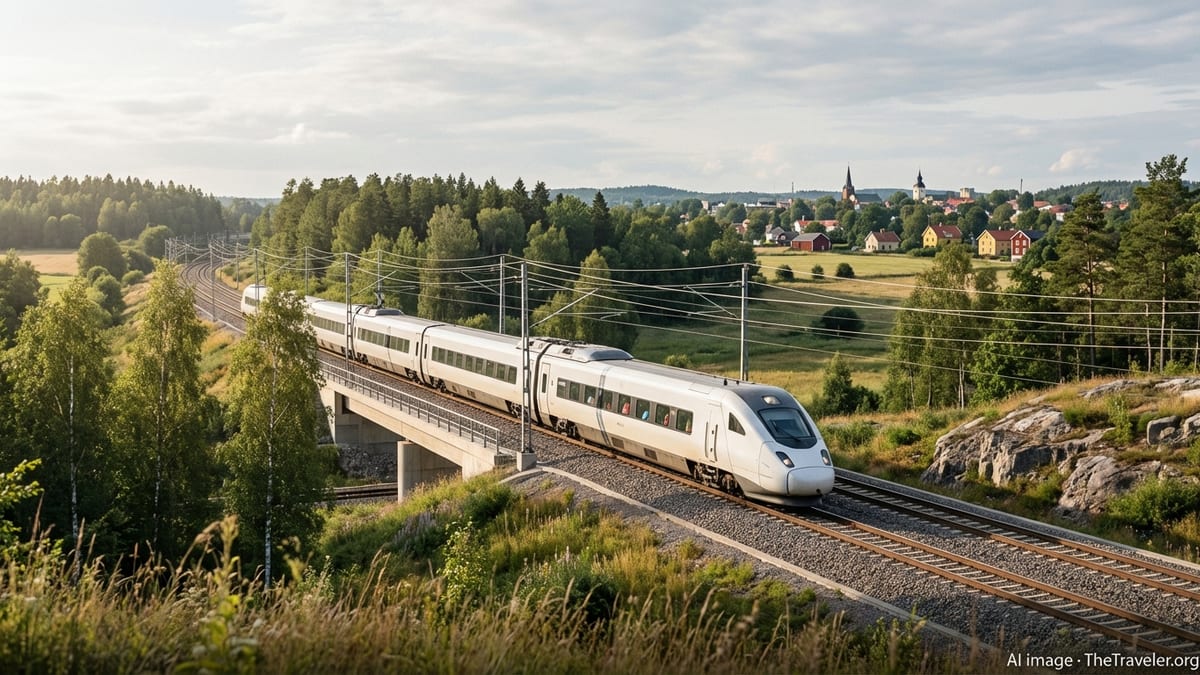
A New High-Speed Spine Between Järna and Linköping
Ostlänken, or the East Link, is an approximately 160-kilometre double-track railway being built between Järna, south of Stockholm, and the city of Linköping in Östergötland County. Designed for speeds of up to 250 kilometres per hour on most official plans, it will form the backbone of a future high-speed network that ultimately connects Stockholm with Gothenburg and Malmö via southern Sweden.
The new line will run through three counties and five municipalities, with stations at Vagnhärad, Nyköping, Skavsta Airport, Norrköping and Linköping. All but Nyköping will gain brand-new high-speed hubs, with Nyköping’s existing station extensively rebuilt and modernised to handle faster, more frequent trains and larger passenger flows.
Construction of Ostlänken formally began in late 2024 after years of planning, environmental review and political debate. Swedish authorities currently plan to open the line to traffic in 2035, positioning it as one of the country’s most significant transport investments of the coming decade.
While the project is still in its early construction phase, it is already beginning to define future expectations for travel along Sweden’s busy Southern Main Line corridor, where crowded tracks and mixed traffic have long constrained capacity and reliability.
Travel Times: From Long-Haul to Easy Day Trip
For travellers moving between Stockholm and Linköping, the most tangible change Ostlänken will deliver is time. The new line is expected to cut journey times on the Southern Main Line leg between Järna and Linköping by around 40 minutes compared with today’s services, depending on stopping patterns and rolling stock.
Current fast trains between Stockholm and Linköping typically take around 1 hour 55 minutes to just over 2 hours, sharing legacy track with regional, commuter and freight services. With Ostlänken in place and high-speed capable trains running at up to 250 kilometres per hour, end-to-end journeys are projected to drop closer to the 1 hour 15–20 minute range for the fastest connections.
The time saving is not only about minutes shaved from a timetable. By transforming what is now a longer intercity ride into an easy day trip, the line will make weekend getaways to Linköping, Norrköping or the coastal landscapes around Nyköping far more attractive for travellers based in Stockholm. For visitors arriving via Stockholm’s airports, it will also open up a broader slice of eastern and southern Sweden for short stays without relying on domestic flights or long car journeys.
Crucially, the improved travel times will also free up capacity on the existing Southern Main Line. As high-speed passenger trains migrate to Ostlänken, regional services and freight operators are expected to gain more reliable paths and better punctuality on the older corridor.
Transforming Commuting and Daily Life Along the Corridor
For residents of cities and towns along the route, Ostlänken is as much a labour market and lifestyle project as a transport upgrade. By compressing distances in time rather than space, the line will effectively pull Linköping, Norrköping and Nyköping closer to the Stockholm region, making long-distance commuting feasible for more people.
Planners describe this as the creation of a larger functional labour market region, where employers can recruit from a wider area and workers can weigh job opportunities in multiple cities without being constrained by long, unpredictable travel times. For young professionals and students, the prospect of studying in one city and working or interning in another, while still living near family or nature, becomes more realistic.
The new stations are being designed as intermodal hubs, with seamless links to local trains, buses and cycling routes. Municipalities along the line are already updating land-use plans, reserving space for new housing, offices and services around future station districts. For visitors, that means easier door-to-door connections from high-speed platforms to historic town centres, waterfront promenades and nature reserves.
In the medium term, the line is also expected to rebalance pressure on Stockholm’s housing market, as faster rail links make it easier to live further south while retaining strong ties to the capital’s jobs and cultural life.
Engineering a High-Speed Line Through Swedish Landscapes
Delivering these benefits requires one of Sweden’s most technically demanding rail builds to date. Roughly a quarter of Ostlänken will be carried on bridges or in tunnels, a reflection of the challenging topography and the authorities’ commitment to limiting impacts on towns, farmland and sensitive natural environments.
In total, the line will feature more than 150 bridges and around 20 kilometres of tunnels, including one of the country’s longest rail tunnels through the Kolmården area. This section alone will see about 15 kilometres of double-track line, with some 8 kilometres underground, threading carefully through a landscape prized for its forests and rocky cliffs.
State-of-the-art European Rail Traffic Management System signalling will be deployed along the route, enabling trains to run at higher speeds with greater safety and efficiency. All level crossings along the corridor will be removed, with roads carried either above or below the tracks to improve safety for both rail users and local traffic.
International engineering firms, working alongside Swedish consultants and contractors, have been engaged on multiple packages, from earthworks and bridge construction to power supply, catenary and telecommunications. The project has been divided into a series of major contracts to spread risk and allow work to proceed in parallel across different sections.
Environmental Goals and a Shift to Sustainable Travel
Ostlänken is being framed by the Swedish Transport Administration as a cornerstone of the country’s climate and sustainability agenda. By providing a fast, frequent alternative to car and domestic air travel, the line is expected to support a broad modal shift to rail for both passengers and freight.
Project partners have been given ambitious carbon reduction targets for the construction phase, including a goal of cutting emissions by more than half compared with traditional railway building methods. This involves careful selection of materials, optimised tunnel designs, and innovations in earthworks and bridge construction intended to limit both carbon output and disturbance to flora and fauna.
In operational terms, electrified high-speed trains running on Ostlänken will draw on Sweden’s largely fossil-free power mix, significantly reducing per-passenger emissions relative to driving or flying. The line’s role linking into broader national and cross-border rail networks is expected to multiply those benefits, particularly once other planned high-speed sections in southern Sweden are built.
For environmentally conscious travellers, the project signals a future in which it becomes easier to plan Swedish itineraries around efficient, low-carbon rail journeys, rather than relying on short internal flights or long highway drives.
Integrating Ostlänken Into Sweden’s Future High-Speed Network
While Ostlänken will initially operate as a stand-alone high-speed corridor between Järna and Linköping, it has always been conceived as a key building block in a larger national network. Future high-speed lines, including the proposed Götalandsbanan westward towards Gothenburg and further south towards Malmö, are planned to interface directly with the East Link.
This means that the travel time savings seen between Stockholm and Linköping will eventually extend much further. Earlier national planning scenarios suggest that, once Ostlänken is combined with new high-speed stretches to the west and south, journeys between Stockholm and Gothenburg could be cut to around two hours, while trips to Malmö would also be significantly reduced.
Although political debates and budgetary concerns have led to revisions and delays to parts of the wider high-speed programme, Ostlänken has retained strong backing as a capacity project for one of Sweden’s busiest rail corridors. Its completion is expected to influence future decisions on where and how to extend the high-speed network, as well as investment in connecting regional lines.
For international travellers, the eventual integration of Ostlänken with other high-speed routes could make rail a more competitive option for cross-border journeys linking Swedish cities with Copenhagen and continental Europe.
Economic Ripple Effects for Stockholm, Norrköping and Linköping
The economic rationale for Ostlänken extends far beyond ticket revenues. Faster, more reliable rail connections are expected to support job creation, attract investment and stimulate tourism in cities and towns along the route.
Linköping and Norrköping, which already form a twin-city region with strong universities, technology firms and manufacturing industries, stand to benefit from closer ties to Stockholm’s financial and service sectors. Businesses in these cities will be better placed to collaborate with partners in the capital while drawing on a broader talent pool willing to commute in either direction.
Smaller municipalities such as Trosa and Nyköping, as well as the area around Skavsta Airport, anticipate new residential and commercial development near stations, including hotels, offices and visitor services tailored to high-speed passengers. Tourism boards are preparing to highlight easier access to coastal archipelagos, historic town centres and nature reserves as the line’s opening date approaches.
For Stockholm itself, the project offers a way to ease housing and infrastructure pressures by encouraging more people and businesses to base themselves further south while remaining closely linked to the capital’s economy.
What Faster Rail Will Mean for Future Visitors to Sweden
For international visitors planning trips in the 2030s, Ostlänken promises to quietly but decisively change how itineraries through Sweden are put together. A journey that once required a longer intercity train ride or a domestic flight will instead become a swift, comfortable high-speed hop from Stockholm to Linköping, with onward options to Norrköping, Nyköping and the Baltic coast.
Tour operators are likely to respond by packaging multi-city rail-based tours, highlighting the ability to visit Stockholm’s museums and waterfront one day, explore Norrköping’s industrial heritage and riverfront the next, and wander the streets and parks of Linköping soon after, all without long transfers. Independent travellers will gain the freedom to add side trips to coastal nature reserves or small-town centres, knowing that high-speed connections can whisk them back to the capital in time for evening plans.
As the line matures and service patterns are refined, Ostlänken is expected to become a defining element of the Swedish travel experience, particularly for visitors keen to combine urban culture, historic towns and scenic landscapes using low-carbon, modern rail.
Although the first passengers will not board until 2035, the East Link is already reshaping maps, plans and expectations, setting the stage for a future where experiencing Sweden by train between Stockholm and Linköping truly feels like a breeze.