

More news on this day
Hundreds of passengers were left isolated at airports across China this week as China Eastern, Air China, Shenzhen Airlines and other carriers scrapped more than 100 flights, choking traffic through critical hubs such as Beijing, Shanghai, Guangzhou, Chengdu and Shenzhen and forcing last-minute rebookings across already strained networks.
Get the latest news straight to your inbox!
Major Chinese Hubs See Wave of Cancellations
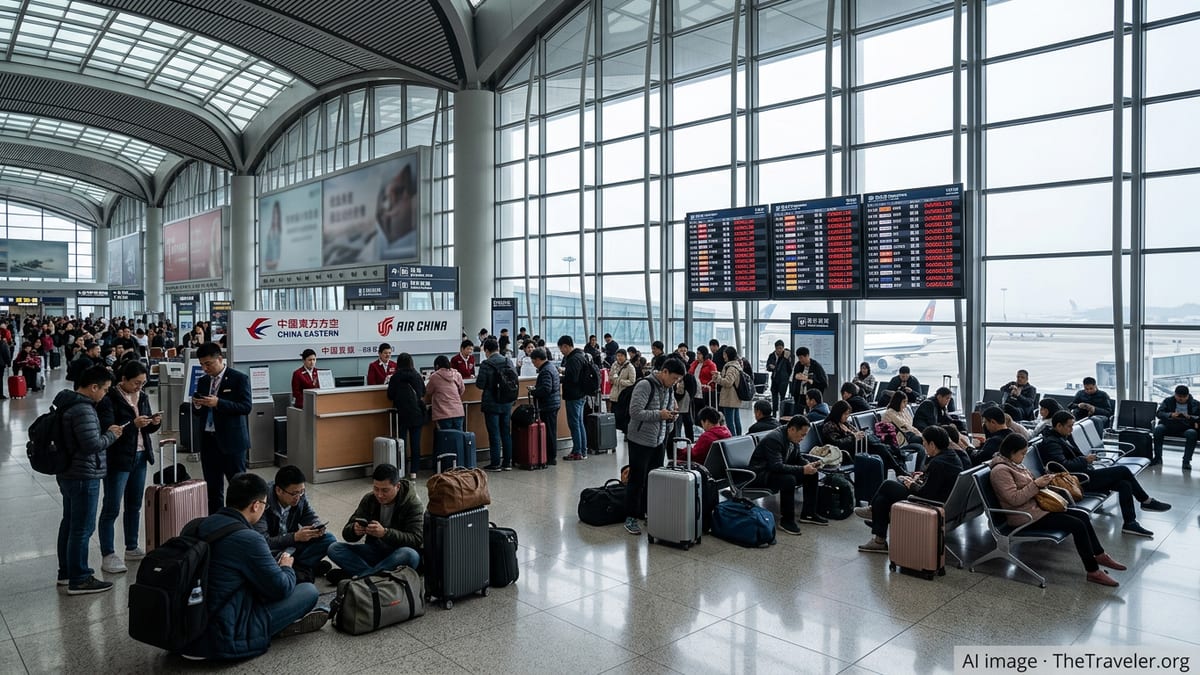
Travelers arriving at some of China’s busiest airports on Wednesday were met with departure boards lit up with red cancellation notices, as severe disruption rippled through the country’s aviation system. Flight-tracking data and local media reports indicated that more than 100 services were pulled from schedules in the latest bout of irregular operations involving China Eastern, Air China, Shenzhen Airlines and several regional partners.
The disruption hit key national gateways including Beijing Capital, Beijing Daxing, Shanghai Pudong, Shanghai Hongqiao, Guangzhou Baiyun, Chengdu Tianfu and Shenzhen Bao’an, where even a relatively small number of cancellations can quickly cascade into hours of delays for onward connections. With many aircraft and crew already out of position from earlier weather and airspace-related issues in Asia, airlines struggled to restore normal rotations.
China Eastern and Air China, which together with China Southern dominate mainland aviation, were again prominent among the affected operators after weeks of elevated disruption tied to regional tensions and winter weather. Shenzhen Airlines, an important player on secondary and regional routes, reported a smaller number of outright cancellations but a high volume of knock-on delays as it held aircraft on the ground at congested hubs.
Industry analysts noted that while the headline figure of just over 100 cancellations may appear modest compared with peak holiday volumes, the impact was magnified by the concentration of those flights at a handful of hub airports that serve as essential transfer points for both domestic and international itineraries.
Knock-On Effects From Regional Airspace Turmoil
The latest wave of cancellations did not occur in isolation. Airlines across Asia have been grappling with the closure or restriction of key Middle East air corridors since late February, forcing carriers to reroute or suspend services and leaving widebody aircraft and crews stranded outside their planned bases. Chinese carriers are no exception, with long-haul schedules to the Gulf and beyond under particular pressure.
Operational data from recent days show that airports including Shanghai Pudong and Shenzhen Bao’an have logged unusually high numbers of delayed departures on services linked indirectly to Middle Eastern connections. As turnaround times stretch and crew duty limits are reached, airlines frequently opt to cancel subsequent short-haul sectors rather than risk safety or regulatory breaches, a pattern that helps explain the sudden loss of short domestic legs feeding the country’s main hubs.
At the same time, carriers continue to trim and consolidate other international routes for economic and political reasons, from curtailed Japan schedules to selective suspensions on secondary city pairs. While these strategic cuts are typically announced weeks or months in advance, they reduce the overall resilience of the network. When unexpected shocks hit, airlines have fewer spare aircraft and crew to redeploy, increasing the likelihood that disruptions at hub airports will spread quickly.
For passengers on the ground in China’s major terminals, the interplay of these factors translated into a familiar experience: long queues at airline counters, packed customer service hotlines and limited options for same-day rebooking as corridors to key regional hubs filled up.
Passengers Face Long Waits and Patchy Support
Scenes at several affected airports on Wednesday and Thursday underscored the strain on both infrastructure and customer service. Queues for China Eastern and Air China service desks in Shanghai and Beijing snaked across departure halls, with staff juggling a rush of walk-up customers, online rebooking requests and coordination with ground handling partners.
Many passengers reported being offered alternative flights several hours or even a full day later, reflecting the scarcity of spare seats on popular trunk routes between the country’s biggest cities. In Guangzhou and Chengdu, travelers heading onward to smaller inland destinations were particularly hard hit, as cancellations on feeder flights severed the final domestic legs of complex itineraries.
Under China’s aviation consumer-protection rules, carriers are generally required to provide meals and accommodation when delays or cancellations are within the airline’s control. In practice, however, the distinction between weather, airspace restrictions and operational decisions can be opaque for travelers, and the level of support varied widely by airport and airline. Some passengers were given hotel vouchers and meal coupons, while others said they were directed to contact third-party booking platforms or purchase new tickets and seek reimbursement later.
Travel advocates warned that foreign visitors unfamiliar with Chinese-language apps and airline procedures were at particular risk of becoming stuck without clear guidance, especially at late-night banks of departures when information desks and airport transit services operate on reduced staffing.
Airlines Loosen Refund and Change Rules
In an effort to contain the fallout and maintain customer confidence, major mainland carriers have expanded flexible booking policies that were initially crafted around specific regions. Air China, China Eastern, China Southern and Shenzhen Airlines have all issued recent notices easing refund and change conditions on certain long-haul and Middle East-related routes, allowing affected passengers to alter plans without additional fees or to claim full refunds on unused segments.
Industry observers say these measures, while welcome, do not always extend to domestic feeder legs that are canceled as a secondary consequence of long-haul disruption. Where policies are narrowly framed around international sectors, travelers whose secondary flights between hubs such as Beijing, Shanghai or Guangzhou are dropped can still find themselves navigating standard rebooking rules, which may involve fare differences or limited re-accommodation options on peak services.
Some carriers have also begun proactively consolidating lightly booked flights, encouraging voluntary rebooking onto alternative departures in advance of the travel date. This strategy can reduce the number of passengers stranded on the day of travel but risks creating confusion when schedule changes are not clearly communicated across all distribution channels, including online travel agencies and corporate booking tools.
Analysts suggest that as disruptions linked to regional airspace and geopolitical tensions persist into the spring, airlines may be forced to further broaden their waiver policies to cover a wider range of connecting itineraries, particularly for high-yield business and international transit customers connecting through China’s primary hubs.
What Travelers Should Do Now
With operational conditions in flux, travel experts recommend that passengers flying into or through Chinese hubs adopt a more conservative approach to planning over the coming weeks. That starts with building longer connection windows through airports such as Beijing Capital, Shanghai Pudong, Guangzhou Baiyun, Chengdu Tianfu and Shenzhen Bao’an, where even modest delays on inbound legs can jeopardize tight domestic or international transfers.
Specialists also advise booking directly with airlines where possible, making it easier to access real-time notifications and to process changes or refunds under evolving waiver policies. Travelers who must book via online agencies or corporate tools are urged to monitor both the airline’s app and third-party platforms closely in the 48 hours before departure, as last-minute retimings and aircraft swaps remain common.
For those already stranded by cancellations, documenting all communications with carriers and keeping receipts for extra expenses such as meals, taxis and hotel stays can improve the chances of successful reimbursement claims later. Passengers should also familiarize themselves with both Chinese consumer rules and any additional protections that may apply under foreign regulations if their journey begins or ends outside China.
While airlines stress that safety remains the primary driver of route changes and cancellations, the latest disruption underscores how quickly shocks elsewhere in the global network can translate into grounded planes and full departure halls in China’s own aviation heartlands. Until regional airspace stabilizes and reserve capacity is rebuilt, travelers can expect China’s busiest hubs to remain vulnerable to further sudden spikes in cancellations and delays.