

More news on this day
Thousands of passengers across Indonesia and Southeast Asia faced unexpected travel chaos this week, as more than 109 flights were cancelled or diverted at Jakarta’s Soekarno Hatta and Makassar’s Sultan Hasanuddin airports, with knock-on disruptions reported in Palu, Singapore, Tangerang and several other cities.
Severe Weather at Soekarno Hatta Sparks Mass Disruptions
Heavy rainfall over the Jakarta region triggered the latest wave of flight chaos at Soekarno Hatta International Airport in Tangerang, one of Southeast Asia’s busiest aviation hubs. Airport operator InJourney Airports confirmed that intense downpours and low visibility forced widespread schedule changes and safety-driven operational measures early in the week.
Authorities reported that at least 109 flights were significantly affected, with a mix of cancellations, diversions to other Indonesian airports and lengthy ground delays. Several arriving aircraft were forced into go-around procedures before landing as crews waited for conditions to stabilize, highlighting how quickly tropical weather can upend even routine operations.
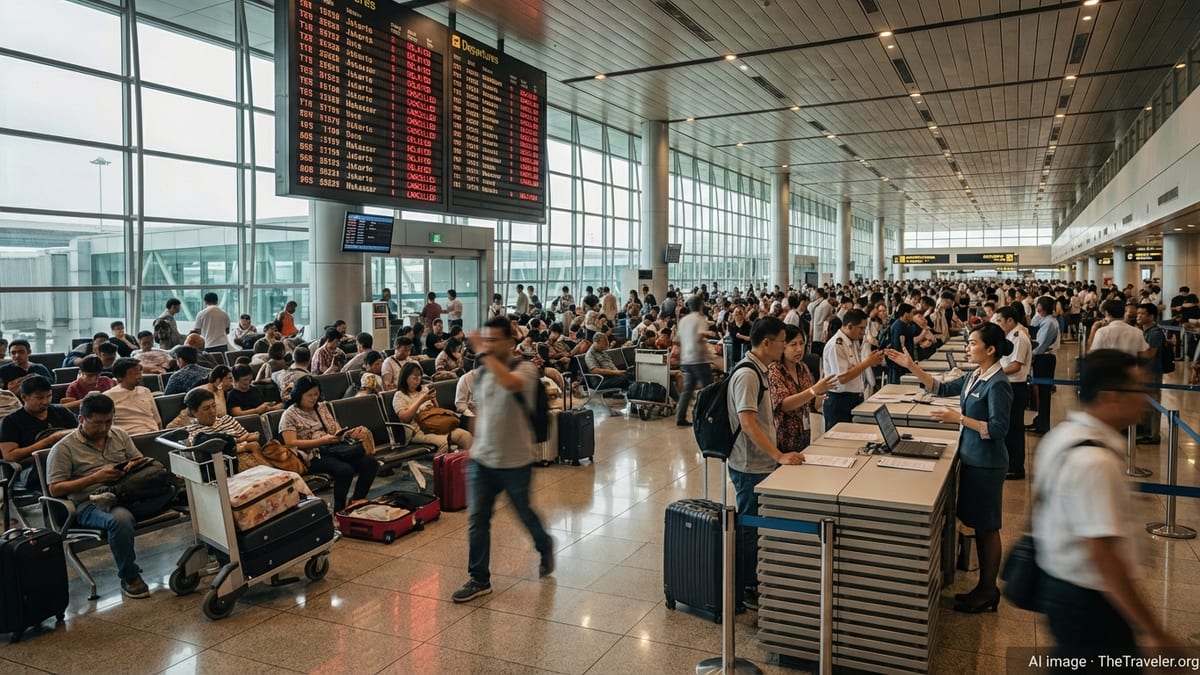
Terminal areas quickly grew crowded as electronic boards lit up with red lines of “cancelled” and “delayed” notices. Airline staff rushed to rebook passengers on later departures or alternative routings, while ground teams implemented standard delay-management procedures to ease congestion on taxiways and at gates.
Airport managers stressed that every decision to halt or divert a flight was made on safety grounds, citing the combination of saturated runways, strong winds and localized thunderstorms. With Jakarta handling large volumes of both domestic and international traffic, disruption at Soekarno Hatta rapidly cascaded into Indonesia’s wider route network.
Ripple Effects From Makassar to Palu and Eastern Indonesia
The knock-on impact was felt acutely at Sultan Hasanuddin International Airport in Makassar, a major bridge between western Indonesia and destinations in Sulawesi, Papua and Maluku. As Jakarta-bound and Jakarta-originating services were cancelled or diverted, aircraft and crew rotations through Makassar were thrown off balance, compounding delays through the day.
Regional routes linking Makassar to Palu’s newly international Mutiara SIS Al Jufrie Airport, as well as other key cities in Sulawesi, saw schedule compression and last-minute retiming. Travellers reported waiting for hours in departure halls while airlines waited for inbound aircraft that had been held up elsewhere in the network.
Operational planners noted that eastern Indonesia’s aviation system remains highly dependent on a relatively small number of aircraft cycling through a web of island-hopping routes. When weather or congestion interrupts movements at a primary hub such as Jakarta or Makassar, relatively minor timetable changes can quickly swell into full cancellations on thinner regional routes.
For many passengers flying for work, medical appointments or family obligations in remote provinces, the lack of immediate backup options added to the frustration. Some travellers opted to rebook for the following day, while others scrambled for connections through alternative hubs, often at higher last-minute fares.
Singapore and Regional Hubs Feel the Strain
The turbulence in Indonesia’s skies also reverberated across borders, notably at Singapore’s Changi Airport, a critical transit point for Southeast Asia. A combination of inbound delays from Jakarta and Makassar and equipment changes by airlines trying to recover their schedules led to pockets of disruption on Indonesia-bound flights.
Passengers heading from Singapore to secondary Indonesian destinations, including cities in Sulawesi and Kalimantan, encountered late departures and tighter connection windows as schedules compressed. Travel agents reported a spike in last-minute itinerary changes as corporate and leisure travellers tried to avoid routings that depended on the most affected hubs.
Recent regional data has already highlighted rising pressure on Asia’s aviation infrastructure, with several days in February marked by unusually high concentrations of delays across multiple hubs. Observers say the fresh wave of weather-linked disruption in Indonesia demonstrates how even a localized event can send shockwaves through flight networks stretching from Singapore and Kuala Lumpur to Manila and Hong Kong.
For Singapore-bound passengers stranded in Indonesian terminals, the main options were rebooking onto later flights or accepting rerouting via alternative gateways. While most airlines offered standard care measures such as meal vouchers and hotel stays for longer delays, many travellers described overnight waits and crowded transit areas as airlines worked through the backlog.
Passengers Perplexed by Patchy Communication
From Palu to Tangerang, one of the most common complaints among stranded passengers was inconsistent or delayed information. Several travellers reported learning about cancellations only when they reached the check-in counters, despite having received no prior notification via airline apps or text messages.
Inside terminals, flight displays sometimes lagged behind reality, showing flights as “on time” or merely “delayed” long after boarding should have started. Airline ground staff were left to manage long queues of anxious customers seeking clarity on whether to wait at the gate, head to immigration or collect baggage and exit the secure area.
Families traveling with children and elderly passengers appeared particularly affected, with some forced to bed down on terminal seats overnight after hotels near major airports filled quickly. Social media posts from Palu, Makassar, Singapore and Jakarta showed crowds gathered around customer-service desks and information boards, reflecting widespread uncertainty about revised departure times.
Industry analysts note that while safety decisions around weather and runway conditions are non-negotiable, the passenger experience often hinges on how quickly and transparently airlines and airport authorities share evolving information. In complex disruption events that hit multiple hubs simultaneously, communication systems and staffing levels can struggle to keep pace with real-time changes to aircraft rotations.
Airlines and Authorities Pledge Improvements as Peak Travel Looms
In the wake of the latest disruption, Indonesian aviation authorities and airport operators reiterated their focus on operational resilience. InJourney Airports and several domestic carriers emphasized that flight safety remained the primary consideration during periods of heavy rain and reduced visibility, but acknowledged that communication and contingency planning would be reviewed.
Airlines serving Jakarta, Makassar and Palu are now conducting internal reviews of how crew and aircraft were deployed during the episode, with a particular focus on whether more proactive cancellations could have prevented late-night airport crowding. Some carriers have signalled that they may adjust schedules or increase buffer times on routes most vulnerable to tropical downpours and congestion.
Travel experts advise passengers with upcoming itineraries through Soekarno Hatta, Sultan Hasanuddin or other Indonesian hubs to build extra connection time into their journeys, especially during the current rainy season. They also recommend making full use of airline apps and official airport channels for updates, while keeping contact details current so disruption alerts can be delivered quickly.
With regional demand for air travel continuing to climb across Southeast Asia, this latest episode of mass cancellations and delays serves as a reminder that the region’s aviation recovery has brought not only renewed connectivity but also heightened sensitivity to weather shocks and operational bottlenecks. As peak holiday and pilgrimage periods approach, both carriers and airport operators will be under pressure to demonstrate that lessons from Jakarta and Makassar have been learned.