

More news on this day
Passengers flying in and out of Egypt are facing mounting disruption this week after Qatar Airways and EgyptAir cancelled or suspended more than two dozen flights, hitting key routes to Dubai, Abu Dhabi, Doha, Jeddah, Amman, Beirut, Kuwait, Baghdad and other major regional hubs.
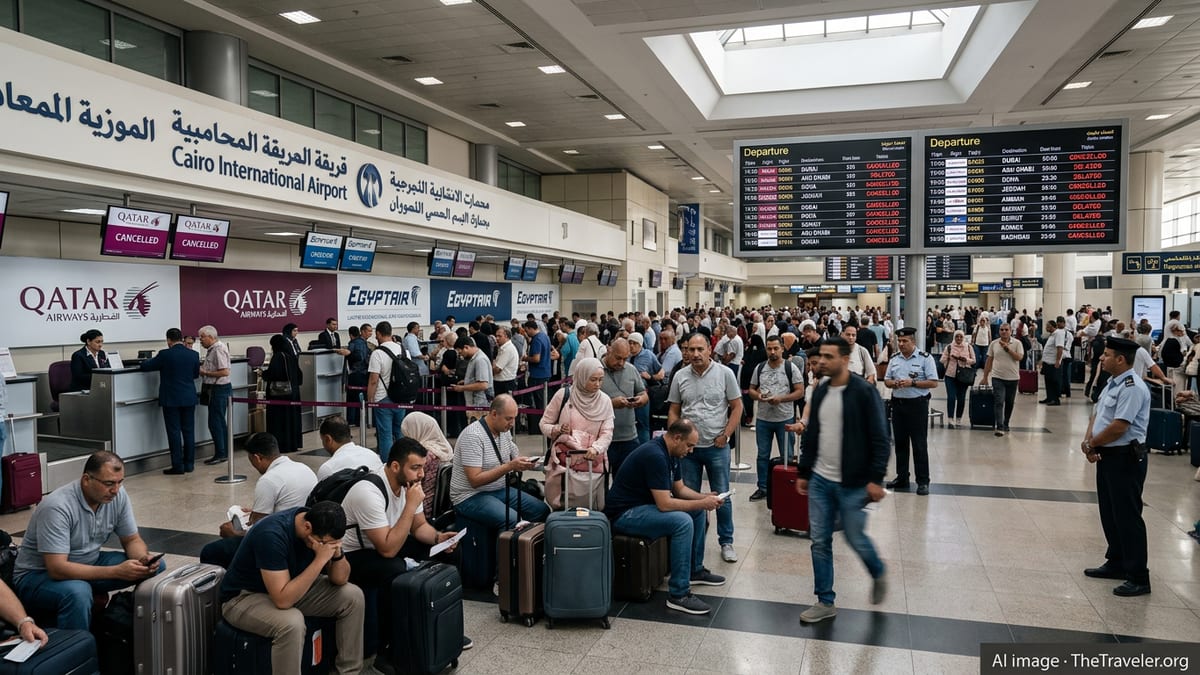
Widening Disruption at Cairo and Other Egyptian Gateways
Flight schedules at Cairo International Airport and other Egyptian gateways have been heavily thinned as regional airspace restrictions and operational constraints ripple across the Middle East network. Data from aviation tracking platforms and airport operations reports show a sharp spike in cancellations and delays on routes linking Egypt to the Gulf and Levant, with Qatar Airways and EgyptAir among the hardest hit carriers.
On Monday and Tuesday, passengers reported arriving at Cairo to find Qatar Airways departures to Doha either cancelled or downgraded to limited relief services, while EgyptAir’s boards showed multiple scrapped flights to cities including Dubai, Abu Dhabi, Kuwait and Beirut. Knock-on disruption is also being felt at connecting hubs such as Dubai International, Hamad International in Doha, Jeddah and Amman, where aircraft and crew rotations have been thrown off schedule.
Independent disruption trackers have counted more than 25 individual cancellations tied directly to Qatar Airways and EgyptAir services touching Egypt over the past several days, with scores more flights suffering long delays. Industry observers warn that the true impact is larger once missed connections and last-minute reroutings via third countries are taken into account.
Airport authorities in Cairo have urged passengers to arrive early and to verify their flight status repeatedly before traveling, noting that schedules remain subject to rapid change as airlines adjust to evolving safety and regulatory guidance.
Qatar Airways Cuts Egypt Services While Running Limited Relief Flights
Qatar Airways, which normally operates a dense schedule between Doha and Egyptian cities such as Cairo and Alexandria, is currently running only a skeletal program of flights after a series of regional airspace closures and restrictions. The airline has been authorized to operate a narrow corridor in and out of Doha and is prioritizing what it describes as relief and repatriation services to key destinations.
In its latest operational update, Qatar Airways confirmed that flights between Doha and Cairo, Jeddah and a handful of long-haul cities would run on a limited basis over the coming days, while many other services remain suspended. Travelers hoping to connect via Doha from Egypt to onward destinations in the Gulf, Levant or Asia are being urged to consult the carrier’s most recent schedules and to consider date changes if their journey is not urgent.
The airline has introduced flexible rebooking and refund policies for passengers with tickets issued before the latest round of disruptions, allowing changes of travel dates or full refunds in many cases. However, travelers report that call centers and ticket offices are under heavy pressure, leading to long wait times and, in some cases, confusion about eligibility for rerouting on partner airlines.
Scenes at Hamad International Airport show long lines of stranded passengers, including many connecting from or to Egypt, queuing at customer service desks in search of alternative itineraries. With capacity sharply reduced, seats on the few operating flights are in high demand and often sell out quickly.
EgyptAir Maintains Suspensions on Key Gulf and Levant Routes
Egypt’s flag carrier EgyptAir has maintained and, in some cases, extended suspensions on a range of regional routes following earlier airspace closures and security advisories. In recent days the airline has confirmed that flights from Cairo to several major Gulf and Levant destinations, including Dubai, Abu Dhabi, Doha, Amman, Beirut, Kuwait and Baghdad, will remain off the schedule until conditions improve.
The suspensions cover both non-stop services and some one-stop itineraries that rely on overflying restricted areas, effectively cutting a number of popular corridors used by business travelers, overseas workers and pilgrims transiting through Egypt. While EgyptAir has started planning phased resumptions to parts of the United Arab Emirates network, capacity remains far below normal and exact restart dates for some cities are still uncertain.
Passengers holding EgyptAir tickets on the affected routes are being offered options to change dates, reroute via permitted hubs or seek refunds, subject to fare conditions. However, with many alternative flights on other carriers also disrupted or fully booked, choices can be limited, especially for those needing to travel at short notice.
Travel agents in Cairo and Alexandria say the situation is particularly challenging for passengers bound for labour markets in the Gulf and for families trying to return home before Ramadan. Some are turning to indirect routings through secondary hubs, adding hours or even days to their journeys and significantly increasing costs.
Egypt-Based Travelers Confront Long Queues, Rising Costs and Uncertainty
For passengers on the ground, the combined cancellations by Qatar Airways and EgyptAir translate into long queues at airport desks, uncertainty over when they will reach their destinations and, in many cases, rising out-of-pocket expenses. Hotel stays, food, new visas and last-minute tickets on alternative airlines are straining the budgets of tourists and migrant workers alike.
At Cairo International, travelers have described overnight waits as they attempt to secure seats on the few operating departures to Gulf hubs such as Dubai and Jeddah. Those with onward connections to cities like Kuwait City, Baghdad or Beirut face additional complications if their separate regional legs have also been cancelled or rescheduled.
Consumer advocates are reminding passengers that, while local and international compensation rules vary, airlines generally have obligations to offer rebooking or refunds when flights are cancelled. They advise keeping all receipts for hotels and transport, documenting communication with carriers and checking whether travel insurance policies include disruption cover for airspace or security-related incidents.
With demand outstripping supply on operating routes, airfares on some remaining services out of Egypt have surged. Travel agents report that families are sometimes forced to split across multiple flights or even multiple airlines, particularly on busy corridors to Dubai, Doha and Abu Dhabi.
What Passengers Should Do Now
Travel specialists say anyone due to fly from Egypt to regional hubs over the next two weeks should treat their booking as provisional and plan accordingly. They recommend checking flight status multiple times a day via airline and airport channels, signing up for SMS and email alerts and, where possible, using mobile apps to manage changes without needing to visit crowded ticket offices.
For travelers whose journeys are not time-sensitive, the most practical option may be to postpone travel until schedules stabilize and airlines have had time to restore aircraft rotations. Those who must travel urgently are advised to explore routings that avoid the most heavily impacted hubs, even if that means longer itineraries or overnight layovers in alternative cities.
Travelers are also being urged to review the fine print of their tickets and travel insurance policies. Fully flexible or refundable fares can significantly reduce stress in fast-changing circumstances, while some premium credit cards and specialist insurance products provide additional coverage for disruption caused by airspace closures or security advisories.
With regional tensions still elevated and airlines adjusting operations day by day, industry analysts caution that the disruption for passengers in Egypt is unlikely to ease immediately. For now, flexibility, patience and close monitoring of official updates remain essential for anyone planning to fly between Egypt and key destinations such as Dubai, Abu Dhabi, Doha, Jeddah, Amman, Beirut, Kuwait and Baghdad.