

More news on this day
Thousands of travelers across Asia are facing extended delays and abrupt itinerary changes after more than 40 flights were canceled at major hubs in Indonesia, Malaysia, Taiwan, and Hong Kong, disrupting routes to Doha, Melbourne, Chennai, Manila, Osaka, and other long-haul destinations.
Get the latest news straight to your inbox!
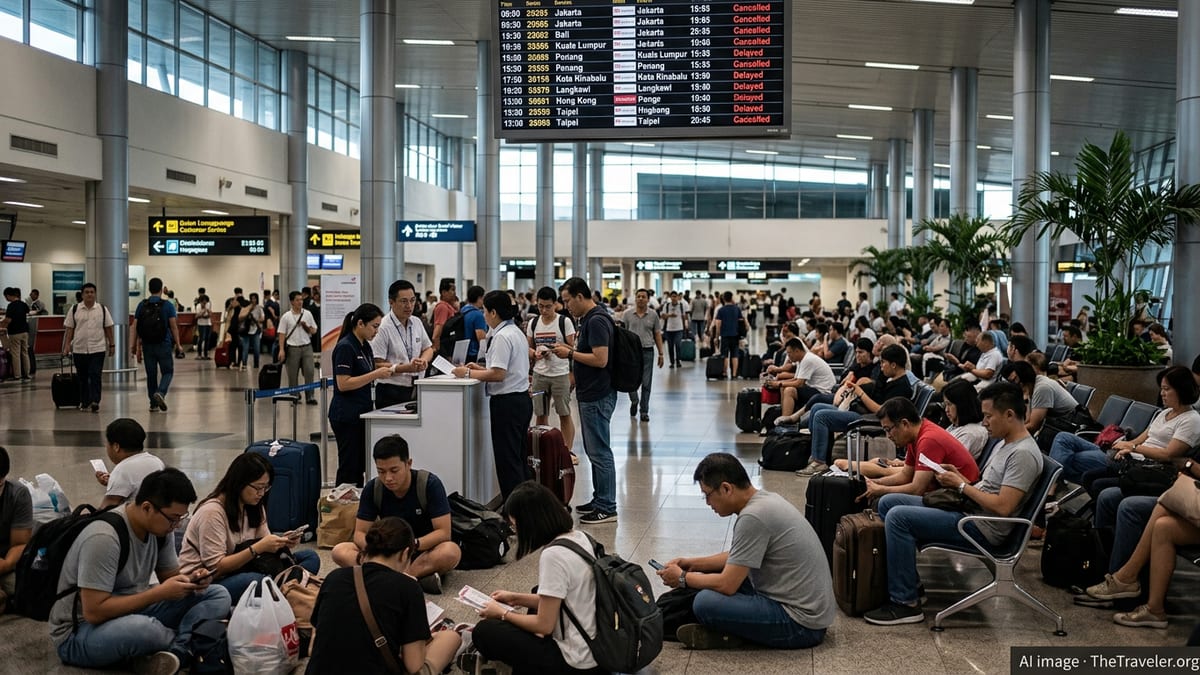
Widespread Disruptions at Major Asian Hubs
Airports in Jakarta, Bali, Kuala Lumpur, Taipei, and Hong Kong have reported clusters of cancellations affecting regional and long-haul services, according to publicly available airport departure boards and airline updates. The disruptions have particularly affected services operated by AirAsia, Malaysia Airlines, Batik Air, Qatar Airways, and several partner or codeshare carriers connecting Southeast and East Asia with the Middle East and Australia.
Reports from local media and aviation tracking platforms indicate that cancellations began building over a short window, with rolling schedule changes rippling through evening and overnight departures. At Jakarta and Bali, several departures to major transit hubs were withdrawn from schedules, forcing passengers to queue at airline counters late into the night in search of alternative routings.
Similar scenes have been described at Kuala Lumpur International Airport and Taipei Taoyuan International Airport, where electronic boards showed blocks of canceled flights, particularly on routes feeding into Doha and other key global connection points. In Hong Kong, a mix of regional and long-haul services was affected, leaving transfer passengers uncertain about onward travel options.
While precise passenger counts have not been released, the combination of peak travel periods, school holidays in some markets, and high demand on Asia–Middle East–Australia corridors means the total number of people impacted is likely to be in the many thousands.
Key Routes Hit: Doha, Melbourne, Chennai, Manila, Osaka and Beyond
The cancellations have been concentrated on routes that serve as vital connectors between Asia and major global hubs. Flights linking Jakarta, Bali, Kuala Lumpur, Taipei, and Hong Kong to Doha have been among the most disrupted, complicating onward travel for passengers bound for Europe, Africa, and the Americas via the Gulf.
Journeys to Melbourne and other Australian cities have also been heavily affected, with some travelers reporting limited or no immediate availability on alternative services over the coming days. The Australia–Asia–Middle East corridor is a critical lifeline for both leisure and business travelers, and any reduction in capacity quickly results in backlogs as rebooking demand outstrips remaining seats.
On the South and East Asia side, connections to Chennai, Manila, and Osaka have seen schedule volatility, particularly for itineraries relying on multi-leg journeys that combine low-cost regional carriers with long-haul operators. Travelers holding separate tickets on different airlines have been especially vulnerable, as a canceled first leg can invalidate later segments or leave passengers stranded midway without automatic protection.
Travel industry observers note that when multiple carriers adjust schedules at the same time, even a few dozen cancellations can cascade through interconnected networks, affecting flights far beyond the original departure cities listed on airport boards.
Operational and Capacity Pressures Behind the Cancellations
Airlines have attributed recent schedule changes to a mix of operational and capacity constraints, as well as wider pressures on global aviation networks. Publicly accessible company statements and timetable revisions suggest that factors include aircraft rotation issues, crew availability challenges, and ongoing adjustments to demand patterns on long-haul routes.
Regional carriers such as AirAsia, Malaysia Airlines, and Batik Air have been managing intense competition on popular Southeast Asian city pairs while also responding to shifts in long-haul connectivity offered by partner airlines. Any disruption at a major transit hub, whether due to weather, congestion, or airspace restrictions, can trigger last-minute cancellations in feeder markets as airlines attempt to reposition aircraft and crews.
For long-haul operators like Qatar Airways, schedule changes on high-demand corridors between Asia, Doha, and onward destinations such as Melbourne can create a knock-on effect for partner and codeshare flights. When a key long-haul leg is removed from the schedule, associated regional connections often become non-viable, leading to further cancellations across the network.
Industry analysts point out that Asia’s aviation recovery has pushed many airlines close to their operational limits, with limited spare aircraft and crews available to absorb disruptions. As a result, carriers are sometimes opting to consolidate services, cancel underperforming rotations on short notice, and prioritize routes with the strongest demand or strategic importance.
Passengers Face Long Queues, Limited Rebooking Options
Travelers affected by the latest wave of cancellations have reported long lines at check-in and customer service counters across affected airports, as well as heavy call-center and app traffic. Many passengers have turned to online rebooking tools, only to find that remaining seats to Doha, Melbourne, Chennai, Manila, Osaka, and other key destinations are scarce or significantly more expensive.
Those traveling on complex, multi-airline itineraries have encountered particular difficulties, with some needing to purchase entirely new tickets to continue their journeys. Separate bookings on low-cost and full-service carriers can limit eligibility for automatic re-accommodation, leaving passengers reliant on goodwill gestures, travel insurance, or out-of-pocket expenditure.
Social media posts and traveler forums describe families sleeping in terminal seating areas, travelers attempting to reroute via alternative hubs such as Singapore, Bangkok, or Dubai, and others choosing to postpone trips altogether. Some passengers with time-sensitive commitments, including work obligations or connecting cruises and tours, are reporting significant financial and logistical knock-on effects.
Consumer advocates note that passengers’ rights and compensation entitlements vary widely across jurisdictions in Asia, and in many cases are less comprehensive than in regions with more developed air passenger regulations. This patchwork of protections can leave travelers uncertain about what support they can reasonably expect after a last-minute cancellation.
What Travelers Should Do Next
Travel experts recommend that passengers currently booked on flights from Jakarta, Bali, Kuala Lumpur, Taipei, or Hong Kong, particularly those connecting via Doha or traveling onward to Melbourne, Chennai, Manila, Osaka, and other long-haul destinations, monitor their bookings closely over the coming days. Checking airline apps and official departure boards several times before heading to the airport can help reduce the risk of arriving for a flight that has already been removed from the schedule.
Travelers are also advised to keep contact details updated in airline profiles so that carriers can send any schedule notifications as quickly as possible. Where feasible, booking all segments of a journey on a single ticket and with a single airline group can offer greater protection, making it easier for carriers to reroute passengers when disruption occurs.
For those already stranded, persistence and flexibility remain essential. Publicly available guidance from travel agencies and consumer organizations suggests exploring alternative routings via secondary hubs, considering nearby departure airports, and being open to changes in travel dates where practical. In some cases, it may be more realistic to request full or partial refunds and rebook travel for a later period once schedules stabilize.
With flight networks across Asia still operating under tight capacity and evolving demand, observers expect that intermittent clusters of cancellations are likely to continue. Travelers planning multi-stop journeys that rely on connections through hubs such as Jakarta, Kuala Lumpur, Taipei, Hong Kong, and Doha are being urged to build in extra time, review ticket conditions carefully, and ensure they have suitable travel insurance in place before departure.