

More news on this day
More than 550 German holidaymakers stranded in the United Arab Emirates and the Maldives have returned home on special repatriation flights operated by TUI, marking one of the most visible milestones yet in the mass evacuation of tourists from the conflict-disrupted Middle East region.
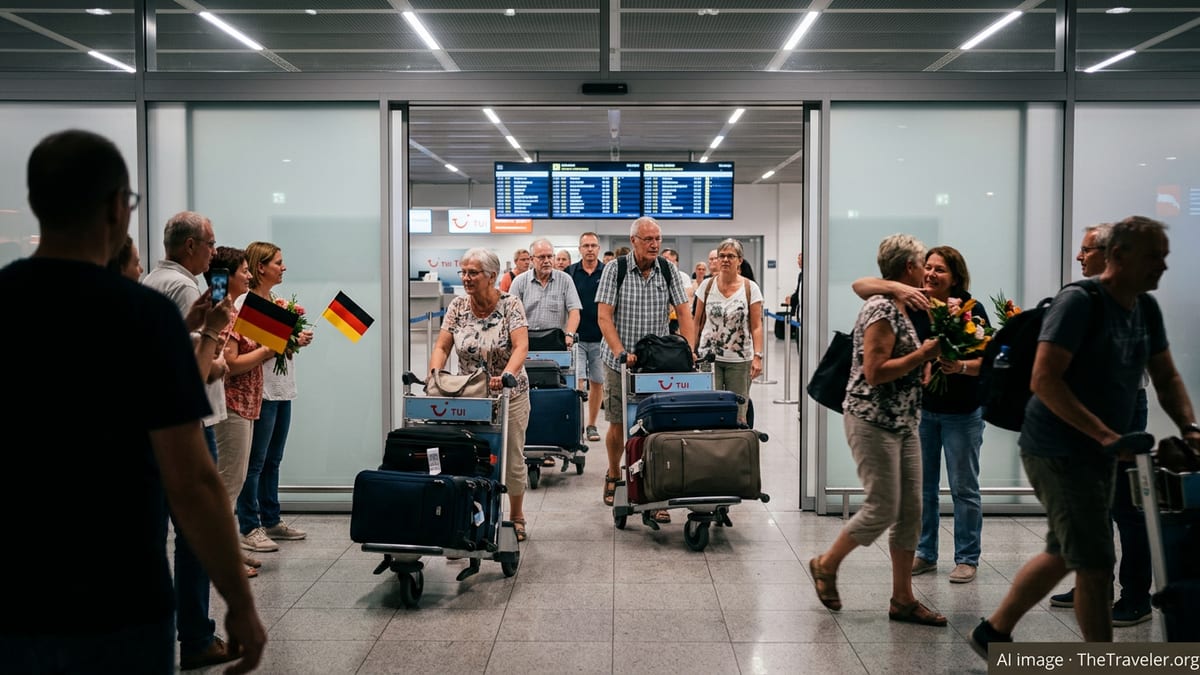
Late-Night Arrivals Mark Key Step in Massive Repatriation Effort
TUI confirmed that a special flight from the Maldives landed in Frankfurt and two additional aircraft operated from Al Ain in the United Arab Emirates via Heraklion to Hanover, together bringing over 550 package holidaymakers back to Germany overnight between March 7 and 8. The operation unfolded as part of a wider emergency airlift launched after sudden airspace closures and security concerns forced widespread cancellations across the Gulf region.
At Hanover-Langenhagen Airport in Lower Saxony, friends and relatives gathered late into the evening to greet returning passengers arriving from Dubai and Al Ain. Images from the terminal showed weary but visibly relieved tourists walking through the arrivals hall, many describing days of uncertainty as routes were repeatedly delayed or rerouted while operators awaited flight approvals.
For TUI, the coordinated arrivals represented both logistical success and an important signal to thousands of other stranded travelers still waiting for confirmed seats back to Europe. The company has been under pressure to deliver on its pledge to prioritize repatriation for customers stuck in destinations affected by the latest escalation in the Middle East.
From Cruise Disruptions to Global Flight Chaos
The repatriation flights from the UAE and Maldives are part of a much broader emergency response triggered by regional tensions and missile activity that disrupted key air corridors over the Gulf in late February and early March. Germany-based TUI was among the hardest-hit European travel brands in the region, with Arabian Gulf cruises and package tours abruptly halted as governments updated travel warnings and airlines scrambled to re-route or suspend services.
Several TUI Cruises itineraries on the Mein Schiff fleet operating out of Abu Dhabi and Doha were cancelled or significantly altered in recent days, leaving thousands of passengers awaiting onward arrangements. While many were able to disembark safely, the closure of airspace and reduction in scheduled flights from hubs such as Dubai, Abu Dhabi and Doha complicated efforts to move customers out quickly.
Against this backdrop, TUI management has emphasized that the company’s immediate priorities are safety and repatriation rather than regular holiday operations. The more than 550 passengers flown home from the Maldives and UAE over the weekend represent only a fraction of the roughly ten thousand TUI customers estimated to have been affected across the broader Middle East region.
Complex Operations Involving Multiple Carriers and Airports
The latest flights underline the complexity of organizing large-scale repatriations when commercial schedules are in flux. TUI has been working with its own airline units and with partner carriers including major Gulf airlines to build ad hoc connections back to Germany and other European home markets as authorities reopen individual routes.
For the return from the Maldives, TUI chartered a dedicated aircraft into Frankfurt, Germany’s busiest hub, to consolidate tourists from multiple island resorts who had seen their original itineraries disrupted. In the UAE, the group deployed two of its TUI Airline aircraft to Al Ain, a secondary airport east of Abu Dhabi, routing them via the Greek island of Crete on the way back to Hanover.
Industry analysts note that such operations require rapid coordination between tour operators, airlines, airport authorities and national regulators. Each new security advisory or temporary airspace closure can force flight plans to be rewritten with little notice, and operators must balance aircraft availability with new crew duty limits and ground-handling capacity at alternative airports.
Relief for Travelers, but Uncertainty Persists for Many
For the travelers on board these initial TUI flights, arrival in Germany brought long-awaited relief after days of watching departure boards change and messages from tour representatives evolve in real time. Many had extended stays in hotels or on ships as operators waited for the green light to move people out of affected destinations.
Yet while the return of more than 550 tourists is a positive development, thousands of holidaymakers across the region are still waiting for clarity on their journeys home. TUI has stated that additional special flights are planned over the coming days, with the pace of operations heavily dependent on the evolving security situation and the reopening of key transit corridors.
Travel experts say that further waves of repatriation are likely, especially from cruise ports and resort hubs in the Gulf and Indian Ocean where European passengers remain in limbo. They also warn that the knock-on effects on spring travel demand for the broader Middle East could be significant, even if core summer programs in more distant Mediterranean destinations stay largely unchanged.
What This Means for Future Travel to the Region
The successful return of several hundred tourists from the UAE and Maldives will be closely watched by travelers with upcoming itineraries, as well as by other tour operators still finalizing their own evacuation and rerouting plans. While TUI has stressed that it is treating this as an exceptional crisis response, the situation highlights how quickly popular winter-sun destinations can be affected by geopolitical shocks far beyond the immediate tourist zones.
German and European travel advisors are now fielding questions from clients about the resilience of itineraries that rely on Gulf hubs for long-haul connections to Asia, Africa and the Indian Ocean. Many expect that operators will diversify routings where possible and refine contingency planning, ensuring that evacuation and repatriation protocols can be activated faster if similar disruptions occur.
For now, TUI’s latest flights from the Maldives and Al Ain stand as a tangible sign that large-scale repatriation from the wider region is underway. As more aircraft secure clearances to depart and land, thousands of remaining tourists will be hoping that their own journeys home follow as swiftly and smoothly as those of the first 550.