

More news on this day
Thousands of travelers were stranded at Kuwait International Airport on Sunday as sweeping airspace closures following US-Israel strikes on Iran triggered the cancellation of more than 92 flights and left major regional carriers scrambling to reroute or suspend operations.
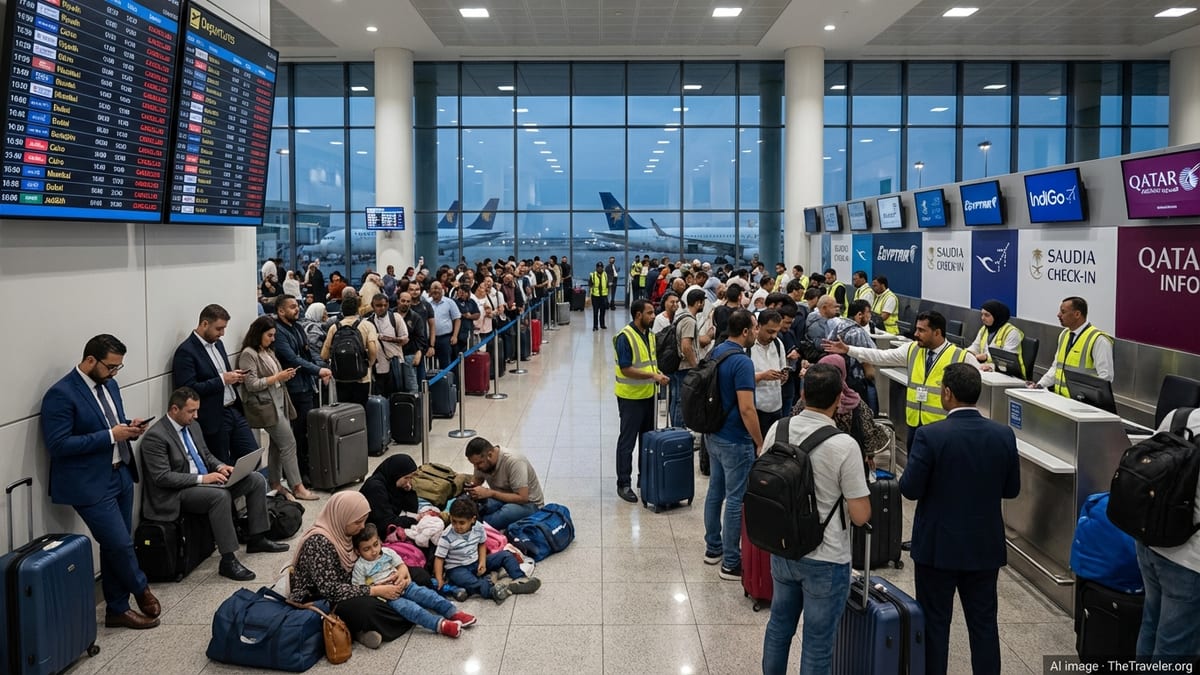
Airspace Closures Push Kuwait Hub to a Standstill
Kuwait International Airport, a vital link between Europe, Asia and the Indian subcontinent, saw operations grind to a halt as authorities shut the country’s airspace amid escalating regional hostilities. Kuwait joined Iran, Iraq, Israel, Bahrain, Qatar and the United Arab Emirates in imposing sudden airspace closures after a wave of strikes on Iran, forcing airlines to divert, delay or abandon services across the Gulf.
According to regional aviation data, cancellations and suspensions quickly cascaded through Kuwait’s schedules, with more than 92 inbound and outbound services scrubbed in less than 24 hours. Flight-tracking maps showed near-empty skies across Kuwait and neighboring states, as traffic shifted toward secondary corridors over Saudi Arabia, Egypt and Cyprus or was cancelled outright.
Inside the terminal, departure boards flashed red as long-haul flights to Europe, South Asia and the wider Middle East were taken off the schedule. Ground staff attempted to manage growing queues at airline desks, while airport authorities urged passengers not to travel to the airport unless they had received direct confirmation that their flights would operate.
The disruption at Kuwait International came on top of widespread shutdowns at other regional hubs including Dubai, Abu Dhabi, Doha and Manama, amplifying a chain reaction that has affected global connectivity between Europe and Asia for a second day.
Saudia, Egyptair, IndiGo and Qatar Airways Under Pressure
The rapid closure of multiple Gulf airspaces has placed particular strain on airlines that rely on Kuwait as a key origin, destination or stopover point. Saudia, Egyptair, IndiGo and Qatar Airways were among the carriers forced to cancel or suspend Kuwait services, as security restrictions and the risk profile over regional skies changed hourly.
Saudi flag carrier Saudia reportedly cancelled a string of flights linking Kuwait with Riyadh, Jeddah and other Saudi gateways, complicating onward connections for religious travelers and business passengers alike. Egyptair suspended Kuwait flights from Cairo as part of a broader halt to routes across Kuwait, the UAE, Qatar, Bahrain and other conflict-adjacent markets, citing rapidly evolving security concerns.
India’s IndiGo, one of the largest operators between the Indian subcontinent and the Gulf, also moved to curtail its Kuwait schedules, cancelling multiple services alongside wider cuts to flights serving Doha, Dubai, Abu Dhabi, Muscat and Bahrain. The reductions followed guidance from Indian aviation authorities to prepare for diversions and possible route suspensions across the Middle East.
Qatar Airways, already contending with the closure of its own airspace and the partial shutdown of Doha’s Hamad International Airport, halted Kuwait links as part of a sweeping suspension of regional services. The combination of cancellations by these four carriers alone left thousands of passengers without immediate alternatives for travel to and from Kuwait.
Kuwait Airways and Jazeera Join Regional Grounding
Home carriers Kuwait Airways and Jazeera Airways added to the disruption as they scaled back or suspended operations in response to the airspace closure. Kuwait’s civil aviation authority ordered all flights to Iran halted until further notice and signaled that broader restrictions would remain in place while security assessments continued.
Industry trackers reported that Kuwait Airways cancelled the majority of its scheduled departures over the weekend, including flights to major Gulf capitals, South Asian cities and European destinations. Jazeera Airways, which relies heavily on regional point-to-point traffic, was also forced to shelve most of its operations, stranding passengers who had used Kuwait as a low-cost connection between Asia, the Middle East and Europe.
The cancellations coincided with reports of a drone strike near Kuwait International Airport, which caused minor damage to terminal infrastructure and injured several airport employees. Emergency protocols were activated, with authorities inspecting runways, aprons and fuel facilities before allowing limited ground movements for repositioning or diversion flights.
While no large-scale structural damage to the airport was reported, the incident underscored the heightened risk facing civil aviation in the region and reinforced regulators’ decisions to keep airspace closed until military tensions ease.
Passengers Face Uncertainty, Limited Alternatives
Inside Kuwait International Airport, scenes were echoed across the region: travelers sleeping on terminal floors, families crowding around airline counters and business passengers frantically rebooking via call centers and smartphone apps. Some airlines asked travelers to abandon checked baggage temporarily as they were shepherded into secure holding areas and, in some cases, bomb shelters during active alerts.
With air corridors over Iran, Iraq, Kuwait and multiple Gulf states closed, rerouting options remained limited. A small number of travelers managed to secure seats on flights operating via Saudi Arabia or Egypt, while others looked to overland routes or maritime links to reach safer airports in neighboring countries. Many, however, were told to expect days of delay and to monitor airline updates rather than return repeatedly to the airport.
Major carriers affected by the shutdowns instituted flexible rebooking policies, offering refunds, travel vouchers or complimentary changes once operations resume. Travel insurers reported a sharp increase in calls, as passengers sought clarity on coverage for conflict-related disruptions and extended hotel stays.
For migrant workers and residents traveling on tight budgets, the sudden cancellations created particular hardship. Some had exhausted leave days or faced expiring visas, while others were left with mounting accommodation costs in Kuwait City as they waited for news on when flights might restart.
Wider Middle East Aviation Shockwaves
The disruption in Kuwait is part of a broader aviation shockwave sweeping the Middle East in the wake of the latest strikes on Iran. Across the Gulf, more than 1,500 flights were cancelled in a single day and several thousand more worldwide as airlines avoided or were barred from using critical airspace corridors.
Regional giants including Emirates, Etihad Airways, Qatar Airways and flydubai have temporarily suspended or sharply reduced operations at their hubs, while European and Asian carriers have cancelled flights into key Middle Eastern cities or plotted lengthy detours around conflict zones. Routing constraints are driving up fuel burn, insurance premiums and crew costs, complicating already fragile post-pandemic recovery plans for many airlines.
Industry analysts warn that, if airspace closures persist, the financial impact on Gulf and international carriers could mount quickly. Long-haul networks that rely on seamless transit through hubs like Dubai, Doha and Kuwait may face schedule overhauls, aircraft reassignments and longer journey times that erode competitive advantages over European and Asian rivals.
For now, aviation authorities have signaled that safety considerations will trump commercial pressures. Travelers planning to transit through Kuwait and neighboring hubs in the coming days are being urged to check the status of their flights frequently, remain in close contact with their airlines or travel agents and prepare for last-minute changes as the security situation evolves.