

More news on this day
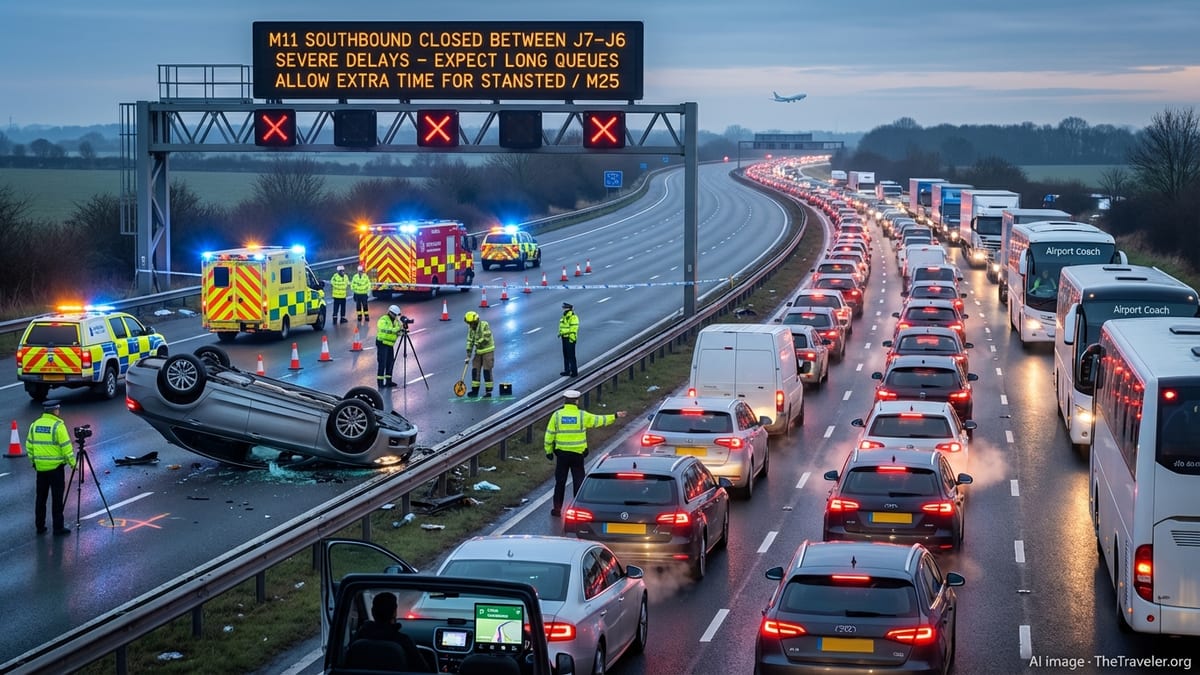
Traffic on the M11 near Stansted Airport was brought to a virtual standstill in the early hours of Wednesday 4 February 2026, after a serious collision left a vehicle overturned on its roof between Junction 7 for Harlow and Junction 6 for the M25 interchange.
The incident triggered hours of disruption on one of the key motorway links between London, Essex and London Stansted Airport, with National Highways warning motorists to expect severe delays well into the morning rush hour.
More News
- TSA Rolls Out $45 ConfirmID Fee for Travelers Without REAL ID at Security
- Flying Blue Launches February 25% Promo Rewards on Transatlantic and Regional Routes
- United Fast-Tracks Starlink Wi‑Fi Across Fleet, Free for MileagePlus Members
Overnight Collision Turns Morning Commute Into Gridlock
The crash occurred at around 12:50 a.m. on the southbound carriageway of the M11, on a stretch that carries heavy volumes of traffic heading toward the capital and connecting with the M25 orbital. According to National Highways and local media reports, a car overturned and came to rest on its roof on the verge adjacent to the carriageway, prompting the immediate closure of all southbound lanes as emergency services moved in to secure the scene and begin an investigation.
What began as a nighttime emergency soon cascaded into a peak hour nightmare. By dawn, long queues had built up in both directions as trapped traffic was carefully released and diversion routes struggled to cope with the volume of displaced vehicles. Traffic cameras showed extensive tailbacks stretching for miles, with some motorists reporting stop start conditions for prolonged periods as they attempted to skirt the closure or await instructions from traffic officers.
National Highways described the disruption as severe and said the closure would remain in place for several hours while collision investigators from Essex Police worked at the scene. With no confirmed reopening time, motorists heading southbound toward London faced significant uncertainty at the start of the working day.
Key Route To London Stansted Airport Severely Affected
The location of the crash on the M11 amplified its impact beyond the usual weekday commuter traffic. The motorway is a principal artery for passengers and staff accessing London Stansted Airport, one of the United Kingdom’s busiest aviation hubs and a major gateway for low cost carriers and European short haul flights. Even short disruptions on this corridor typically ripple quickly into missed flights, late arrivals and operational headaches for airlines.
On Wednesday morning, drivers heading to Stansted were told to allow considerably more time than usual, with National Highways warning of very long delays and urging travelers to check traffic conditions before setting off. While the collision itself took place between Junction 7 and Junction 6, heavy congestion built up across a wider area of the M11 and feeder roads, complicating access from both Essex and north and east London.
Some passengers took to social media to describe abandoning their original routes and striking out along local roads through Harlow and surrounding communities in an effort to reach the airport. Others reported high stress journeys with satnav systems repeatedly recalculating as closures and rolling queues shifted in real time. For many early morning flights, particularly those departing before sunrise, the timing of the incident meant there was little margin for delay.
Emergency Services and Highway Teams Lead Complex Response
Emergency responders arrived swiftly after the first calls were received shortly before 1 a.m. Essex Police, ambulance crews, fire and rescue teams and National Highways traffic officers all attended the scene, working in concert to manage both the immediate safety risks and the developing traffic crisis. With a car overturned and resting on its roof off the carriageway, officers established a wide safety perimeter and halted all southbound traffic, while assessing any potential spillages, debris or structural damage near the road surface.
Collision investigators from Essex Police then began detailed work to reconstruct the circumstances of the crash. That process, which can involve on site measurements, forensic imaging and witness interviews, typically requires lanes to remain closed for several hours to preserve evidence and allow investigators to work without interference from moving traffic. National Highways confirmed that the southbound carriageway would not reopen until police had completed their work and recovery contractors had safely removed the vehicle.
Throughout the morning, traffic officers focused on releasing vehicles caught within the closure. This is often a painstaking operation, carried out under tight safety controls, as cars and lorries are turned around or escorted out of the affected zone. In parallel, National Highways’ control centres coordinated diversion routes and issued continuous updates to broadcasters and digital journey planning services, urging drivers to avoid the area if at all possible.
Drivers Warned Of Long Delays And Urged To Reroute
As morning approached and traffic volumes began to build, authorities sharpened their messaging. Motorists planning to use the M11 toward London or the M25 were advised to seek alternative routes, including the A414 through Harlow and connections via local A roads linking into the orbital motorway at other junctions. Those who had no choice but to travel via the affected corridor were told to expect delays far in excess of normal peak conditions.
National Highways reported queues of several miles forming on the southbound side, with upstream congestion also spilling onto connecting routes. Given that the M11 is frequently used by freight hauliers and coach services as well as private motorists, the cumulative effect was to slow journey times across a broad swathe of the regional road network. Local roads near Harlow, Epping and other communities along the corridor also experienced heavier than usual flows as drivers attempted to circumvent the motorway closure.
By mid morning, some lanes elsewhere on the M11 had reopened, but residual delays were still reported along both directions, with journey times remaining significantly extended. Authorities reiterated that, while the overturned vehicle had come to rest off the carriageway, the need for a thorough police investigation and careful recovery operation meant there could be no shortcut to a full reopening, even under pressure from mounting commuter frustration.
Recurring Safety Concerns On A Busy Motorway Corridor
Wednesday’s crash adds to a pattern of recent serious incidents on the M11 in Essex, particularly on stretches serving Stansted Airport and the approaches to the M25. In recent months and years, drivers have repeatedly faced long queues and diversions following multi vehicle collisions, overturned heavy goods vehicles and lane closures triggered by serious injuries and police investigations.
Road safety campaigners and motoring organisations have long flagged the vulnerability of tightly trafficked motorway corridors that mix local commuter traffic, heavy goods vehicles and airport bound travelers, especially during overnight and early morning hours. Fatigue, speed and lane discipline are persistent concerns, while changing weather conditions and roadworks can compound the risks. Each new incident prompts fresh calls for stricter enforcement, better driver education and more resilient traffic management plans for key junctions.
While the precise causes of the latest collision remain under investigation, the fact that a vehicle ended up overturned on its roof will likely focus attention on vehicle stability, road surface conditions and driver behaviour at the time of the crash. Essex Police are expected to release further details once their inquiries progress, including confirmation of any injuries and whether other vehicles were directly involved.
Impact On Local Communities And Regional Economy
Beyond the immediate inconvenience for individual drivers and air passengers, major disruptions on the M11 have a broader knock on effect for communities and businesses across Essex and the wider East of England. Towns such as Harlow, Bishop’s Stortford and smaller villages along diversion corridors experience surges in through traffic during motorway closures, with residential streets and local high streets feeling the strain of unexpected congestion, noise and air pollution.
For businesses reliant on just in time deliveries, airport logistics and commuter workforces, prolonged closures can mean missed connections, delayed consignments and lost working hours. Stansted Airport’s role as a key employer and economic driver in the region means any constraint on reliable surface access reverberates through supply chains and service industries ranging from catering to maintenance and security.
Local councils and transport planners have been urged in the past to work closely with National Highways and the airport operator to strengthen contingency plans for serious incidents, ensuring diversion routes are clearly signed, public information is timely and consistent, and vulnerable communities are protected from acute traffic surges where possible. Wednesday’s events are likely to renew debate about how resilient the current arrangements truly are when a single collision can lock up a critical motorway for hours.
Travel Advice For Motorists And Air Passengers
In the wake of the crash, transport authorities issued a series of practical recommendations for those traveling in and around the affected corridor. Motorists were advised to check live traffic information before departure, consider delaying non essential journeys, and follow official diversion symbols rather than relying solely on satellite navigation systems, which can funnel large numbers of drivers onto narrow local roads not designed for heavy volumes.
Air passengers heading to Stansted were urged to allow significantly longer journey times and, where possible, explore alternative rail and coach options that bypass the closed section of motorway. With airlines generally maintaining strict check in and boarding deadlines, even minor further delays on key approaches could make the difference between making or missing a flight. Some carriers have in the past offered limited flexibility for passengers affected by major road closures, though such measures are typically handled on a case by case basis.
Authorities also reminded drivers of the importance of leaving space for emergency vehicles and adhering to instructions from traffic officers at the scene. Attempts by some motorists to make unsafe U turns, drive along hard shoulders or force their way through closures can put lives at risk and further slow the recovery effort. Patience, they stressed, is vital when a serious collision transforms a routine journey into an extended ordeal.
FAQ
Q1: Where exactly did the M11 incident happen?
The collision occurred on the southbound M11 between Junction 7 for Harlow and Junction 6 for the M25 interchange, on a stretch of motorway used heavily by traffic heading toward London and London Stansted Airport.
Q2: What time did the vehicle overturn on the M11?
The crash was reported shortly before 1 a.m., at around 12:50 a.m. on Wednesday 4 February 2026, triggering the immediate closure of all southbound lanes in the affected area.
Q3: What type of vehicle overturned near Stansted Airport?
Early reports indicate that a car overturned and came to rest on its roof on the verge adjacent to the southbound carriageway, prompting a major emergency response and the full closure of that side of the motorway.
Q4: How badly is traffic affected on the M11?
Drivers have faced severe delays, with several miles of queues reported on the southbound carriageway and knock on congestion on connecting roads and diversion routes as trapped vehicles are released and new traffic is routed away from the closure.
Q5: Is access to London Stansted Airport still possible?
Yes, access remains possible but journeys may take considerably longer than usual. Authorities are urging passengers to allow extra time, use alternative routes where available and check live travel updates before setting off for the airport.
Q6: Are there reports of injuries from the overturned vehicle?
At the time of writing, full details of any injuries have not been formally released. Collision investigators from Essex Police are still working at the scene, and further information is expected once their enquiries progress.
Q7: How long are the M11 lanes expected to remain closed?
National Highways has warned that the southbound closure is likely to remain in place for several hours while police complete their investigation and recovery teams remove the overturned vehicle. No precise reopening time has been confirmed.
Q8: What should drivers do if they are already on the M11 near the closure?
Motorists caught within the affected section are being assisted by National Highways traffic officers, who are gradually releasing vehicles when it is safe to do so. Drivers are urged to follow instructions on scene and avoid taking unilateral action such as turning in live lanes.
Q9: Which alternative routes are being recommended to avoid the M11 closure?
Drivers are being directed to use signed diversion routes, including stretches of the A414 through Harlow and other local A roads linking back to the M25 and wider network. Authorities stress that motorists should follow official diversion symbols rather than cutting through unsuitable minor roads.
Q10: How can air passengers minimise disruption to their travel plans?
Passengers with flights from Stansted are advised to leave much earlier than usual, consider rail or coach options where practical, keep in close contact with their airline for any updates, and monitor real time traffic information so they can adjust their route if conditions worsen.