

More news on this day
As Pakistan heads into another season of Eid homecomings, Pakistan Railways is rapidly reshaping how millions travel for the holidays, adding special trains, fare relief and new operational measures to turn once-frantic journeys into more predictable festive migrations.
Get the latest news straight to your inbox!
Scaling up special trains for Eid homecomings
Recent schedules and public announcements show Pakistan Railways steadily increasing the number of special trains around Eid, particularly on the country’s busiest corridors. For Eid ul Fitr 2025, the railway introduced multiple special departures from Karachi to Lahore and other major cities, timed to begin in the last week of Ramadan and continue through the first days after the holiday, targeting the peak demand window when migrant workers and students rush to their hometowns.
For Eid ul Azha 2025, the network moved further, unveiling five dedicated special trains to handle surging crowds between June 2 and June 4, primarily along the Karachi to Lahore and Karachi to Rawalpindi axes. These services were structured to provide both daytime and overnight options, giving travelers more flexibility to coordinate arrivals with family gatherings and livestock markets in the run-up to the festival.
Railway notices indicate that these specials are being layered on top of already busy regular expresses such as the Shalimar Express and Shah Hussain Express on the Karachi to Lahore route. The objective is to spread demand across additional departures rather than concentrating it on a handful of overnight trains, a pattern that historically led to intense crowding, lengthy wait lists and packed station concourses in Karachi, Lahore and Rawalpindi.
By publicly signaling extra capacity weeks before Eid, the operator is nudging passengers to plan ahead, reduce last-minute scrambles for seats and use rail rather than higher-cost road options. This approach is gradually turning the festive travel surge into a more managed, scheduled operation instead of the once-chaotic rush that defined earlier decades.
Fare relief and incentives to keep rail affordable
Parallel to the expansion of special trains, Pakistan Railways has increasingly used targeted fare relief to keep long-distance rail competitive during the most expensive travel period of the year. On Eid ul Fitr 2025, a nationwide 20 percent discount was announced for all mail, express, passenger and intercity trains across all classes on the first three days of Eid, effectively cutting prices on everything from basic economy seats to air-conditioned berths.
Reports indicate that this fare reduction was applied on regular scheduled services rather than on the separately priced Eid specials, which often sell at a premium during peak dates. The policy created a two-tier festive offering: regular trains made more affordable for early planners willing to travel slightly off-peak, and special trains providing additional capacity for those constrained to depart closer to Eid day.
Local business coverage notes that the discount strategy was framed as a way to ease pressure on household budgets already strained by inflation and rising transport costs. For families traveling in groups of five or more, the 20 percent cut on long intercity journeys such as Karachi to Lahore or Lahore to Quetta translated into substantial savings, reinforcing rail’s position as the most cost-effective long-haul mode for many low and middle-income travelers.
These incentives also have a network effect. By drawing price-sensitive travelers into earlier or slightly off-peak departures, discounted tickets help smooth passenger loads across the week, reducing extreme crowding on the final pre-Eid days. Over time, this kind of yield management, still relatively new in Pakistan’s public rail sector, is likely to influence booking behavior and relieve some of the operational pressure at major junctions.
Managing crowds, safety and resilience amid rising demand
While the festive travel push has brought fresh energy to Pakistan Railways, it is unfolding against a backdrop of security challenges, infrastructure strain and recent accidents. The network has faced a series of derailments and disruptions since 2024, including freight and passenger incidents that have periodically blocked key corridors and triggered delays for thousands of travelers.
In response, publicly available information shows the operator combining short-term crowd management tools with longer-term resilience efforts. Ahead of major holidays, stations in cities such as Karachi, Lahore and Rawalpindi introduce temporary crowd control barriers, additional ticket checking and more visible security patrols on platforms and concourses, particularly during evening departures of Eid specials.
At the same time, there is a parallel emphasis on repairing and upgrading vulnerable stretches of track to keep the system running through the festive surge. Work to restore routes affected by attacks or blasts, including lines used by major expresses such as the Jaffar Express, has been prioritized to ensure that key intercity links remain open during Eid periods, when any single blockage can cascade into nationwide delays.
This combination of operational vigilance and infrastructure repair is gradually shifting the narrative from one of recurrent breakdowns to one of cautious reliability. For travelers planning their annual reunion journeys, the knowledge that corridors are being reinforced and monitored more closely can be as important as the addition of extra trains.
Digitalisation and passenger information for smoother journeys
Beyond physical capacity and fares, Pakistan Railways is also leaning into digital tools to make the festive travel experience more predictable. Media reports over the past year highlight efforts to modernise reservation systems, expand online ticketing and improve digital communication around special trains and disruptions.
The digitalisation drive includes upgrading back-end ticketing infrastructure and expanding the use of mobile and web-based booking portals. For Eid, these platforms are especially significant, as they allow passengers to search for special trains, compare timings with regular services and secure seats without joining long queues at station counters, a perennial complaint during Ramadan evenings.
There is also increased use of social and broadcast media channels to circulate special train schedules, fare discount announcements and last-minute updates. This more proactive information environment reduces reliance on informal word-of-mouth networks, in which news of extra trains or new discounts often arrived too late for many would-be travelers.
Over time, these digital tools are expected to support more sophisticated capacity planning. As online booking data reveals patterns in when and where passengers choose to travel for Eid, planners can calibrate future specials, adjust coach compositions and refine departure times, pushing the system closer to the data-driven operations common in larger regional railways.
Reimagining festive rail as a shared national ritual
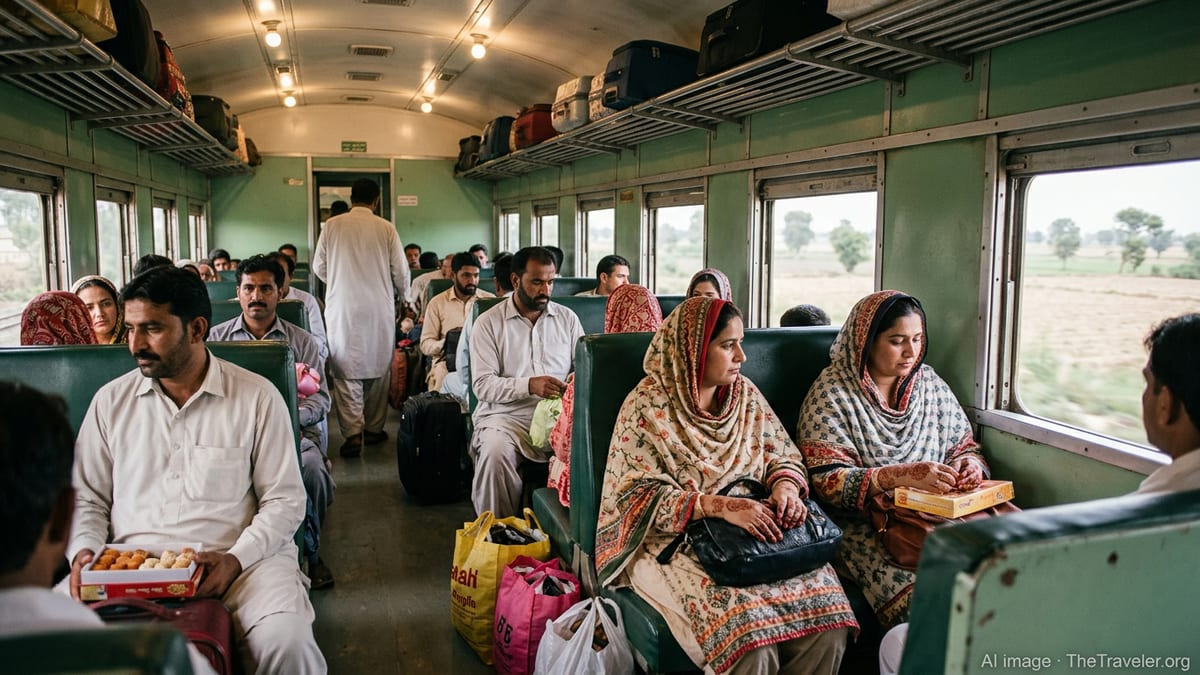
Taken together, the expansion of Eid specials, fare relief, safety measures and digital upgrades is gradually transforming Pakistan’s festive rail journeys from a test of endurance into something closer to a shared national ritual. Crowded platforms, late-night chai stalls and families boarding Karachi-bound or Lahore-bound trains with suitcases and sweet boxes remain familiar scenes, but they are increasingly framed by clearer schedules and more predictable service.
The move to strengthen rail’s festive role also has broader economic and social implications. By keeping long-distance travel relatively affordable and reliable at Eid, the network supports seasonal spending in secondary cities and rural districts, as urban workers return home with savings and gifts. Local markets and small businesses in towns along major corridors often see some of their busiest days of the year aligned with these holiday arrivals.
For many passengers, the journey itself is part of the celebration. Overnight rides on special trains, shared cabins filled with children and elders, and glimpses of the Indus plains or Punjab fields at sunrise create memories that are hard to replicate on short-haul flights or solitary highway bus trips. In this sense, Pakistan Railways is not only moving people; it is curating an experience that binds distant cities and scattered families into a single festive timeline.
As new projects such as major corridor upgrades and high-speed proposals gradually unfold, the seasonal performance of the existing network during Eid will remain a key test of progress. Each year’s special trains, discounts and service adjustments offer a glimpse of how a modernised Pakistan Railways might eventually carry the country’s festive migrations faster, safer and with a little more comfort, while preserving the sense of reunion that has always defined travel during these holidays.