

More news on this day
Paleokastritsa Beach on the Greek island of Corfu has earned a place among the top 15 beaches in the world in a newly published international ranking, drawing fresh attention to the Ionian coastline as global demand for Mediterranean travel continues to rise.
Get the latest news straight to your inbox!
Global Ranking Puts Corfu in the Beach Tourism Spotlight
According to recent travel coverage that compiles traveler ratings, expert assessments and social media engagement, Paleokastritsa Beach features in a select group of the top 15 beaches worldwide. The recognition places the Corfu favorite alongside long-established global icons in the Caribbean, Indian Ocean and Pacific, underscoring how competitive Greece has become in the premium sun-and-sea segment.
Published reports indicate that the latest list draws on a combination of user reviews on major travel platforms, editorial curation from travel publishers and visibility across image-led social networks. In this context, the inclusion of Paleokastritsa suggests strong performance not only in traditional measures such as water quality and scenery, but also in digital-era metrics like shareability and online sentiment.
The accolade comes at a time when rankings of the world’s best beaches are receiving wide circulation ahead of the 2026 summer season. Travel media summaries note that Mediterranean destinations feature prominently, with Greece, Spain, Portugal and Italy all represented, yet only a small handful achieve a top 15 placing at global level.
Corfu’s presence in such a short list is seen in regional tourism analysis as a boost for the wider Ionian island group, which has been steadily attracting more long-haul visitors who previously focused on Aegean hotspots like Mykonos and Santorini.
What Makes Paleokastritsa Stand Out
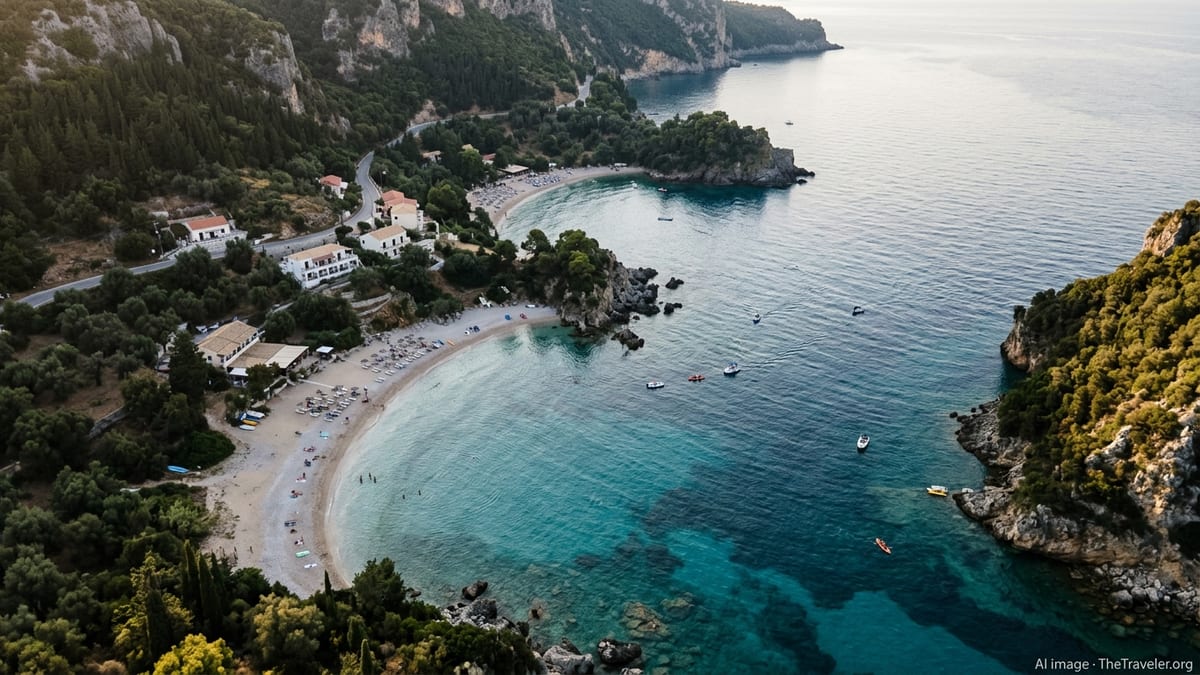
Paleokastritsa is known for a dramatic combination of steep green cliffs, sheltered coves and deep-blue waters that quickly turn turquoise in the shallows. The beach area actually comprises a cluster of small bays, with the main organized strand of Agios Spyridon backed by modest development and several smaller pebbly coves accessible on foot or by boat.
Publicly available descriptions from travel guides describe the water here as notably clear, with visibility that appeals to swimmers and snorkelers. The seabed drops away relatively quickly in parts of the bay, producing a layered palette of blues that has made the coastline a staple of social media posts showcasing Corfu’s natural scenery.
In addition to its visual appeal, the bay is protected from open-sea swells by surrounding headlands, creating relatively calm conditions during typical summer weather. This sheltered setting supports a mix of activities, from families paddling close to shore to visitors hiring small motorboats to explore nearby sea caves and hidden coves.
Above the shoreline, olive groves and pine-covered slopes lead up to viewpoints and the historic monastery of Theotokos, giving the area a vertical dimension that differs from flatter resort beaches. Travel writers often highlight the combination of coastal and hillside scenery as a distinguishing feature in comparisons with other Greek destinations.
Ionian Islands Consolidate Their Global Beach Reputation
The latest recognition for Paleokastritsa comes as the Ionian Islands more broadly attract attention in international beach rankings. Recent travel roundups of top global beaches have noted a concentration of highly rated shorelines across Corfu, Kefalonia and Zakynthos, often citing a blend of dramatic limestone cliffs, lush vegetation and sheltered bays.
According to summaries of global beach awards published in late 2025 and early 2026, multiple Greek beaches in the Ionian Sea have appeared within the upper tiers of world lists, including several within the top 50. Commentators in Greek tourism media have pointed to this clustering as evidence that the Ionian coastline is now competing directly with leading long-haul destinations for scenery-focused travelers.
Corfu, in particular, has benefited from increased air connectivity and the extension of its tourism season, supported by growing interest in walking, cycling and cultural touring outside peak summer months. The prominence of Paleokastritsa in influential beach rankings is expected by local travel businesses, according to trade press reports, to further support marketing efforts that frame the island as a premium yet accessible destination.
Industry analysis notes that global lists can have an outsized effect on first-time visitor choices, especially for travelers from markets such as North America, where a single image of a ranked beach often shapes perceptions of an entire island or country.
Visitor Experience and Access on Corfu’s Western Coast
Paleokastritsa sits on Corfu’s west coast, around 25 kilometers from Corfu Town and its international airport. Public information indicates that the area is accessible by road in roughly 30 to 40 minutes under typical traffic conditions, with scheduled bus services supplementing private transfers and rental cars during the main season.
The main beach is an organized stretch offering sunbeds, umbrellas and watersports rentals in summer, alongside tavernas and small hotels clustered along the coastal road. Additional coves nearby provide a quieter experience but can involve walking on inclines or taking small boats, a factor that travel forums often mention for visitors with mobility considerations.
Reports from recent seasons describe peak-day congestion around parking areas in high summer, reflecting the bay’s growing popularity. Many travel advisories recommend early arrivals or combining a beach visit with time spent in nearby hilltop viewpoints to spread visitor flows across the day.
Despite these pressures, feedback in traveler reviews frequently highlights the preservation of the surrounding natural landscape. Construction along the immediate waterfront remains relatively low-rise compared with some Mediterranean resorts, and the steep terrain has limited large-scale development along parts of the coastline.
Recognition Fuels Expectations Ahead of the 2026 Season
The latest top 15 ranking for Paleokastritsa is expected, according to tourism trend analysis, to translate into heightened international interest ahead of the 2026 summer period. Tour operators and online travel agencies routinely feature beaches that appear in global lists in brochures and search filters, which can quickly raise awareness among travelers planning trips months in advance.
Greek tourism data for recent years show steady growth in arrivals to the Ionian Islands, and industry commentary suggests that symbolic honors, such as inclusion among the world’s best beaches, can reinforce this trajectory. Destinations that achieve repeated mentions across multiple rankings often see a medium-term shift toward higher-spending segments seeking scenic, experiential travel.
For Paleokastritsa, the challenge highlighted in local planning discussions is to manage increased visitor numbers while protecting the very qualities that earned the beach international recognition. That includes maintaining water quality, managing boat traffic in the coves and balancing demand for new accommodation with landscape conservation.
As global travelers look ahead to the next warm-weather season, Paleokastritsa’s name is now appearing more frequently in beach roundups and travel inspiration features, positioning Corfu firmly on the map for those seeking dramatic Mediterranean coastal scenery within relatively easy reach of major European hubs.