

Paleokastritsa, Glyfada and Sidari sit on very different corners of Corfu, yet all three rank among the island’s most sought after coastal bases. Each offers a distinct mix of scenery, beaches and atmosphere, from Paleokastritsa’s dramatic coves to Glyfada’s broad sweep of sand and Sidari’s extroverted resort vibe around the famous Canal d’Amour. Choosing between them can shape your entire Corfu experience.
Setting the Scene: Where Each Resort Sits on Corfu
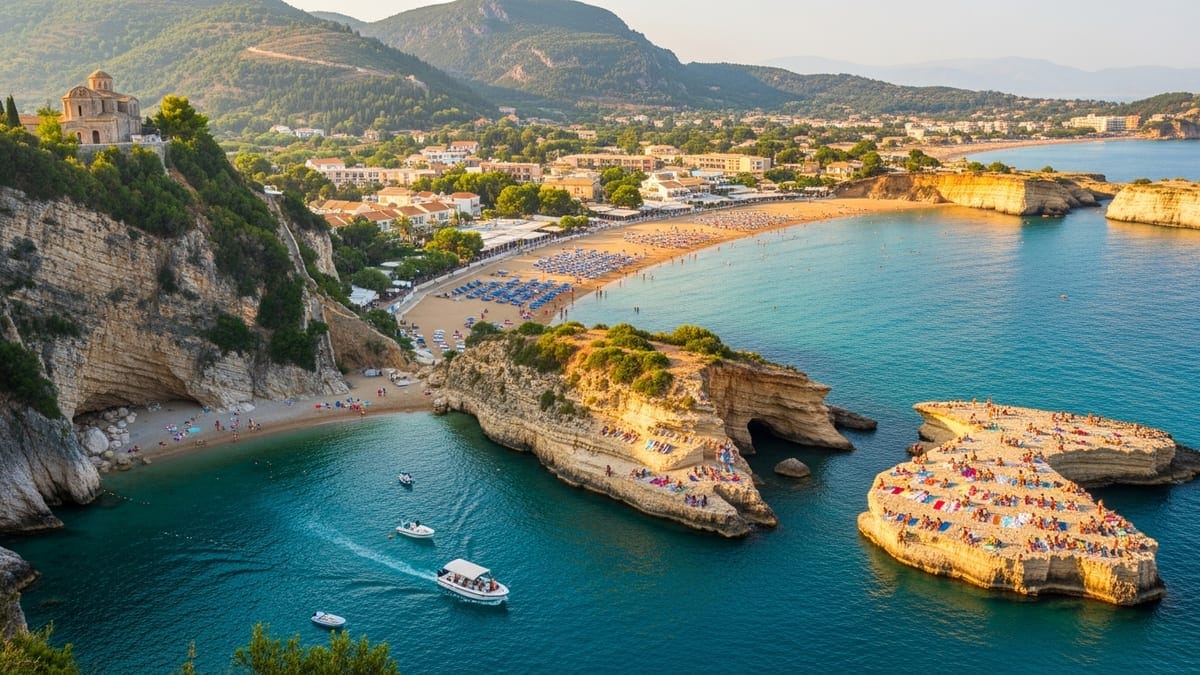
Paleokastritsa lies on Corfu’s rugged northwest coast, roughly 23 kilometers from Corfu Town. The area is spread across several bays framed by steep green hills and limestone cliffs, with Monastery Hill rising above the main harbor. The feel here is dramatic and vertical: roads and paths coil up and down between headlands, viewpoints and beaches. The result is one of Corfu’s most photographed panoramas, but also an area that feels more fragmented and less like a single compact village.
Glyfada sits further south on the west coast, about 16 kilometers from Corfu Town. It is essentially a single, deep bay that opens to the Ionian Sea, edged by soft sand and backed by steep, pine clad hills. Unlike Paleokastritsa’s cluster of coves, Glyfada is one long main beach with low rise hotels, tavernas and beach clubs set behind the sand. The resort itself is small, and many visitors also spend time in nearby Pelekas village on the hillside above for extra tavernas, sunset bars and local atmosphere.
Sidari occupies a broad stretch of coastline in the far north of Corfu, around 38 to 40 kilometers from Corfu Town. The resort runs along a flat coastal plain, with long beaches, sandstone headlands and the carved inlets of Canal d’Amour to the west. It feels like a sizeable holiday town, with multiple beach sections, a busy main strip and surrounding clusters of apartments and hotels. The relative flatness makes it easy to walk around, in stark contrast to the stairways and gradients you will encounter in Paleokastritsa.
In pure geography, therefore, Paleokastritsa is the most dramatic and dispersed, Glyfada the most straightforward and beach focused, and Sidari the most expansive resort hub. Those differences underpin almost everything else, from the style of accommodation to how you will spend your evenings.
Beaches and Swimming: Coves vs Big Sand vs Canal d’Amour
Paleokastritsa is built around a series of six main beaches plus numerous tiny coves, all set in deep, fjord like bays. The sand here is generally coarse or mixed sand and shingle, and the water is famously clear but also among the coldest on the island due to underwater springs. Main beaches such as Agios Spyridon and Agia Triada offer sunbeds, boat rentals and tavernas, while small coves can be reached by boat taxi. Swimming is excellent for snorkelers, but the depth drops quickly in places and the pebbly shorelines are less suited to long barefoot walks.
Glyfada offers almost the opposite profile. Here you have a single long arc of fine golden sand, gently shelving into the sea. It is one of Corfu’s classic family beaches, with large sections of organized sunbeds, beach bars pumping music in high season and big patches of free sand if you prefer to bring your own umbrella. The sea is typically calmer and warmer than in the northwest coves, and the consistently sandy bottom draws those who want easy, all day swimming and lounging without needing a boat or car to switch beaches.
Sidari’s main town beach is a long strip of soft, shallow sand that extends westward toward Canal d’Amour. The water here is usually calm and very shallow for quite some distance, ideal for children and nervous swimmers. What sets Sidari apart are the sandstone formations carved by the sea into cliffs, channels and small inlets. The most iconic is Canal d’Amour, a narrow sea channel between ochre cliffs where local legend promises eternal love to couples who swim through together. Around it you will find tiny sandy coves and flat rock shelves used as natural sun decks.
For pure beach quality, Glyfada is hard to beat if you want one large, easily accessible sandy shore. Paleokastritsa excels for cove hopping and underwater visibility, appealing to swimmers who enjoy depth and rock formations. Sidari, meanwhile, delivers a mix of family friendly shallows and a unique landscape at Canal d’Amour that you simply will not find elsewhere on Corfu, though in peak season both the channel and the surrounding coves can be crowded.
Atmosphere and Nightlife: Quiet Drama vs Beach Club Chill vs Resort Buzz
The overall mood in Paleokastritsa tends toward calm and scenic rather than boisterous. The area is spread along a coastal road and up side lanes, so there is no single, dense “strip.” Instead you will find tavernas with sea views, a handful of cocktail bars and hotel lounges, plus boats shuttling in and out of the bays during daylight. In the evening, the resort quiets fairly early compared with Sidari, and much of the entertainment is low key: dinners overlooking the water, sundowners at clifftop viewpoints and strolls along the harbor. It attracts couples, hikers and families who prioritize natural beauty over nightlife.
Glyfada’s character revolves almost entirely around the beach. During the day, large sections of the sand are animated by music from beach clubs, water sports operations and family groups setting up in front of hotel complexes. Yet the resort is compact, and after sunset many visitors either stay within their hotel bars or head up to Pelekas for tavernas and bars with village atmosphere and views over the west coast. Glyfada itself does not have a substantial independent nightlife strip; what it does offer is a relaxed, beach club style scene in daylight and a quieter tone at night than Sidari.
Sidari, by contrast, is one of Corfu’s liveliest northern resorts. The main road behind the beaches functions as a classic holiday strip filled with pubs, karaoke bars, cocktail lounges, live music venues and late opening restaurants. Families will find plenty of casual entertainment options such as mini golf, small water parks tied to hotels and arcades, while groups of friends appreciate the abundance of budget bars and themed nights. Canal d’Amour itself is relatively tranquil by comparison, but still framed by tavernas and cafes. If you crave nightlife and a social, outgoing scene without going to the extremes of Kavos in the south, Sidari is the strongest of the three.
This means your temperament should weigh heavily on your choice. For peaceful sea views and early nights, Paleokastritsa is the most suitable. For daytime beach life with the option to retreat to a quiet hotel or nearby village, Glyfada works well. For long evenings out and a constant buzz, Sidari is the obvious pick.
Getting There and Getting Around: Buses, Roads and Walking
All three resorts are connected to Corfu Town by the island’s Green Bus network, with services concentrated in the main holiday months. Paleokastritsa sits on the A9 bus route and is one of the best served coastal villages, with buses running roughly every half hour during the day in peak season and taking around 45 to 50 minutes from the central KTEL terminal. Fares have remained in the low single digit euro range, keeping the route one of the most budget friendly ways to reach the northwest coast without a car.
Sidari is on the A2 route, also running from the KTEL terminal through northern Corfu’s resorts. The journey time is usually around an hour to an hour and fifteen minutes depending on intermediate stops. Frequency varies by season, with more departures in summer, and fares generally a little higher than to Paleokastritsa due to the longer distance, yet still modest compared with taxi costs. Once in Sidari, the resort is largely flat, and walking between different parts of town or to Canal d’Amour is straightforward.
Glyfada does not have the same level of direct bus coverage as the larger northern resorts, and some visitors instead use buses to Pelekas or nearby villages, then transfer by taxi or on foot for the final stretch down to the beach. Because of this, many Glyfada visitors either rent a car or rely on prebooked transfers from the airport. On the plus side, driving to Glyfada is quite simple, with good road access and a large free parking area directly behind the beach. The drive from Corfu Town usually takes around 25 to 30 minutes in normal traffic.
In all three locations, taxis from Corfu Town or the airport can be arranged in advance or on arrival, with journey times typically around 30 minutes to Glyfada, 45 minutes to Paleokastritsa and close to an hour to Sidari. Travelers planning to explore widely around the island generally find a rental car most convenient, especially in Paleokastritsa where beaches and viewpoints are scattered along a hilly coastline, and in Glyfada where public bus options are more limited.
Accommodation, Budget and Who Each Resort Suits
Paleokastritsa’s accommodation stock is dominated by small to mid sized hotels, apartments and studios, often terraced into the hillside. A few properties sit right on the main beachfront, but many are perched above the bays, trading immediate sand access for sweeping views. Prices in peak months (July and August) tend to run mid range, with some premium for sea view balconies. Self catering studios allow couples or families to keep costs down, though the area is not generally the cheapest on Corfu due to its scenic reputation.
Glyfada has a more resort style mix of hotels, beachfront apartments and holiday complexes tucked into the slopes behind the sand. Many bookings here are part of package holidays, and all inclusive or half board stays are common. While there are some simpler apartment options, the area skews toward mid range travelers and families who appreciate being directly on a large sandy beach. Because the resort is compact, you are likely to be within a short walk of the water regardless of where you stay, but you may pay extra for units with uninterrupted sea views.
Sidari offers the widest price range and the broadest spectrum of accommodation styles among the three. Budget bedsit apartments, small family run hotels, larger resort complexes and adult focused properties are all represented. Canal d’Amour’s immediate surroundings have several romantic minded apartment blocks and small hotels, while the main town strip hosts larger operations geared to families and groups of friends. Overall, Sidari is typically the most budget friendly of the three for dining, drinks and accommodation, simply because competition is intense and visitor numbers high.
In terms of traveler profile, Paleokastritsa is best suited to couples who want scenic tranquility, walkers and those comfortable driving or using boats to access different coves. Glyfada is ideal for classic beach holidays, families with young children who value a large, safe sandy bay and travelers keen on hotel based stays with straightforward access from lounger to sea. Sidari works well for sociable groups, families needing flat terrain and lots of entertainment, and budget conscious travelers who still want a sandy beach plus a choice of bars and restaurants.
Things to See and Do Beyond the Beach
Paleokastritsa’s signature attractions away from the sand are closely tied to its landscape. Boat trips explore the surrounding sea caves, coves and nearby beaches such as Paradise or Rovinia, often with opportunities to swim in deep blue water. The 13th century Theotokos Monastery sits high on a promontory above the main bay, combining religious history with standout views across the coastline. Inland, a short drive brings you to villages like Lakones, perched on the ridge with terraces that look down over the bays and offer some of the best sunset views on Corfu’s west coast.
From Glyfada, the most popular off beach excursion is up to Pelekas village and the Kaiser’s Throne viewpoint on the ridge. From here you can see much of central and western Corfu, and sunset is a particular highlight. Golfers will find Corfu’s main golf course not far inland, while walkers can pick up paths criss crossing the hills and olive groves behind the resort. Because Glyfada itself is compact, exploring nearby villages for tavernas and atmosphere is a natural part of a stay here, especially in the evenings.
Sidari anchors a number of boat excursions along the north coast and out to the Diapontia Islands of Erikousa, Mathraki and Othoni, which lie offshore to the northwest. Canal d’Amour and neighboring coves can be explored independently on foot, but guided boat trips around the sandstone formations offer a different perspective. Back in town, small water parks, mini golf and evening entertainment venues give families plenty to do without needing a car. More culturally minded visitors can detour to small local museums in the wider area or use Sidari as a starting point to visit other northern villages and beaches by rental car or organized excursion.
All three resorts also work as bases for island wide exploration if you hire a vehicle. Paleokastritsa and Glyfada place you closer to central and southern sights when compared with Sidari, but Sidari compensates with easier access to the northern coastal villages and the offshore islands. If you plan to split your time between driving days and relaxed beach days, Paleokastritsa and Glyfada make it slightly easier to reach Corfu Town, Achilleion Palace and the southeast villages in a single day trip.
Which Area Is Better For You?
When travelers ask which of Paleokastritsa, Glyfada or Sidari is “better,” what they usually mean is which one is better aligned with their personal travel style. There is no universal winner. Each area has a clear personality, and matching that to your expectations is more important than comparing star ratings or distance from the airport.
If you are drawn to dramatic scenery, do not mind hills and steps, and like the idea of exploring multiple coves with a boat as often as a bus, Paleokastritsa is the strongest contender. It rewards those who value views and sea color over nightlong bar crawls. The compromise is that beaches are smaller and more pebbly, and getting from one bay to another sometimes involves either steep walking or paid boat services.
If your priority is to step out of your accommodation and onto a broad sandy beach where you can settle for the day, Glyfada is likely to feel “better.” It offers straightforward days of sun, sea and sand with minimal logistics, particularly suitable for families with young children and couples looking for a classic resort setting. The trade off is that evening options are more limited on your doorstep, and you may need to head to neighboring villages if you want variety in dining and atmosphere over a longer stay.
If you want long sandy beaches combined with a bustling strip of bars, cafes and casual entertainment, Sidari fits the brief. It balances family friendly facilities and shallow water with an extroverted nightlife scene, making it versatile for mixed age groups. The north coast location does mean a longer transfer from the airport and potentially more time on buses if you rely on public transport, but budget travelers often find the savings in accommodation and dining outweigh the extra hour on the road.
The Takeaway
Choosing between Paleokastritsa, Glyfada and Sidari comes down less to which resort is objectively “better” and more to which one mirrors the holiday you imagine when you picture Corfu. If that vision is of sheer cliffs, monastery topped headlands and boats slipping in and out of turquoise coves, Paleokastritsa answers it almost perfectly. If it is of a single wide beach where children can run barefoot from room to lounger and back again, Glyfada is hard to beat. If it is of warm evenings on a busy strip, karaoke echoing down the road and shallow seas full of inflatable rings, then Sidari is likely the best match.
All three share core Corfiot ingredients: clear Ionian water, olive clad hills, Greek tavernas and summer sunsets. None is a poor choice. Yet subtle differences in layout, atmosphere, transport and price will strongly influence how your days unfold. Before you book, be honest about how much nightlife you really want, how far you are willing to walk or drive and whether you would rather wake to the call of cicadas on a quiet hillside or the hum of a busy resort street.
For travelers with time, a split stay across two areas can reveal just how varied Corfu can feel within a short drive. For those with a single week, use this comparison as a filter. If tranquility and views come first, favor Paleokastritsa. If sand and simplicity matter most, choose Glyfada. If buzz, budget and easygoing fun are top of the list, Sidari will probably feel like the better Corfu base.
FAQ
Q1. Which area is best for families with young children?
Paleokastritsa, Glyfada and Sidari can all work for families, but Glyfada and Sidari generally suit young children best. Glyfada has a wide, gently sloping sandy beach right in front of most accommodation, making it easy to supervise kids at the water’s edge. Sidari offers very shallow water along much of its main beach and plenty of low key attractions such as small water parks and mini golf. Paleokastritsa’s coves are beautiful but can be pebbly, steeper and deeper, so they tend to work better for confident swimmers.
Q2. Which area has the best nightlife?
Sidari has the most active nightlife of the three, with a long strip of bars, pubs, karaoke venues and late opening restaurants. It appeals to groups of friends and sociable couples who want a lively atmosphere without the intensity associated with Corfu’s southern party resorts. Paleokastritsa and Glyfada are comparatively quiet in the evenings, with a handful of bars and tavernas but little in the way of club style venues or late night entertainment.
Q3. Is a car necessary in Paleokastritsa, Glyfada or Sidari?
You can stay in any of the three without a car, but your experience will differ. In Paleokastritsa, a car or at least regular use of boats makes it easier to reach different coves and high viewpoints, as the area is hilly and spread out. Glyfada is compact and focused on a single beach, so a car is less necessary if you are content to stay local, though it helps for visiting nearby villages and Corfu Town. Sidari is largely flat with many facilities in walking distance, and regular bus connections to Corfu Town, so you can manage comfortably without a vehicle if you are not planning extensive island exploration.
Q4. Which resort is closest to Corfu Town and the airport?
Glyfada is the closest of the three, around 25 to 30 minutes by car from Corfu Town and the airport in typical traffic. Paleokastritsa is slightly farther, at about 45 to 50 minutes by bus or taxi. Sidari is the most distant, usually just under an hour by road depending on the route and stops. If transfer time is a key concern or you plan on making multiple day trips into Corfu Town, Glyfada and Paleokastritsa have a modest advantage.
Q5. Where will I find the most picturesque scenery?
All three areas have scenic elements, but Paleokastritsa is widely regarded as one of the most visually striking spots on Corfu. Its combination of steep green hills, limestone cliffs, monastery topped promontory and multiple deep blue bays creates a dramatic coastal panorama. Canal d’Amour in Sidari offers a unique sandstone landscape that is extremely photogenic on a smaller scale. Glyfada’s appeal lies in its wide open bay and sunsets over the sea rather than intricate rock formations or towering cliffs.
Q6. Which area is better for a romantic getaway?
Paleokastritsa and the Canal d’Amour side of Sidari both lend themselves well to romantic trips but in different ways. Paleokastritsa offers more seclusion, elevated sea view rooms and quiet evenings, ideal for couples seeking rest, scenery and relaxed dinners with a view. Canal d’Amour brings in the folklore of the “channel of love” and has intimate coves framed by sandstone cliffs, while still giving access to Sidari’s broader range of restaurants and bars. Glyfada can also be romantic if you value long walks on a wide sandy beach and sunsets from beachfront hotels.
Q7. How crowded do these resorts get in peak season?
In July and August all three resorts see a significant influx of visitors. Sidari’s main strip and Canal d’Amour coves can feel very busy at peak hours, with limited space on the smallest beaches. Glyfada’s central sections also fill quickly, especially around popular beach bars and hotel frontages, though there is usually room farther along the sand. Paleokastritsa’s main beaches get crowded during the day, and boat trips can be in high demand, but some smaller coves remain quieter, particularly in early morning or late afternoon. Traveling in late May, June, September or early October offers a calmer experience across all three.
Q8. Which area is more budget friendly?
Sidari is generally the most budget friendly of the three, thanks to its wide range of accommodation, numerous competitive tavernas and bars and frequent package deals. Glyfada and Paleokastritsa tend to price slightly higher in peak season, especially for seafront rooms or properties with standout views. That said, careful booking in the shoulder seasons and opting for self catering apartments with occasional meals out can keep costs manageable in any of the three resorts.
Q9. Are there good public transport options between these resorts?
Direct public transport connections between Paleokastritsa, Glyfada and Sidari are limited. The Green Bus network is designed primarily to link resorts with Corfu Town, not with each other. To go from one of these resorts to another by bus, you will typically travel into Corfu Town and change there, which can take several hours. For visitors keen to sample more than one of the three in a single trip, renting a car for at least part of the stay is the most practical approach.
Q10. If I only have three or four days on Corfu, which area should I choose?
With a short stay, it is usually best to pick the resort that most closely matches your priorities rather than trying to sample all three. If you want classic sandy beach relaxation with minimal effort, Glyfada is a strong choice. If unforgettable scenery and cove hopping appeal more, Paleokastritsa will leave a lasting impression. If you are traveling with friends and want both a beach and a lively evening strip, Sidari is likely the better fit. For those unsure, starting in Paleokastritsa for scenery and then planning a day trip to Sidari or Glyfada during a future, longer visit can be a balanced way to experience Corfu over time.