

More news on this day
Panama City Beach is entering spring break 2026 with some of its toughest seasonal rules yet, including expanded alcohol restrictions, tighter curfews for minors, and the power to close crowded beach areas with little warning.
Get the latest news straight to your inbox!
March booze bans return, with stricter enforcement
For visitors planning a spring break trip to Panama City Beach this year, the most significant rule remains clear: alcohol is not allowed on the sandy beach at any time during the entire month of March. Publicly available city information stresses that both possession and consumption of alcohol on the sand are prohibited from March 1 through March 31, regardless of the hour. The ban also extends to some parking areas and rights of way, limiting where vacationers can carry open containers near the shoreline.
Local guidance for 2026 reiterates that these measures were put in place after years of unruly spring break crowds and are now considered a permanent feature of the season. Bars and restaurants in the beach area are permitted to sell alcohol, but operating rules are tighter during spring break. City and tourism notices indicate that alcohol sales in Panama City Beach must stop by 2 a.m. during March, and separate baywide rules can further restrict late-night sales in designated nightlife zones.
Several travel and legal advisories circulating ahead of March 2026 warn visitors that these restrictions are actively enforced. Recent coverage highlights that past violators have faced arrests, fines, and criminal records for ignoring open-container bans on the sand. Travelers are being urged to keep drinking confined to private accommodations and licensed venues and to expect a visible law enforcement presence along the waterfront.
These rules apply to all visitors, not just college students. Families and older travelers arriving in March are being reminded that a casual drink on the sand is treated the same as a party cooler on a crowded spring break stretch, and that local ordinances do not carve out exceptions for age or group size.
New high impact period brings surprise closure powers
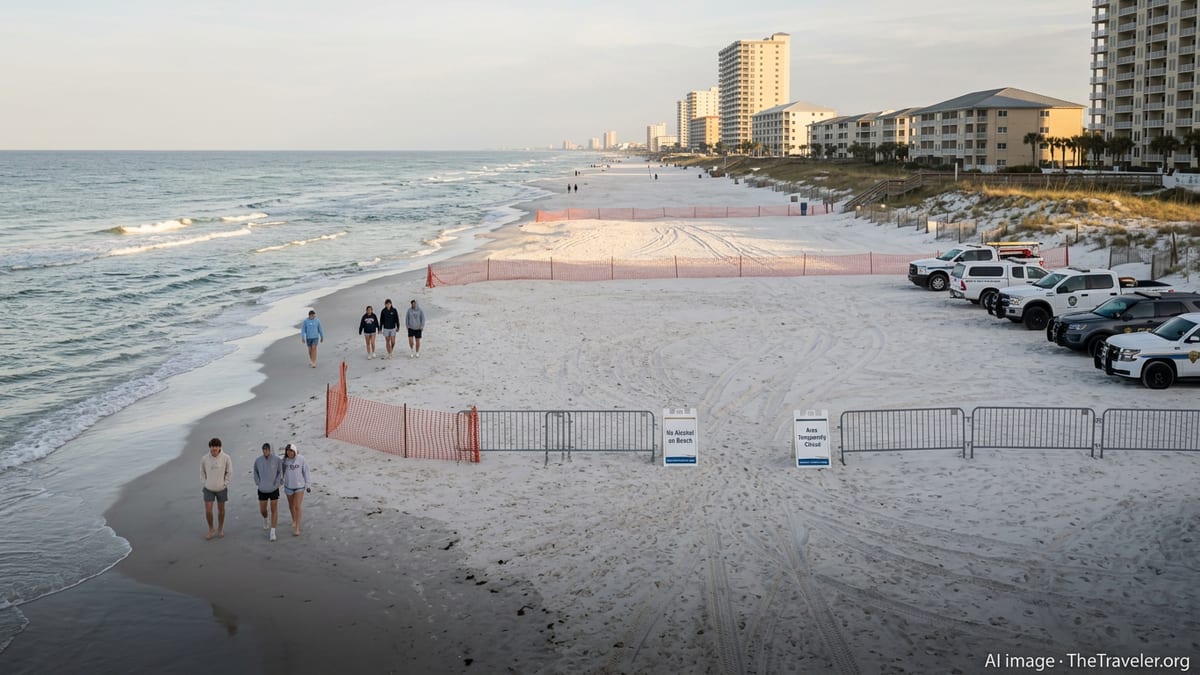
Beyond alcohol rules, 2026 spring break in Panama City Beach introduces a more formalized “High Impact Period” that runs from March 28 through April 11. Tourism and county notices describe this window as a time when additional safety measures can be activated quickly in response to crowd surges. One of the most notable tools now available is the authority to close or restrict access to beaches, beach access points, parks, parking areas, and public rights of way if conditions are deemed unsafe or overcrowded.
Bay County’s spring break notice for 2026 explains that these closures do not have to be scheduled far in advance. Areas can be cordoned off immediately when public safety is judged to be at risk, meaning travelers could encounter unexpected barricades or restricted zones during busier nights and weekends. This can include beach entrances in popular corridors along Front Beach Road and Thomas Drive, as well as nearby public parking.
City records from recent seasons show that Panama City Beach has already experimented with limited nighttime beach closures in specific hotspots, especially during peak spring break weeks. Those actions temporarily blocked access to sections of the shoreline overnight to discourage large late-night gatherings. The new county-level framework for 2026 appears to give officials a broader and more flexible option to repeat or expand those closures if crowds swell again this year.
Visitors are being encouraged by tourism officials and local travel advisories to pay close attention to posted signage, barricades, and law enforcement instructions in these high-impact zones. Because closures can be reactive and localized, travelers may find that one access point is closed while another nearby remains open, creating a patchwork of available shoreline along the busiest sections of the beach.
Curfews and access limits for minors tighten
Spring break 2026 also marks a tougher approach to underage visitors in Panama City Beach and surrounding Bay County. Publicly available county guidance outlines a curfew for unaccompanied minors during the High Impact Period, from March 28 to April 11. During those dates, anyone under 18 who is not with a parent, guardian, or qualified adult may be subject to an overnight curfew that runs from 8 p.m. to 5 a.m. in designated high-impact areas.
The same notice details limits on minors inside alcohol-serving venues. In high-impact zones, individuals under 18 are not allowed inside establishments that sell alcohol for on-site consumption between 10 p.m. and 6 a.m., even if they are not drinking. Businesses face penalties for allowing minors to remain during those hours, and parents or guardians can be held responsible if they knowingly allow curfew violations.
Vacation rental rules are also stricter during spring break. The Bay County guidance for 2026 states that vacation rentals in the affected areas may not be rented or leased to anyone under 21. Travel planners note that some property managers and condominium associations apply even higher age thresholds during the season, making it essential for student groups to verify rental terms before booking.
These measures collectively create a more controlled overnight environment along the main tourist corridors. Families traveling with teens are being advised to plan evening activities carefully, carry identification, and be prepared for increased ID checks, particularly near bars, clubs, and high-traffic beachfront spots during the busiest weeks.
What travelers should expect on the ground
Although many of the most visible rules focus on alcohol and youth access, the broader spring break ordinance package reaches into noise, traffic, and general conduct. City information on seasonal rules notes that loud music audible more than 25 feet away, riding on the exterior of vehicles, loitering in closed parking lots, and ignoring posted beach flag warnings can all draw enforcement. These standards apply throughout March and are reinforced during the High Impact Period.
Recent regional news coverage indicates that local agencies are again increasing staff levels for spring break 2026 and partnering with state agencies for support. According to these reports, additional patrols, mobile processing centers, and coordinated traffic control are being deployed along the most popular strips of Panama City Beach. Travelers can expect checkpoints, active monitoring of beach access points, and rapid responses to large gatherings, especially on weekends and around major university break dates.
Tourism officials and visitor bureaus continue to promote Panama City Beach as a family-friendly destination, highlighting that the combination of alcohol bans, curfews, and potential beach closures is designed to keep the experience safer and more manageable for residents and guests. Visitor guidance emphasizes that those who plan ahead, stay informed about current rules, and keep parties inside private spaces or licensed venues are unlikely to encounter serious issues.
For travelers heading to the Gulf this spring, the practical takeaway is straightforward: expect a stricter environment than Panama City Beach’s spring break reputation of years past. Checking local updates before heading out each day, reviewing rental and resort rules on arrival, and leaving alcohol off the sand throughout March are now essential parts of planning a trouble-free trip.