

More news on this day
A new high-capacity rail corridor planned between Panama City and the Costa Rican border at Paso Canoas, with onward connection studies under way in Costa Rica, is being hailed as a potential game-changer for both leisure travel and freight flows across Central America.
Get the latest news straight to your inbox!
From Feasibility Studies to a Cross-Border Vision
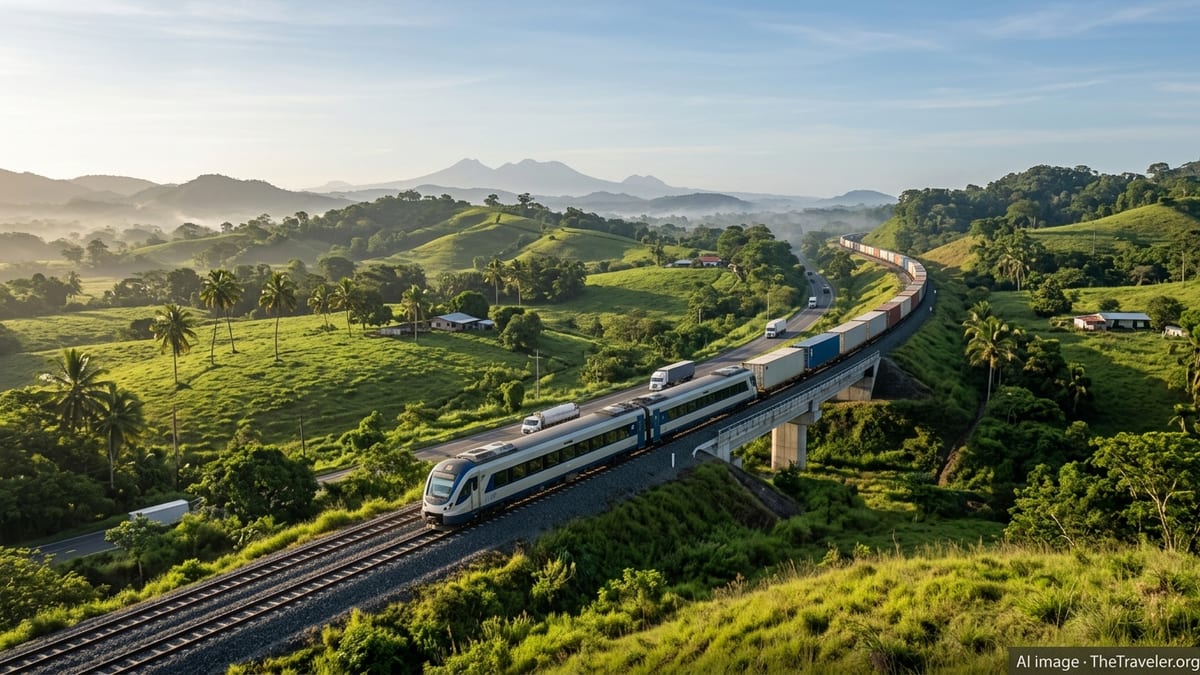
Plans for a Panama–Costa Rica rail connection have moved from long-discussed ambition to a structured program of studies, agreements and early-stage implementation steps. Publicly available information shows that Panama is advancing a 475-kilometre railway from Panama City to Paso Canoas in Chiriquí province, directly on the frontier with Costa Rica. The project has been framed as a dual-use corridor for both passengers and cargo, running broadly parallel to the Pan-American Highway and linking a string of regional cities and logistics hubs.
Feasibility work initiated several years ago with international partners examined engineering options, ridership projections and freight demand, particularly for container flows now largely carried by trucks between the interior and the capital. More recent government communications indicate that the current administration in Panama has made the rail line a flagship infrastructure priority, with technical master plans, environmental reviews and route definition for the Panama City to David section substantially advanced.
At the border, published coverage in regional outlets indicates that Costa Rica has been monitoring the project closely and has commissioned its own analysis of a potential San José to Paso Canoas rail link. The emerging concept is a continuous cross-border corridor that would eventually allow passengers and cargo to move by train from the Costa Rican capital directly into Panama’s national rail spine and, through it, to port and airport connections.
While construction on the Panamanian section is projected to begin before work on the Costa Rican side, the two countries have recently announced new framework agreements on railway cooperation and regional logistics integration. These steps, while still high-level, signal political alignment around a shared rail vision that could extend beyond the immediate border area to the wider Central American region.
Epic New Journeys for Travelers and Commuters
For travelers, the proposed Panama–Costa Rica rail link promises an entirely new way of experiencing Central America. Current overland journeys between Panama City and southern Costa Rica rely on long-distance buses and private coaches that spend many hours in highway congestion and at border posts. Early route descriptions of the railway suggest journey times that could be cut dramatically, with modern trains running at higher average speeds and operating on dedicated tracks.
The Panamanian route is expected to include around 14 stations, connecting the capital with secondary cities and tourism gateways in interior provinces. Travel writers and regional analysts point to the likely emergence of new multi-stop itineraries, where visitors can combine beaches, cloud forests, coffee-growing highlands and cultural towns along a single rail line. The ability to board in an urban transport hub in Panama City and disembark close to the Costa Rican frontier, with coordinated onward connections, is being framed as a new kind of “rail backbone” for adventure and eco-tourism.
Within Costa Rica, studies examining a San José to Paso Canoas railway are still at an earlier stage, but scenarios discussed in local media envision eventual through-services or at least seamless transfers between two integrated systems. Such a configuration could one day allow passengers to travel from the metropolitan valley around San José to Panama City without setting foot on a highway coach, reshaping travel habits for both residents and international visitors.
In addition to long-distance tourism, planners highlight the potential for daily and weekly commuting patterns to change between Panama’s interior regions and the capital. Faster and more predictable rail services may encourage workers to live further from the metropolitan area, easing housing pressure while maintaining access to jobs and services, and may similarly support cross-border labor mobility in the frontier region.
Lightning-Fast Cargo and a New Logistics Spine
Beyond the passenger buzz, the most transformative impact may be on cargo. Studies prepared for the Panama City to David corridor describe significant reductions in transport times for containers and bulk goods moving between the interior, the capital and the border. Current truck journeys between the greater San José area and Panama can take a day or more, with delays at bottlenecks and customs checkpoints. Preliminary rail projections cited in regional coverage suggest that a well-operated freight service could compress some of these movements to under ten hours.
The Panama route has been conceived with dual passenger and freight capacity from the outset, with design parameters aimed at accommodating container trains, agricultural shipments and manufactured goods. Stations and sidings near logistics parks, agribusiness clusters and free zones are expected to support transfer between the rail line and local road networks. Analysts argue that shifting a significant share of long-haul freight from trucks to rail could reduce highway congestion, lower transport costs and cut emissions associated with heavy road traffic.
At the Paso Canoas frontier, the railway is being positioned as a new gateway for Costa Rican exports and imports, giving producers in the south of the country more direct access to Panamanian ports and airports. Public information from infrastructure and trade institutions across the region highlights strong interest from manufacturers and agricultural exporters in more reliable, scheduled services for moving goods, particularly as global supply chains seek alternatives that are both faster and less carbon intensive.
Longer term, regional planning documents produced by multilateral development banks and technical agencies envision the Panama–Costa Rica axis as part of a broader Central American logistics network. In that scenario, a continuous chain of freight-capable rail lines, highways and ports would connect markets from southern Mexico to the isthmus, with the new cross-border railway acting as a central link in that chain.
Regional Integration, Investment and Environmental Questions
The emerging cross-border rail corridor is also being discussed in the context of Central America’s wider integration agenda. For decades, regional cooperation has focused heavily on power grids, customs harmonization and road improvements. The Panama–Costa Rica railway, if fully realized with an extension into Costa Rica and potential connections further north, would represent one of the first large-scale attempts to knit multiple national rail visions into a coherent regional system.
Reports from regional economic bodies note that Central America has only a small amount of active railway relative to its size and population. Integrating the new Panama line with potential Costa Rican segments is therefore seen not only as a transport upgrade, but as a structural shift in how the region organizes mobility and trade. Investment interest is reported from a mix of domestic public funds, international lenders and foreign engineering firms, pointing to a complex financing and governance picture that will likely evolve over the coming years.
At the same time, environmental and social considerations are central to how the project is being evaluated. The proposed route crosses areas of high biodiversity, productive farmland and communities that have historically been under-served by large infrastructure projects. Environmental impact assessments and public consultation processes, highlighted in planning documents and specialist coverage, underline the need to avoid sensitive ecosystems, limit deforestation and ensure that benefits in terms of jobs, connectivity and services are widely shared.
Advocates for sustainable transport argue that, if carefully implemented, the railway could help reduce overall environmental pressure by limiting heavy truck traffic, cutting emissions and steering growth into compact, transit-oriented development hubs around stations. Critics, however, point to the risk that new land speculation, poorly planned urbanization or insufficient safeguards could offset some of these gains. The balance between accelerated growth and ecological protection is expected to remain a key point of debate as designs are refined.
What It Means for Future Travelers
For future travelers planning trips across Central America, the prospect of a Panama–Costa Rica rail link represents a notable shift in how the region might be experienced within the next decade. Instead of stitching together a journey through a series of long bus rides and border crossings, visitors could organize their itineraries around a spine of modern rail services, using stations as jumping-off points for national parks, coastal resorts and cultural destinations.
Tourism boards and private-sector operators are already beginning to explore how multi-country packages, rail-inclusive passes and coordinated marketing campaigns could position the corridor as a signature route. Travel planners envisage combinations such as a city-and-canal stay in Panama, followed by rail-powered exploration of the Chiriquí highlands and an easy cross-border hop into Costa Rica’s Pacific or southern highland attractions.
For now, the project remains in the phase of final route definition, recruitment of technical teams and high-level coordination between the two neighbors. Yet each new announcement, study and cooperation agreement adds to a growing sense that Central America may be on the verge of a new rail era. If timelines hold and companion investments materialize in Costa Rica, the Panama–Costa Rica cross-border railway could soon move from plans on paper to a defining feature of travel and trade across the isthmus.