

More news on this day
A sudden evacuation at Paphos Airport after the sighting of a suspicious flying object has rattled Cyprus’ role as a regional travel hub, triggering scores of flight cancellations and fresh scrutiny of airport security as tensions between Israel, Iran and the United States spill further into the Eastern Mediterranean.
Suspicious Object Triggers Evacuation and Cancellations
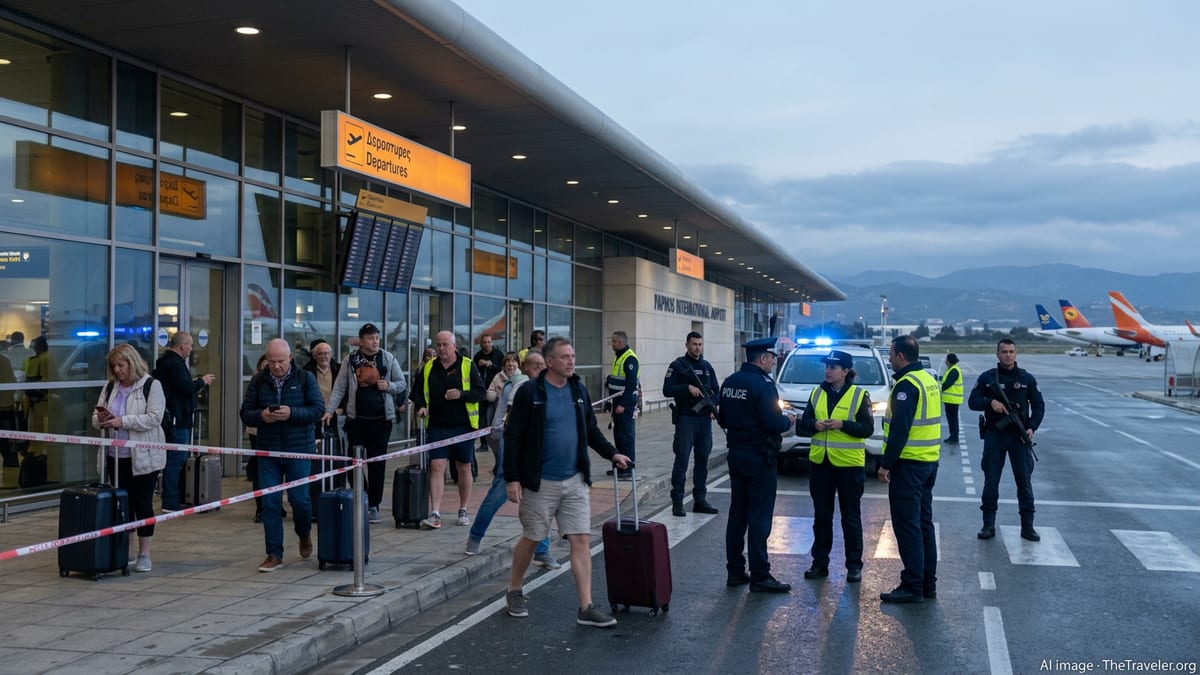
Pafos Airport and several nearby communities were ordered evacuated on March 2 after authorities reported a suspicious flying object over the area, initially believed to be a drone targeting strategic installations. Government officials later confirmed that two unmanned aircraft heading toward the British military base at Akrotiri had been intercepted, prompting an immediate security response across the wider Paphos region.
Operations at the airport were temporarily halted while security forces swept airside and landside zones. Passengers were moved out of the terminal and surrounding areas, with local residents in nearby villages including Timi, Mandria, Acheleia and Anarita also instructed to leave as a precaution. The alert heightened concerns that Cyprus’ civilian aviation infrastructure could be drawn more directly into the regional confrontation.
While authorities have since allowed flights to resume, the disruption was significant. Local aviation and travel-industry sources reported that around 60 flights to and from Cyprus were cancelled or heavily delayed over the weekend, affecting services not only at Paphos but also at Larnaca, the island’s primary international gateway. Airlines rerouted aircraft, consolidated schedules or suspended rotations altogether as they assessed the evolving threat picture.
Passengers described scenes of confusion, with departure boards filling with cancellations and queues forming at check-in desks as travelers sought rebooking options or refunds. Ground handling systems strained under the volume of stranded passengers, many of whom had already seen earlier journeys disrupted by the broader Middle East airspace closures.
US and UK Warnings Underscore Heightened Risk
The evacuation unfolded against a backdrop of escalating security messages from foreign missions on the island. The US Embassy in Nicosia issued an alert warning of a possible drone threat to the Paphos region and urged American citizens to stay clear of the embassy unless facing an emergency, advising them to remain vigilant and follow local guidance. British authorities similarly moved to safeguard personnel around the sovereign base areas, with reports of sirens sounding at Akrotiri as military facilities activated contingency plans.
The developments follow joint US and Israeli strikes on Iranian targets and subsequent missile and drone retaliation that have destabilised key air corridors across the Eastern Mediterranean and the Gulf. Shipping and aviation routes already upended by the Strait of Hormuz crisis are now compounded by concerns that long-range systems could reach infrastructure in Cyprus, which lies within a few hundred kilometres of both Israel and parts of the Levant.
For many travellers, the embassy alerts were the first indication that Cyprus’ status as a comparatively calm outpost in a volatile region could be shifting. Travel advisers in major outbound markets such as the United Kingdom note that, while no broad advisory against travel to Cyprus has been issued, governments are now highlighting the possibility of sudden disruption to flights and advising visitors to maintain a higher level of situational awareness.
Local officials, for their part, have sought to balance transparency with reassurance. Government spokespeople have stressed that the interception of the drones demonstrated the effectiveness of existing defence and surveillance systems, even as they acknowledged that the threat environment has become more complex and unpredictable.
Cyprus’ Airports Under Pressure as Regional Hub
The latest scare comes on top of a growing catalogue of operational strains at Cyprus’ airports as they absorb the knock-on effects of Middle East airspace closures. In the days leading up to the Paphos evacuation, airport operator Hermes Airports was already urging passengers to arrive at least three hours before departure because of high traffic volumes, longer check-in times and slower security screening.
On March 1, the company spent much of the day in crisis mode after the sudden closure of airspace across parts of the Middle East forced airlines to cancel dozens of services routed through Larnaca and Paphos. Flights to major regional hubs such as Tel Aviv and key Gulf cities were particularly affected, underlining how tightly Cyprus is tied into the aerial bridge between Europe and the Levant.
The island’s geographic location, which has long been an asset for tourism and business travel, now carries fresh vulnerabilities. With Israel diverting some of its leisure traffic away from Paphos in recent months due to security considerations, and with carriers recalibrating schedules in response to evolving military risks, Cyprus is having to reassert its reliability as a transit and holiday destination even as regional instability intensifies.
Industry stakeholders point out that this is not the first test of the country’s aviation resilience. In previous crises, including large-scale evacuations from neighbouring conflict zones, Cypriot airports have functioned as staging points for repatriation flights while maintaining regular tourism traffic. What is different this time, they argue, is the proximity of drone and missile activity to the island itself.
Intensified Security and the Traveler Experience
Authorities have responded to the weekend’s events by tightening security protocols across both international airports, with particular focus on perimeter surveillance, drone-detection systems and passenger screening. While officials are reluctant to discuss operational details, travellers should expect more visible policing around terminals, additional checks at access roads and possible restrictions on where the public can gather or linger landside.
In practical terms, the enhanced measures are likely to extend queueing times at security and passport control, especially during peak travel waves. Airport management has reiterated its request that passengers build additional time into their journeys, heed instructions from terminal staff and remain patient when confronted with sudden gate changes or rolling delays as air traffic control responds to evolving airspace constraints.
For airlines, the combination of security uncertainty and operational bottlenecks raises delicate questions about network planning. Carrier representatives privately acknowledge that they are reviewing risk assessments for routes into Cyprus, particularly from Israel and the wider Middle East, yet most emphasise that the island remains a crucial component of their Eastern Mediterranean schedules. Several have introduced more flexible rebooking policies to accommodate passengers caught out by last-minute cancellations.
Travel agents expect short-term jitters, particularly among families and older travellers, but note that Cyprus’ established reputation as a safe and well-run tourism destination could help the market bounce back if there are no further incidents. Early summer bookings from core markets such as the UK and central Europe remain solid, though much now depends on whether the regional security situation stabilises.
Tourism Outlook as Geopolitics Darken
Beyond the airport perimeter, the Paphos evacuation feeds into a broader sense of unease as the Eastern Mediterranean absorbs the shockwaves of the confrontation between Israel, Iran and the United States. The same strategic position that allows Cyprus to act as a bridge between continents also places it close to the front line of a shifting security order, where long-range drones, cyber operations and contested airspace are redrawing the risk map for airlines and tour operators.
Tourism officials have spent recent years promoting Cyprus as a resilient sun-and-sea destination capable of withstanding turbulence in neighbouring states. Before the latest escalation, arrivals were trending near record levels, buoyed by strong demand from European markets and a partial rebound from Israel. Now, attention is turning to whether travellers will continue to see the island as a safe alternative to destinations directly affected by conflict, or whether repeated airport disruptions will begin to erode confidence.
Local hoteliers and tourism businesses say they are monitoring developments closely but stress that daily life across most of the island remains calm and that attractions, resorts and coastal promenades are operating as normal. Their immediate concern is less about a sharp collapse in arrivals and more about a drip-by-drip pattern of cancellations, reroutings and shortened stays as visitors seek maximum flexibility in a time of uncertainty.
For now, Cyprus finds itself pulled deeper into a widening geopolitical storm, its airports serving as both barometers and amplifiers of regional tension. How the country manages airport security, communication with travellers and coordination with foreign partners in the coming weeks will play a central role in determining whether the weekend’s drama is remembered as a passing scare or as a pivot point in the island’s image as a dependable gateway between Europe and the Middle East.