

Parikia is the low-key heart of Paros, and its compact harbor is where most visitors first step onto the island. The whitewashed lanes of the Old Town begin just across from the ferry quay, and bus, taxi, and rental offices are all within a short walk.
Because the port is small and busy, knowing what to expect when your ship docks will make arrivals and departures smoother, help you choose the right ferry, and ensure that your onward journey to Naoussa, the airport, or the island’s beaches is straightforward.
Understanding Parikia Port and Ferry Options
Parikia’s port is the main maritime gateway for Paros, handling both large conventional ferries and faster high-speed catamarans. It is a single, relatively compact harbor rather than a sprawling terminal complex, which means you can walk from one side to the other in only a few minutes.
The quay where ferries dock sits directly in front of Parikia town, so you are instantly within reach of accommodation, cafes, and transport once you disembark.
Several major Greek ferry companies serve Parikia, with routes connecting the island to Piraeus and Rafina near Athens, as well as to other Cycladic islands such as Naxos, Mykonos, Santorini, Syros, Ios, and small islands like Koufonisia. In summer, multiple sailings operate daily on the key routes, while in the shoulder and winter seasons schedules are reduced and crossings can be rescheduled or canceled in rough weather.
Because timetables change each year and sometimes within the season, it is essential to check current schedules and book tickets in advance, especially for July and August.
Travelers can choose between conventional ferries and high-speed vessels. Conventional ferries are larger, usually more stable in rough seas, and offer open decks where you can enjoy Aegean views. Journey times from Piraeus to Paros typically range from around four to five hours on these services.
High-speed catamarans are smaller and faster, sometimes cutting an hour or more off the trip, but they are more exposed to choppy conditions and generally more expensive. For those prone to seasickness, the slower, bigger ships are usually the more comfortable option despite the longer ride.
Within Parikia itself, there is one main passenger port rather than separate terminals for each company, but different ferries will tie up at different sections of the quay. Electronic boards and ground staff direct passengers to the correct spot as vessels approach.
Allow extra time if you need to locate your ship amid several arrivals and departures, as it is common in high season for multiple ferries to be maneuvering in the harbor around the same time.
Arriving in Parikia: What to Expect at the Port
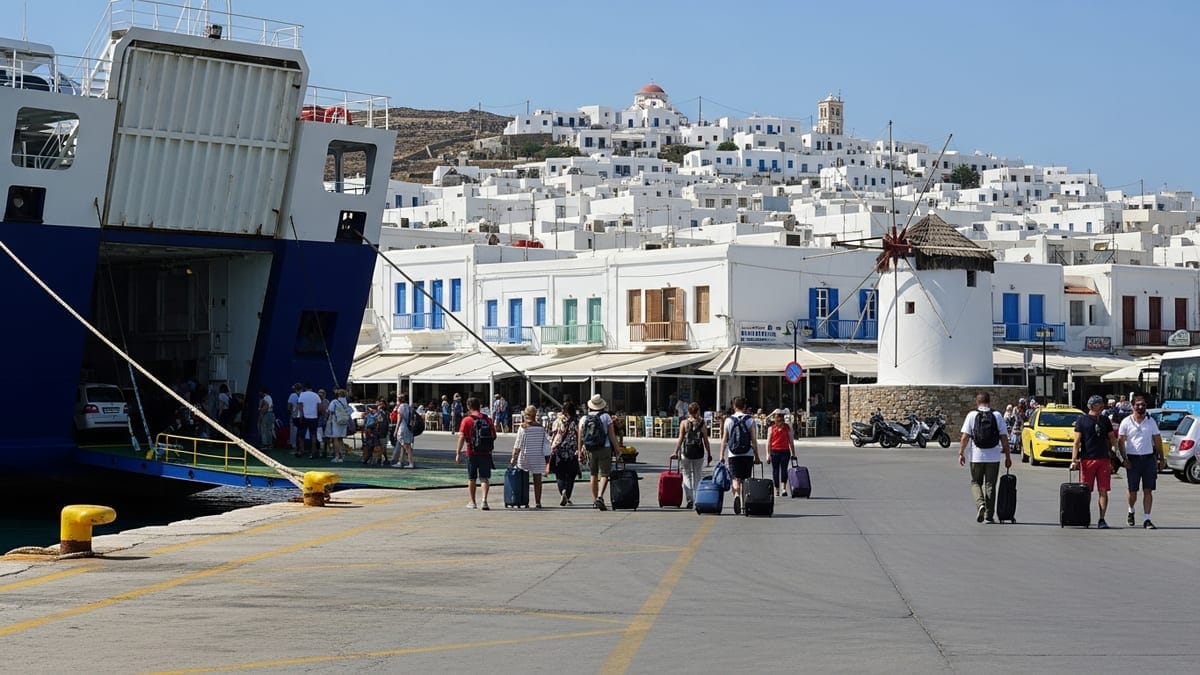
Approaching Parikia by sea is one of the classic Aegean island experiences. As the ferry enters the bay, you will see the white cube houses of the town rising in tiers behind the waterfront, with a picturesque windmill landmark near the center of the harbor.
When the ship docks, vehicle ramps lower to the quay and foot passengers are directed to disembark via the main gangways. The process is fast paced because turnarounds in the Greek islands are short, so have your bag ready and follow the crowd off the ferry without lingering too long on the ramp or gangway.
Once you step ashore, you emerge onto the main harborside strip. There is no large indoor terminal hall; instead, the “terminal” is essentially the open quay and the streets immediately behind it.
You will find small ticket offices belonging to the different ferry companies distributed along the waterfront, along with independent travel agencies that can assist with ticketing, changes, or last-minute bookings. If you have prebooked tickets that need to be printed, these are the offices where you will collect them before boarding on departure days.
Facilities at Parikia port are fairly simple but sufficient for most travelers. There are a few covered waiting areas and benches near the embarkation zone, and the harborside promenade is lined with cafes, bakeries, and snack bars where you can sit out your wait over coffee or a meal.
Several of these establishments open early and close late to coincide with ferry arrivals, and many are accustomed to guests with luggage. Public toilets are available near the port area, although some visitors prefer using the facilities in nearby cafes.
For money matters, ATMs are located within a short walk along the waterfront and around the main square behind the port. Shops and ticket offices usually accept cards, but smaller minimarkets and some bus ticket outlets still prefer cash.
Left-luggage storage is not as standardized as in big-city ports, but depending on the season you may find luggage services through local travel agencies or hotels, especially if you already have a reservation. If you are only in Parikia for a day between ferries, many cafes and rental offices will watch bags informally by arrangement when it is not too busy, though this should not be relied on during peak periods.
Choosing and Booking Ferries to and from Paros
For most visitors, the trip to Paros begins in Athens or on a neighboring island. From Piraeus and Rafina, several daily sailings operate in high season, including both conventional ferries and high-speed catamarans.
Journey times vary by vessel type, intermediate stops, and route, so it is worth comparing options rather than simply choosing the first departure you see. Prices also vary, with high-speed tickets generally costing more than standard ferries for the same route.
When booking, consider whether you want a numbered airplane-style seat, a deck seat, or a cabin on the longer routes. Numbered seats guarantee you a place to sit indoors, which can be important on crowded summer sailings.
Deck seating is more flexible and enjoyable in good weather, but you may have to search for a free spot and it can be windy or hot. Cabins, available on certain larger ferries, are more common on overnight or long-distance routes and are rarely necessary for Athens to Paros, although they can be attractive for travelers wanting complete privacy or a space to sleep undisturbed.
Advance booking is strongly recommended from mid-June through early September, especially on weekends, public holidays, and around popular events. Ferries can and do sell out during these times, particularly high-speed vessels and crossings connecting multiple islands in one chain.
Buying tickets several weeks ahead is usually sufficient, though in August and on very popular routes it may be wise to secure them even earlier. Outside of peak periods, you can often buy tickets just a day or two before departure or even on the day itself, but schedules are limited, so flexibility helps.
Travelers should also be aware of occasional schedule shifts and weather-related disruptions. Strong Meltemi winds that blow in the Aegean, particularly in July and August, can cause delays or cancellations, especially for high-speed catamarans.
If you are catching an international flight after your time in Paros, avoid planning your final ferry as a same-day connection with minimal buffer. Allow at least one night in Athens or at the departure island before flying out to reduce the risk of missed flights due to ferry changes.
Getting From Parikia Port to Naoussa and Other Destinations
Once you arrive at Parikia port, most travelers either stay in town or head straight to Naoussa, the island’s second major hub in the north. The main public transport option is the island’s KTEL bus network, which uses Parikia as its central terminal. The bus station is located just a short walk from the ferry quay, typically a minute or two on foot to the right as you exit the main port area.
Services run regularly in summer between Parikia and Naoussa, with additional routes connecting to villages such as Lefkes and resort areas like Piso Livadi, Aliki, and the airport.
The bus from Parikia to Naoussa is an efficient and budget-friendly choice. Journey times typically range from about 20 to 40 minutes depending on the route and traffic, and tickets are inexpensive by European standards. In peak season, buses can be quite full, but departures are scheduled to broadly align with ferry arrivals, and additional services may be added on the busiest days.
Tickets can be bought at the station kiosk or on board, usually in cash, although buying at the kiosk can sometimes be slightly cheaper and quicker.
For those who prefer door-to-door convenience, taxis are readily available at the port whenever ferries are scheduled to arrive. The taxi rank is close to the harbor windmill landmark, within clear sight of the ferry exit. Rides from Parikia to Naoussa generally take around 15 to 25 minutes depending on traffic and route.
Fares are typically set by meter and can vary with time of day, luggage, and exact destination, but you can expect a broad range that is higher than the bus yet still manageable when shared between several passengers. In high season, queues at the taxi stand can be long immediately after popular ferry arrivals, and prearranged transfers through local operators or hotel partners can save time.
Car, scooter, and ATV rental offices cluster near Parikia port, making it easy to pick up a vehicle as soon as you land. Driving from Parikia to Naoussa is straightforward, taking about 20 minutes via the main island road.
For those staying in more remote locations or planning to explore smaller beaches and hill villages, having your own vehicle can be very useful, especially outside of the core summer bus timetable. Supply is limited on a small island, though, and it is wise to reserve well ahead for visits in July and August. Always check license requirements, particularly for scooters and ATVs, which may require a specific motorcycle endorsement.
Connecting From Parikia Port to Paros Airport and Other Islands
Paros National Airport lies in the southern part of the island, a relatively short distance from Parikia. There is no dedicated ferry-to-airport terminal, but the journey is simple by road. Taxis are the most direct option, taking around 15 to 25 minutes depending on traffic.
During the core summer months, taxis frequently shuttle between the port and the airport, and many hotels will help arrange transfers on request. Fares vary with time of day, luggage, and vehicle type, with vans or prebooked private transfers usually costing more than standard taxis.
Public buses also connect Parikia and the airport, although services are more limited in the shoulder and off seasons. Routes typically run during daylight hours, and you may need to check locally for the latest schedules as timetables can change with each season.
Travelers relying on the bus should allow extra time for connections, particularly if continuing on to or from Naoussa or another resort area, as this may involve changing buses in Parikia. To avoid tight timing, many visitors plan at least one overnight on the island at either the start or end of a trip if pairing flights and ferries.
Parikia also serves as a useful stepping stone if you are island-hopping. Ferries link Paros with neighboring Naxos and the Small Cyclades, as well as with larger hubs like Mykonos and Santorini. Some routes are direct, while others involve changing boats in Paros or another island.
When planning complex itineraries, consider the cumulative effect of weather, possible delays, and minimum connection times at each port. It is often more reliable to build a trip around one or two central hubs rather than stacking too many same-day inter-island transfers.
If your next destination is nearby Antiparos, note that the main car and passenger ferry to Antiparos departs not from Parikia but from the small port of Pounda on Paros’s western side. It is a short drive or bus ride from Parikia to Pounda, where frequent shuttle ferries make the quick crossing to Antiparos Town. In summer, many visitors combine time on both islands, using Parikia as a base for wider exploration.
Orientation, Facilities, and Staying Near the Port
Because Parikia’s port is integrated into the fabric of the town rather than separated by a long industrial fringe, it is easy to orient yourself on foot. From the quay, the Old Town’s maze of narrow streets begins just across the coastal road, leading uphill past churches, small squares, and traditional houses.
To one side of the port stretch the town beaches and a string of waterfront bars and tavernas, while to the other lies the main bus station and commercial strip with supermarkets, bakeries, and services.
Accommodation options near the port run from simple rooms above cafes to mid-range hotels and boutique guesthouses tucked into the lanes behind the promenade. Staying within walking distance of the harbor is particularly convenient for travelers with early-morning or late-evening ferries, or for those making a brief stopover as part of a longer island-hopping trip.
Many properties are accustomed to guests arriving at unusual hours and will store luggage for a few hours before check-in or after check-out, though this is up to each hotel’s policy.
Parikia has several small supermarkets and convenience shops within an easy walk of the port, useful for stocking up on water, snacks, and picnic supplies before boarding your next ferry. Pharmacies, bakeries, and produce markets are clustered in the central streets just behind the waterfront. If you intend to self-cater in an apartment or villa elsewhere on the island, Parikia is often the most practical place to do a larger grocery shop soon after arriving.
For those with time between ferries, Parikia itself is worth exploring rather than simply treating it as a transit point. The church complex of Panagia Ekatontapiliani, one of the most important early Christian monuments in the Aegean, sits a short walk inland from the port.
The Old Town’s network of alleys rewards slow wandering, with small boutiques, cafes, and traditional ouzeries hidden away from the main drag. Even a couple of hours are enough to get a feel for the town, enjoy a meal, or watch the sunset from the harbor mole before your next departure.
Practical Arrival Tips and Seasonal Considerations
Travel through Parikia port is generally straightforward, but a few practical habits will help smooth your journey. First, have your luggage organized and ready before the ferry docks, keeping valuables and essentials in a daypack that you can carry easily while walking along the quay or queuing for transport.
Wheeled suitcases are manageable around the port and on the main streets, though cobblestones and uneven pavements in the Old Town can make heavier bags awkward. Light, compact luggage is always an advantage when boarding or disembarking quickly.
Hydration and sun protection are important, particularly if you are arriving in the heat of the day or waiting outside for a bus or taxi. Shade is limited along parts of the quay, and crowds can build when multiple ferries arrive back-to-back.
A hat, sunglasses, sunscreen, and a refillable water bottle will make the transition more comfortable. During the shoulder seasons of April, May, late September, and October, temperatures are milder and crowds lighter, but evenings can be cool and winds brisk, so having a light jacket is useful.
Planning for contingencies is also wise. When seas are rough or strong winds sweep the Cyclades, ferry schedules may change at short notice. Sign up for notifications when booking tickets if the option is available, and keep an eye on messages from your ferry company or travel agent.
If you learn of a delay or cancellation in advance, try to adapt your accommodation and transport plans proactively. Local hotels and operators are used to such disruptions and often display some flexibility around late arrivals when notified.
Finally, build in realistic margins around your ferry times. Allow extra minutes at arrival to find the bus station or taxi rank, especially if you have not visited before. Do not plan tight same-day connections with flights or onward ferries, particularly at the end of your trip.
Paros is best enjoyed at a slightly slower pace, and giving yourself breathing room in the schedule will reduce stress and allow you to appreciate the harbor atmosphere instead of racing through it.
The Takeaway
Parikia’s port may be compact, but it functions as a crucial hub for the Cyclades, linking Paros to Athens, neighboring islands, and air connections via the island’s airport.
Understanding its simple layout, the range of ferry types and schedules, and the options for onward travel to Naoussa and other destinations will help you use it with confidence. Most of what you need is within a short walk of the quay, from tickets and transport to cafes and basic services.
By booking ferries with some forethought, allowing time for possible weather disruptions, and choosing the right combination of bus, taxi, or rental vehicle for your plans, you can turn what might otherwise be a rushed transit into an easy and even enjoyable part of your Greek island journey.
Whether you linger in Parikia’s Old Town or head straight for the beaches and villages beyond, a smooth arrival and departure from its harbor set the tone for a relaxed stay on Paros.
FAQ
Q1. How early should I arrive at Parikia port before my ferry departure?
For most sailings, arriving 45 to 60 minutes before departure is sufficient, especially if you already have a printed or mobile boarding pass. In peak summer or when traveling with a vehicle, aim for at least 90 minutes to allow time for ticket collection, boarding checks, and potential queues on the quay.
Q2. Can I walk from the ferry to the Parikia bus station?
Yes. The main KTEL bus station is only a short walk from the ferry quay, generally a minute or two on foot along the waterfront. It is clearly signposted, and buses to Naoussa, the airport, and other island destinations depart from there.
Q3. How do I get from Parikia port to Naoussa without a car?
The simplest option is the KTEL bus, which runs regularly in summer and takes about 20 to 40 minutes depending on the route. Tickets are inexpensive and can be bought at the station or on board. Alternatively, you can take a taxi from the rank near the port, which offers a faster, direct ride at a higher but still manageable cost if shared.
Q4. Are there taxis waiting at the port when ferries arrive?
Yes. Taxis time their presence to the ferry schedule and line up at a rank close to the harbor windmill landmark. In high season, however, demand can exceed supply immediately after busy arrivals, which may mean waiting in line or prebooking a private transfer through a local operator or your accommodation.
Q5. Is it necessary to book Paros ferries in advance?
During July and August, and particularly on weekends or public holidays, advance booking is strongly recommended because popular sailings and high-speed vessels can sell out. In shoulder seasons, it is often possible to secure tickets closer to departure, but schedules are less frequent, so checking options ahead of time still makes sense.
Q6. What is the best way to reach Paros airport from Parikia port?
The most straightforward method is by taxi, which usually takes around 15 to 25 minutes depending on traffic and costs more than the bus but offers a direct connection. Public buses also run between Parikia and the airport during the day, but departures are less frequent and subject to seasonal changes, so always verify the latest timetable locally.
Q7. Are there luggage storage facilities at Parikia port?
There is no large, centralized left-luggage terminal, but some travel agencies, hotels, and rental offices near the port offer short-term storage, particularly for customers. In quieter periods, cafes and guesthouses may also agree to keep bags for a few hours by arrangement. In midsummer, it is best to confirm storage options in advance rather than relying on informal solutions.
Q8. Can I rent a car, scooter, or ATV immediately after arriving?
Yes. Numerous rental agencies operate within walking distance of the quay, and many travelers pick up vehicles shortly after disembarking. Availability is limited in peak season, so it is advisable to reserve ahead, especially for scooters and ATVs, and to ensure you have the correct driving license category required under Greek regulations.
Q9. What should I do if my ferry is canceled due to bad weather?
If your ferry is canceled, contact the issuing ticket office or ferry company for rebooking or refund options. They may move you to the next available sailing or offer alternatives on a different route. Inform your accommodation about the delay so they can adjust check-in expectations, and, if necessary, arrange an extra night on the island where you are currently staying until services resume.
Q10. Is Parikia worth staying in, or should I go straight to Naoussa?
Parikia is more than just a transit port and offers a charming Old Town, historic churches, waterfront promenades, and nearby beaches that make it a pleasant base, especially for short stays or travelers who enjoy being close to the ferry and bus hubs. Naoussa has a more resort-like atmosphere and is particularly popular for dining and nightlife. Many visitors split their time between the two, using Parikia as a practical arrival or departure base and Naoussa for longer, more relaxed stays.