

More news on this day
Travellers passing through Paris are facing significant disruption as a fresh wave of delays and cancellations affects flights operated by El Al, Air France, SAS and several other international carriers serving the French capital’s main airports.
Get the latest news straight to your inbox!
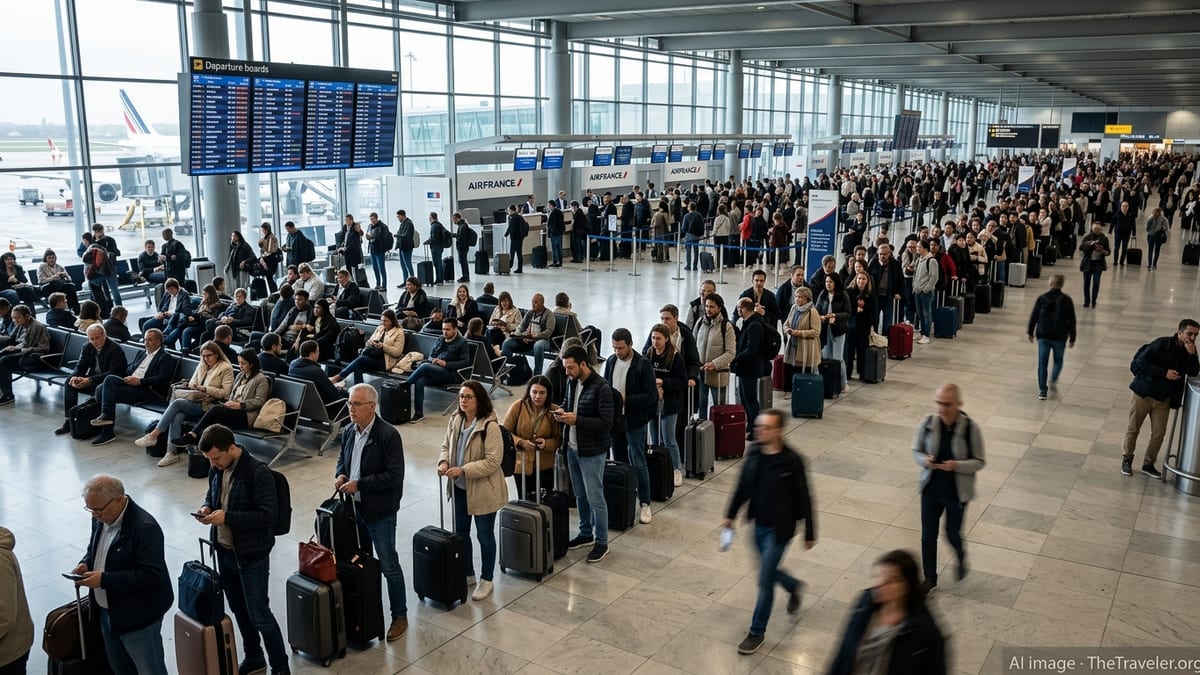
Widespread Disruptions at Charles de Gaulle and Orly
Publicly available flight-tracking data and media coverage indicate that Paris Charles de Gaulle and Paris Orly are experiencing a sharp rise in operational disruption, with a dozen or more flights cancelled and several hundred delayed across multiple airlines. The disruption is affecting both short-haul European services and long-haul routes, leaving passengers facing missed connections, extended waits in terminals and last-minute rerouting.
Operations at Charles de Gaulle, Europe’s second-busiest hub by number of airlines, appear to be particularly strained, with knock-on effects rippling through connecting traffic to Africa, the Middle East, North America and Asia. Orly, which handles a high volume of domestic and leisure-oriented services, is also reporting irregular operations, with cancellations and rolling delays compressing capacity on remaining departures.
The pattern of disruption is uneven across the schedule, with some banks of flights operating close to normal while others show high concentrations of delays exceeding one or two hours. This volatility is complicating travel plans for passengers who had counted on tight connections through Paris and who now face uncertainty over departure times and arrival days.
While the situation remains fluid, operational data suggests that irregularities are likely to persist over the short term as airlines and airport handlers work through aircraft and crew rotations that have been thrown off schedule.
El Al, Air France, SAS and Other Carriers Adjust Schedules
Among the airlines most visibly affected at Paris airports are Israel’s El Al, French flag carrier Air France and Scandinavian operator SAS, alongside a mix of European and long-haul carriers. Schedules show that each of these airlines has enacted targeted cancellations from Paris, particularly on routes with multiple daily frequencies where consolidating passengers onto fewer flights is operationally feasible.
For El Al, disruptions at Paris are interacting with a broader period of volatility in regional air travel, with ongoing adjustments to routes linking Europe and the Middle East. Some Paris–Tel Aviv services have been cancelled outright, while others have been rescheduled or rerouted, creating uncertainty for travellers heading to or from Israel via the French capital.
Air France, which operates the largest network from Charles de Gaulle and maintains a more limited presence at Orly, has implemented a series of cancellations and rolling delays on European feeder routes as well as selected long-haul services. According to published coverage and airline advisories, these changes are being used to create operational breathing space, allowing remaining flights to depart with more predictable timings and better-managed aircraft utilisation.
SAS and a number of other European carriers serving Paris from Scandinavia, Germany, Southern Europe and the United Kingdom are also trimming frequencies or merging lightly booked flights. While this strategy helps stabilise operations from an airline perspective, it increases the likelihood that passengers will face last-minute rebooking or extended layovers.
Operational Pressures and Capacity Constraints
The current wave of disruption comes against a backdrop of persistent operational pressures in European aviation, including tight staffing levels in air traffic control, ground handling and airline operations. Reports from recent months highlight recurrent constraints in French and neighbouring airspace, with periods of congestion or flow restrictions leading to extended holding times and downstream scheduling issues.
At airport level, peaks in traffic at Charles de Gaulle and Orly can strain check-in, security, and baggage systems, particularly when several delayed flights depart in quick succession. Publicly available information indicates that some carriers are proactively cancelling lower-priority or duplicate flights to avoid gridlock at gates and on taxiways, even when weather at Paris itself is not severe.
External factors, such as rerouting of traffic around sensitive airspace and ad hoc safety measures on certain long-haul corridors, are also contributing to longer flight times and tighter crew duty windows. When aircraft and crew exceed regulated working hours because of extended flight or ground delays, airlines are frequently forced to cancel subsequent rotations, adding to the tally of disrupted services in Paris.
These pressures interact in complex ways, meaning that travellers can experience disruption at Paris airports even on days with relatively benign local conditions. Once rotations fall out of sync, it can take several days for carriers to fully restore normal patterns of operation, especially at a major hub with intricate connection waves.
Impact on Passengers and Rights Under EU Rules
For passengers, the immediate impact of the current disruptions is felt in crowded terminals, long queues at airline service desks and uncertainty over onward travel. Travellers connecting through Charles de Gaulle or Orly report having to rebook itineraries, overnight unexpectedly in Paris or switch to rail and bus options when same-day flights are unavailable.
Under European Union air passenger rules, notably Regulation EC 261/2004 and related frameworks, many travellers departing from Paris may be entitled to assistance such as meals, refreshments and hotel accommodation during extended delays or overnight cancellations. In specific circumstances, they may also qualify for monetary compensation if the disruption is attributable to factors within an airline’s control, such as crew scheduling or technical issues, and if notification thresholds are not met.
However, eligibility can be complex and depends on the cause of the disruption, the length of delay, the distance of the flight and whether passengers were informed sufficiently in advance. Public guidance from consumer organisations stresses the importance of retaining boarding passes, booking confirmations and receipts for reasonable out-of-pocket expenses to support any subsequent claims.
With multiple airlines involved, passengers on the same route or even the same aircraft may find themselves subject to different conditions and procedures. As a result, many travellers are turning to airline apps, online claim portals and independent advisory resources to understand their options for rerouting, refunds or compensation.
Advice for Travellers Heading Via Paris
Given the evolving situation at Paris airports, travel experts and consumer advocates are urging passengers to build extra flexibility into their journeys. For those with flights booked on El Al, Air France, SAS or other carriers operating through Charles de Gaulle or Orly, checking flight status repeatedly in the 24 hours before departure is particularly important. Same-day changes and rolling delays are common during periods of operational stress.
Passengers with tight connections in Paris are being advised, where possible, to opt for longer layovers or earlier feeder flights to reduce the risk of misconnecting. Those starting their journey in France may wish to arrive at the airport earlier than usual to allow for potential queues at check-in and security, especially during peak morning and late-afternoon departure banks.
Travel insurance remains another consideration. Policies that include cover for missed connections, delays, and additional accommodation can provide a financial safety net when disruption escalates beyond a few hours. Travellers are encouraged to review policy wording carefully, as coverage limits and qualifying criteria vary significantly between providers.
With schedules still in flux, the outlook for the coming days will depend on how quickly airlines can restore regular rotations and whether wider European airspace constraints ease. Until then, anyone planning to transit through Paris is likely to benefit from a cautious approach that prioritises flexibility, real-time information and contingency planning.