

More news on this day
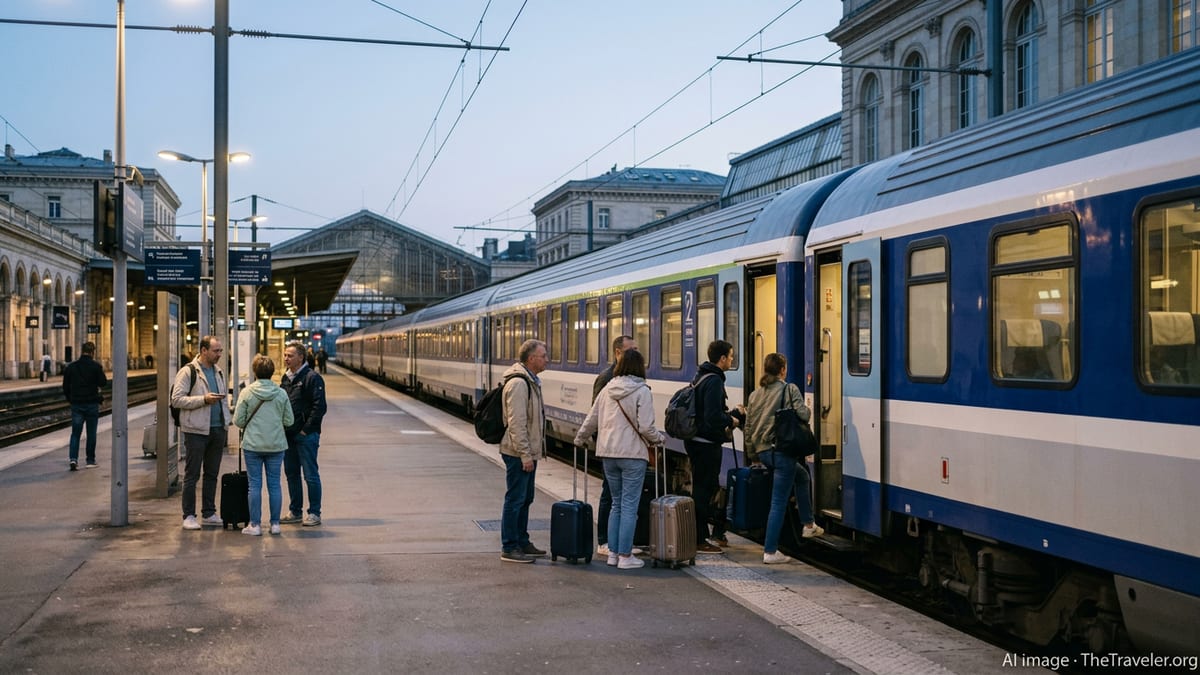
Overnight rail between Paris and Berlin is set for a dramatic comeback, as a new direct night train prepares to roll out in March 2026, restoring a storied link between France and Germany and reshaping how Europeans move between two of the continent’s most influential capitals.
Get the latest news straight to your inbox!
A Historic Route Reborn After Funding Turbulence
The revival of the direct night connection between Paris and Berlin comes after a turbulent few years for cross-border sleeper services. Austrian operator ÖBB only relaunched its Nightjet services between the two capitals in December 2023, nine years after the previous sleeper was scrapped. Those trains quickly became emblematic of Europe’s night train comeback, but they also depended heavily on French public subsidies to remain viable.
That support was withdrawn in 2025, prompting ÖBB and its partners to confirm that Nightjet services linking Paris with both Berlin and Vienna would end in mid December 2025. The decision sparked criticism from passenger groups and climate advocates, who argued that cutting international sleepers ran counter to Europe’s decarbonisation goals and growing public demand for rail alternatives to short-haul flights.
Into this gap steps European Sleeper, a Belgian Dutch cooperative that has steadily grown a network of night services from Brussels toward Berlin, Prague and seasonal southern routes. The company has now confirmed that it will extend its existing Brussels Berlin line through to Paris, formally restoring the direct overnight route between the French and German capitals from late March 2026.
The announcement reframes the Paris Berlin link as a symbol of rail liberalisation in Europe. Instead of a traditional partnership between state rail incumbents, the new train will be operated by an independent cooperative threading its way across infrastructure managed by three national networks in France, Belgium and Germany.
What the New Paris–Berlin Night Train Will Look Like
European Sleeper plans to launch the Paris–Berlin service on 26 March 2026, with trains expected to depart Paris on Sundays, Tuesdays and Thursdays and return from Berlin on Mondays, Wednesdays and Fridays. The timetable is designed to appeal both to leisure travellers on extended city breaks and to business passengers who value arriving in the centre of town at the start of the working day.
According to information released by the cooperative, the train will be formed of 12 to 14 carriages offering a range of comfort levels. Travellers can expect a mix of classic seated cars, shared couchettes and more private sleeper compartments, in line with the operator’s existing Brussels–Berlin–Prague services. While final interior details have yet to be disclosed, the company has indicated that the rolling stock will come from a German leasing company and be refurbished to modern standards.
Journey times are expected to run roughly in parallel with the current Nightjet pattern, leaving one capital in the evening and arriving in the other shortly after breakfast. For many travellers, the appeal lies less in outright speed and more in the ability to reclaim daytime hours: board after dinner, sleep in motion and step off the train the next morning without a trip to the airport or a hotel night on either end.
The route is also set to plug Paris and Berlin more tightly into the wider overnight rail map. By piggybacking on European Sleeper’s Brussels hub, passengers from the two capitals will gain easier overnight connections to cities such as Amsterdam, Rotterdam and Prague, and to seasonal services that fan out toward the Alps and the Adriatic.
Daytime High-Speed Rivals and a New Rail Ecosystem
The night service will not operate in isolation. Paris and Berlin are already linked by a direct high speed daytime train, jointly operated by France’s SNCF and Germany’s Deutsche Bahn, which began running in December 2024. Branded as an ICE TGV partnership, that service cuts the daytime rail journey to under eight hours via Strasbourg, Karlsruhe and Frankfurt, dramatically improving competitiveness with air travel for passengers who prefer to travel by day.
Together, the new sleeper and the existing high speed route create an unusually dense rail corridor between the capitals of the European Union’s two largest member states. For some passengers, the day train will remain the natural choice, especially for shorter trips and same day meetings. For others, the night train will offer better value when factoring in a saved hotel night and the convenience of city centre to city centre travel.
The coexistence of both options also illustrates an emerging European rail ecosystem in which different operators and business models overlap. While state incumbents focus on daytime high speed links, smaller cooperatives and private players are increasingly taking on the complexity of night train operations, which require cross border rolling stock approvals, access charges in multiple countries and sophisticated timetable coordination.
Industry analysts see the Paris–Berlin case as a test of whether this division of labour can deliver a stable long term future for sleeper trains. If European Sleeper can make the route work financially without French state subsidies, it may encourage other independent operators to step into gaps left by legacy carriers retreating from overnight services.
Climate, Convenience and a Shift in Traveler Priorities
The return of the Paris–Berlin sleeper also taps into wider shifts in European travel behaviour. In recent years, climate conscious travellers have increasingly sought out rail options in order to cut their carbon footprint, particularly on routes where rail can viably replace short haul flights. Advocacy groups have frequently cited the Paris–Berlin corridor as a prime example of a journey where overnight trains can combine substantial emissions savings with a comfortable passenger experience.
Data from the first year of Nightjet’s Paris links indicated strong demand despite a limited number of departures and recurring operational issues. Campaigners argued that the main barrier to success was not a lack of passengers but the underlying funding model and regulatory framework, which made it harder to sustain international night services than domestic ones. The new cooperative operated train will be closely watched to see whether a leaner, more flexible structure can square that circle.
For leisure travellers, the sleeper’s revival can fundamentally reshape how itineraries are planned. A traveller leaving Paris on a Sunday evening could wake up in Berlin on Monday, continue by day train to Poland or the Czech Republic and be back in France by the end of the week, all without boarding a plane. The route also promises simpler overnight access in the other direction for German travellers keen to combine Berlin’s cultural scene with a few nights in the French capital.
Airlines will still dominate long haul intercontinental travel, but on medium distance intra European routes like Paris–Berlin, overnight rail is increasingly seen as the missing middle ground between ultra fast but carbon intensive flights and slower, multi change daytime trains. The new service aims to fill precisely that niche.
What This Means for the Future of European Night Trains
The Paris–Berlin sleeper’s return is already being framed by rail advocates as a bellwether for the broader renaissance of European night trains. Over the past decade, several high profile overnight routes were abandoned as state railways prioritised high speed daytime services and cut loss making sleepers. More recently, however, fresh political attention on climate targets and changing public attitudes have generated momentum behind a more extensive night train network.
If European Sleeper’s new service proves popular and financially sustainable, it could strengthen arguments in Brussels and national capitals for clearer long term support mechanisms for cross border rail, from reduced track access charges to targeted infrastructure investment at key bottlenecks. The cooperative has highlighted the complexity of securing suitable time slots with three different infrastructure managers for this single route, a reminder that operational barriers remain high even where demand exists.
At the same time, the decision by French authorities to step back from directly subsidising Nightjet’s Paris services underlines that public money will not automatically be available to prop up every train that struggles to break even. That reality is forcing operators to experiment with new business models, from dynamic pricing and more diverse onboard services to partnerships with tour operators and corporate clients.
For travellers, the immediate impact is simpler: from spring 2026, the overnight rail link between France and Germany’s capitals will once again be a practical, bookable option rather than a nostalgic memory. The success or failure of this renewed connection is likely to echo far beyond Paris and Berlin, influencing how Europe chooses to travel at night for years to come.