

More news on this day
Hundreds of passengers were left stranded in France on Monday as widespread disruption at Paris Charles de Gaulle and Orly airports led to at least 25 flight cancellations and 194 delays, snarling services operated by Lufthansa, ITA Airways, Finnair, Air France, easyJet and other major carriers and feeding into a global wave of travel chaos stretching from Dubai and Doha to Jeddah, Tel Aviv and Copenhagen.
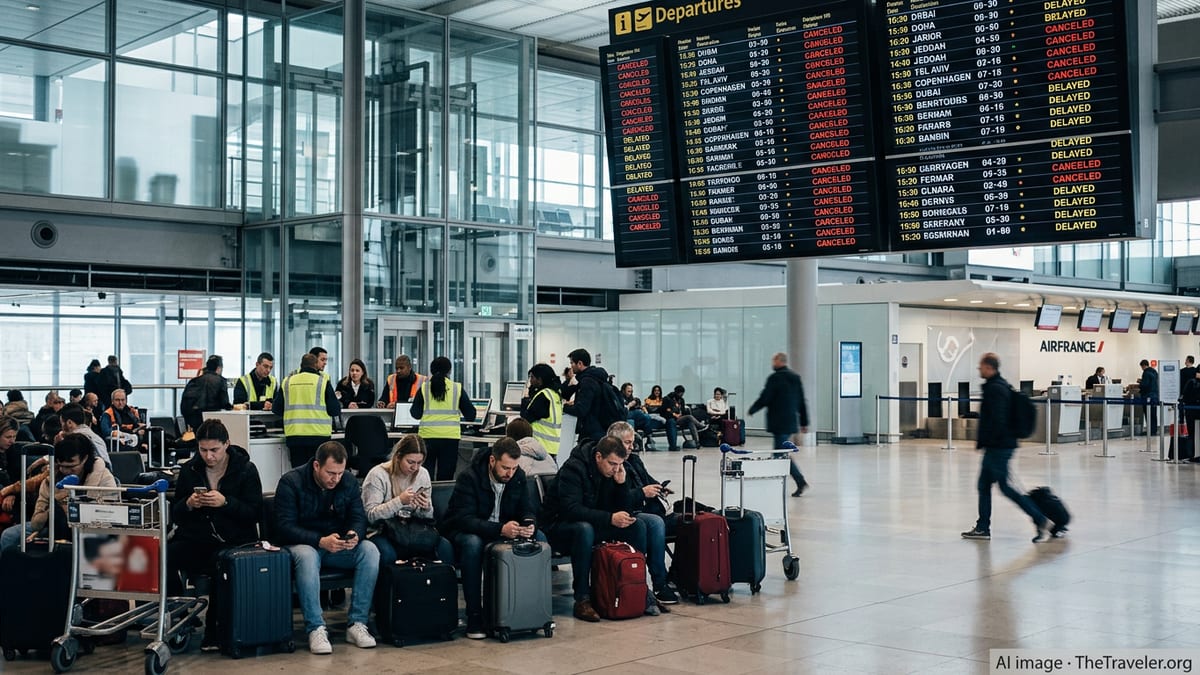
Paris Hubs Buckle Under Fresh Wave of Disruptions
Operational data from Monday shows Paris Charles de Gaulle and Orly among Europe’s hardest-hit hubs, with a combined tally of 25 cancellations and close to 200 delayed flights at Charles de Gaulle alone, and dozens more schedule changes at Orly. The disruption has left departure boards flickering with red notices and forced airport staff to manage growing queues at customer service desks as travelers scrambled for scarce alternative seats.
Air France, easyJet, Transavia and a roster of international carriers reliant on Paris for both point-to-point and connecting traffic all reported knock-on impacts. Airlines cited a mix of staffing constraints, aircraft and crew out of position, and longer routings around closed airspace further east as key reasons why tight European schedules were suddenly unraveling.
For passengers, the numbers translated into hours in terminal waiting areas, unexpected nights in airport hotels and missed onward connections. Stranded travelers reported being rebooked two or three days later on already crowded services, while others were handed meal vouchers amid uncertainty over when normal operations would resume.
French aviation officials said they were monitoring the situation but acknowledged that the combination of local bottlenecks and wider geopolitical turmoil had left airlines with limited room to maneuver. Even modest delays in the Paris system now risk cascading across a day’s operations.
Global Fallout Reaches the Gulf and the Eastern Mediterranean
The turbulence in Paris is unfolding against a backdrop of severe disruption in the Middle East, where airspace closures linked to the ongoing U.S.–Israel and Iran confrontation since late February have forced airlines to redraw their route maps. Major hubs at Dubai, Abu Dhabi and Doha have all experienced periods of partial or complete shutdown, prompting mass cancellations and diversions.
Lufthansa Group carriers, ITA Airways and Finnair are among European airlines that have suspended or curtailed flights to key Gulf and Middle Eastern cities, including Dubai, Abu Dhabi, Doha and Tel Aviv, with some suspensions now extended well into March and April. Air France has likewise prolonged the halt of its services to Dubai, Riyadh, Tel Aviv and Beirut while it reassesses the security outlook.
The result is a tightening squeeze on already limited long haul capacity between Europe and the Middle East. Flights that are still operating often take southerly detours to avoid restricted airspace, adding up to two hours to some journeys and throwing aircraft rotations off schedule. That in turn makes it harder for carriers to keep European short haul networks running smoothly, intensifying pressure on hubs like Paris.
From the passenger perspective, the geography of the disruption can feel arbitrary. A delay or cancellation notice in Paris may be triggered by events thousands of kilometers away: a crew who timed out after an extended reroute from Asia, or an aircraft stuck overnight in the Gulf due to a late-arriving security clearance.
Stranded Travelers Face Patchwork of Airline Responses
At Charles de Gaulle and Orly, the immediate human impact of the latest wave of disruption is visible in snaking queues at ticket counters and security checkpoints. Families bound for holidays, business travelers with full agendas and medical passengers on their way to specialist appointments have all found themselves with limited options as key routes into the Middle East and onward to Asia constrict.
Passenger experiences vary sharply depending on airline and ticket type. Some travelers reported that carriers, including major European network airlines, were proactively offering hotel rooms, meal vouchers and rebookings onto partner airlines. Others said they were directed to manage changes via apps and websites that buckled under demand or showed no alternative flights for days.
Consumer advocates noted that flights departing from European airports, including Paris, fall under EU passenger rights rules requiring assistance and, in some circumstances, compensation. However, airlines can invoke extraordinary circumstances when disruptions stem from security crises or sudden airspace closures, limiting travelers’ ability to claim cash payouts even while they remain entitled to care such as accommodation and meals.
For now, many stranded passengers are resorting to improvised solutions: buying separate tickets on low cost carriers to reach secondary hubs, rerouting via northern Europe to bypass congested southern corridors, or delaying trips entirely until airlines publish clearer schedules for the weeks ahead.
Airlines Struggle to Rebuild Fragile Timetables
Behind the scenes, operations control centers at European airlines are working around the clock to stitch together viable timetables day by day. With flights into and out of the Middle East repeatedly adjusted, carriers such as Lufthansa, ITA Airways and Finnair are juggling aircraft swaps, last minute charter additions and crew reassignments in an effort to keep their broader networks intact.
Air France, which relies heavily on Charles de Gaulle as its long haul gateway, has been recalibrating its schedule in real time, prioritizing key transatlantic and African routes while granting customers flexible rebooking options for affected Middle Eastern destinations. Low cost rivals like easyJet, which depend on tight turnarounds at busy airports, have also been forced into reactive cancellations when delays elsewhere make it impossible to operate certain rotations.
Industry analysts warn that even if the security situation in the Middle East stabilizes, it will take days to clear aircraft and crew backlogs and restore predictable operations. The interconnected nature of modern airline networks means that a cancelled morning departure from Paris can still be rippling through evening schedules in Copenhagen or Tel Aviv, particularly when spare aircraft capacity is already thin at the tail end of the winter season.
For European regulators and airport operators, the latest episode underscores how sensitive the continent’s air transport system has become to external shocks. With traffic nearing or exceeding pre-pandemic levels, there is far less slack in the system to absorb sudden route closures or large scale rerouting.
What Travelers Can Expect in the Coming Days
Travel experts advise anyone due to transit through Paris or to fly to or from the Gulf and the Eastern Mediterranean in the coming days to prepare for potential disruption, even if their flight is still listed as operating. That means monitoring flight status closely, allowing extra time at the airport, and keeping digital and printed copies of booking confirmations, insurance policies and key contact numbers.
Passengers already on the ground in France are being urged to make use of airline apps and online tools to request rebookings or refunds, but also to speak directly with airport staff when possible, particularly if they have urgent travel needs. In some cases, airlines have been willing to reroute travelers via alternative hubs such as Frankfurt, Amsterdam or Madrid to bypass the most affected corridors.
While the situation remains fluid, there are early signs that some Gulf carriers are gradually restoring limited services from Dubai and Doha, which may ease pressure on European networks if the security outlook improves. Yet airlines are proceeding cautiously, wary of reopening routes only to shut them again if airspace restrictions tighten.
For now, the scene at Paris Charles de Gaulle and Orly captures the fragility of global aviation in early 2026: a complex web where geopolitical tensions, operational constraints and surging passenger demand collide, leaving travelers at the mercy of cascading disruptions that can begin far beyond the terminal where they wait.