

More news on this day
Montmartre, one of Paris’ most recognizable neighborhoods and a symbol of bohemian charm, has been added to Fodor’s influential “No List” for 2026, spotlighting mounting concerns over overtourism in the French capital.
Get the latest news straight to your inbox!
Fodor’s No List 2026 Targets Overtourism Hotspots
The annual Fodor’s No List is designed as a cautionary signal rather than a boycott, drawing attention to destinations where visitor numbers are straining local life, heritage, and infrastructure. The 2026 edition highlights eight places around the world where travel demand is growing faster than communities and ecosystems can comfortably absorb.
Montmartre appears on this latest list alongside destinations such as Mexico City, the Canary Islands, and parts of Switzerland. Coverage of the list explains that these places are not being written off as unworthy of travel. Instead, they are cited as areas where travelers are urged to pause, reconsider timing and behavior, and look for less disruptive ways to explore.
The inclusion of a Paris neighborhood, rather than just a remote island or fragile natural site, underscores how overtourism has become an urban issue. As international arrivals to France rebound and Paris prepares for another busy year of events and cultural reopenings, pressure on high-profile districts has intensified.
Montmartre’s appearance on the No List reflects a growing global debate about how cities can preserve livability and authenticity while remaining open to visitors, and how individual travelers can adjust their habits in response.
Montmartre’s Crowds, Rising Prices, and “Disneyfication” Fears
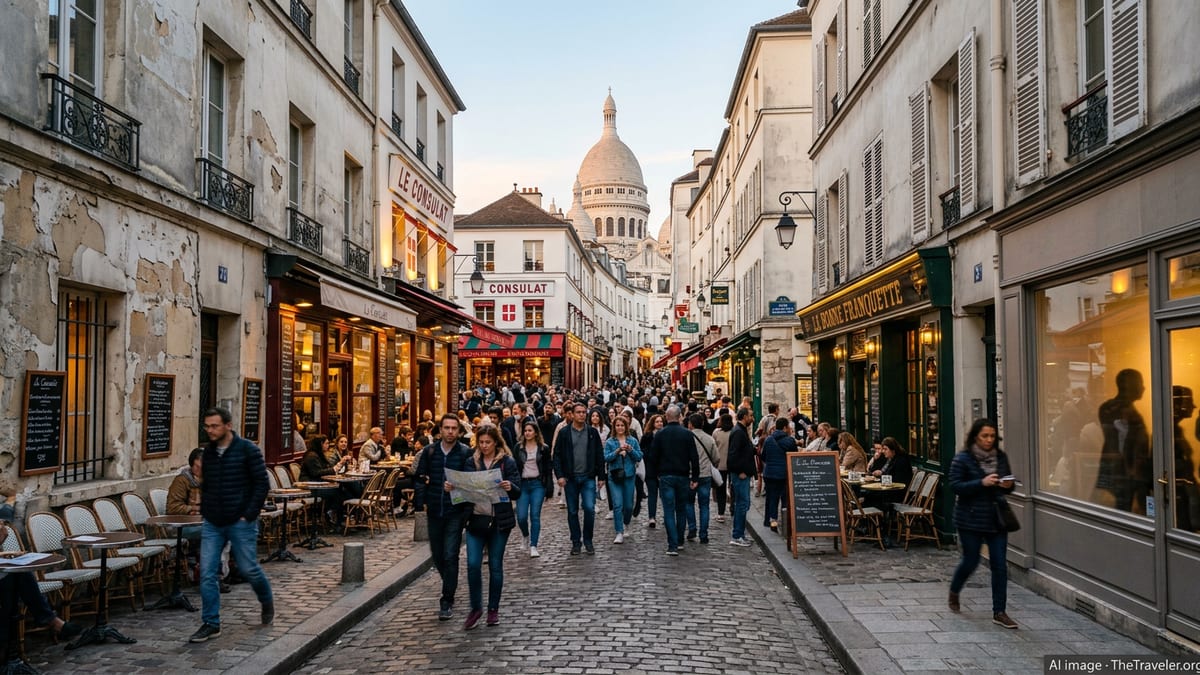
Perched on a hill in the 18th arrondissement and crowned by the Basilica of Sacré Coeur, Montmartre has long been a magnet for artists, filmmakers, and tourists drawn to its cobbled lanes and sweeping city views. Recent reporting on the district notes that it now receives millions of visitors each year, rivaling or even surpassing other marquee Paris attractions.
This heavy footfall is changing the fabric of daily life. Media coverage of the No List and local commentary describe a neighborhood where souvenir stalls, terrace restaurants, and short-term rentals increasingly dominate streets once known for village-like intimacy. Longtime residents and observers have raised concerns about a creeping “Disneyfication,” in which everyday businesses and traditional meeting spots are pushed out by venues catering almost exclusively to visitors.
Rising commercial rents and property prices linked to tourist demand are cited as key pressures. Some reports highlight efforts by local officials and community groups to keep schools and essential services in place despite demographic shifts, signaling a struggle to maintain a balanced, year-round population.
Evening and nighttime congestion, particularly around Place du Tertre and the steps of Sacré Coeur, has become another flashpoint. Accounts from residents and travel writers describe crowded terraces, dense queues, and a steady stream of tour groups that can make the neighborhood feel overwhelmed for much of the year.
What the “No List” Means for Paris Travelers
Fodor’s No List is framed as an advisory, not a binding directive. For visitors planning trips to Paris in 2026, the Montmartre warning functions as a call to rethink both where and how they spend their time. The message from travel editors and commentators is not simply to stay away, but to consider whether a visit at peak hours, or during peak seasons, contributes to the very pressures that are threatening the area’s appeal.
Publicly accessible information about the list emphasizes that the goal is to relieve some of the burden on overtaxed neighborhoods while encouraging discovery of lesser-known corners of the same city or region. In the case of Paris, that can mean seeking out alternative viewpoints over the skyline, exploring other historic quarters, or distributing time more evenly across the city instead of concentrating it in a handful of famous spots.
For travelers unwilling to skip Montmartre entirely, the warning serves as an incentive to adopt a lighter footprint. That might include visiting early in the morning or on quieter weekdays, spending money at locally owned businesses beyond the main squares, and choosing activities that do not add to noise or crowding in already saturated areas.
The broader implication is that popular urban districts, no less than beaches or national parks, now require more careful visitor management and more conscious travel behavior to remain livable and enjoyable.
Paris Balances Iconic Status With Quality of Life
Paris continues to rank among the world’s most visited and most admired cities, with recent industry analyses still placing it at or near the top of global city destination lists. That enduring draw fuels the local economy but also magnifies the stakes of managing tourism sustainably in neighborhoods like Montmartre.
As arrivals recover in the wake of recent global disruptions, Paris is juggling multiple, sometimes competing priorities: showcasing major cultural monuments, supporting local businesses that rely on tourism, protecting residential communities, and preserving heritage sites from overuse. The addition of Montmartre to a high-profile travel warning list highlights how difficult this balancing act has become.
Coverage of overtourism in France points to a pattern seen in other European destinations, where resident protests, stricter rules on short-term rentals, and new visitor management strategies are becoming more common. Paris is part of this wider shift, experimenting with measures that range from crowd monitoring near iconic sites to public campaigns encouraging off-season and off-the-beaten-path exploration.
For now, there is no single policy that resolves the tension entirely. Instead, city stakeholders are navigating incremental adjustments, and international travel advisories such as Fodor’s No List are feeding into public discussion about which areas can continue to absorb growth and which may need a temporary reprieve.
Responsible Alternatives and Changing Traveler Expectations
The 2026 spotlight on Montmartre aligns with a broader movement toward more responsible and slower travel. Surveys and trend reports suggest that a growing share of travelers are at least aware of overtourism and are open to adjusting plans if it means a more authentic, less crowded experience.
For visitors to Paris, this can translate into exploring surrounding districts that retain strong local character but sit outside the heaviest tourist flows, or allocating more time to neighborhoods where independent shops and community markets still dominate. Travel features and city guides increasingly highlight such areas as attractive complements or alternatives to headline districts.
In this context, Montmartre’s presence on Fodor’s No List functions less as a prohibition and more as a test case for changing expectations. Tourists are being invited to weigh the impact of their choices, from the season they travel to the type of accommodation they book and the way they move through popular spaces.
How travelers respond in 2026 and beyond will help determine whether historic districts like Montmartre can remain both beloved symbols on the postcard and livable neighborhoods for the people who call them home.