

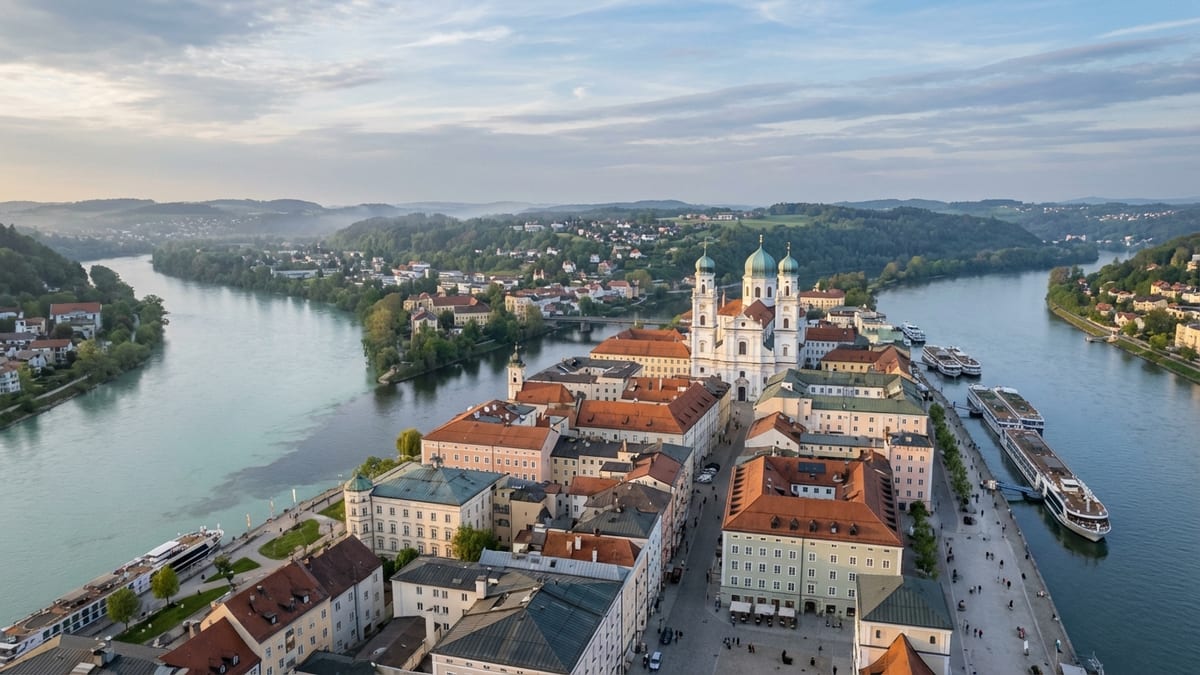
I arrived in Passau the way many people do, on a Danube cruise that treated the town as either a starting point or a convenient pause between better known cities. Before I went, Passau existed in my mind purely as “that pretty place where three rivers meet.” After spending time both as a cruise passenger and on my own, I left with a more complicated impression.
Passau is scenic and compact, with real moments of charm. It is also, at times, overwhelmed by river tourism, thin on deeper experiences if you do not plan well, and more of a short-stay town than a destination in its own right. Whether it is “worth visiting” depends a lot on how you travel, what you expect, and how long you give it.
First Impressions From the River: Picture Perfect, Then Crowded
Arriving by river felt almost unfairly pretty. The pastel houses stepped up the hills, church towers punched through the skyline, and the confluence where the Danube, Inn, and Ilz meet gave the whole scene a cinematic backdrop. From the water, Passau looks like the definition of a charming Central European town. I remember thinking that if it looked this good from a distance, exploring it at street level would be a delight.
Then my ship docked. The main moorings along the Danube promenade are only around ten to fifteen minutes on foot from the old town, which is convenient, but in peak season those moorings are packed with ships tied up side by side. I had to walk through another vessel to reach the gangway. It felt less like wandering into a quaint Bavarian town and more like disembarking into a floating cruise terminal that happened to be attached to one. That is not Passau’s fault, but it did puncture the romantic arrival I had imagined.
Once I stepped onto the promenade and followed the short, flat walk toward the Altstadt, the noise of buses, groups with lollipop signs, and overlapping loudspeakers from different tours hit me. It is very efficient if you are on a schedule: coaches wait right by the docks, the main squares are a short walk away, and almost everything in the historic center is reachable on foot. But the scene made it clear that Passau has calibrated itself heavily toward group visits of a few hours rather than independent travelers lingering for days.
The Old Town: Compact, Atmospheric, and Slightly Repetitive
Once I had shaken off the dockside chaos, I started to enjoy the old town. Passau’s Altstadt sits on a narrow peninsula, with pastel façades, cobbled lanes, and regular river views at the ends of streets. Walking from the promenade to the Town Hall and then up to the cathedral took me about fifteen minutes, even with photo stops. The compactness is one of Passau’s best features. It is hard to get lost and easy to see most of the highlights in half a day.
The Town Hall itself, with its Venetian-style façade and 38-meter tower, gives the riverfront a bit of drama. I watched the carillon play at 11:30 a.m., a pleasant little moment that felt more local than touristic. The surrounding streets mix Baroque architecture with the usual European blend of bakeries, pharmacies, and souvenir shops. After a while, though, there was a sameness to the storefronts: a lot of trinkets and fairly generic gifts rather than distinctive local crafts. I had hoped for more places that felt tied to the region’s culture rather than to cruise traffic.
What the old town does well is atmosphere. In the early morning or evening, after the day-trip buses leave, it takes on a quieter, more lived-in character. I enjoyed those times most, when I could hear church bells rather than megaphones and see residents running errands instead of only tour groups. If you only ever see Passau between 10 a.m. and 4 p.m., you get a much more commercial version of the city than the one I glimpsed at the edges of the day.
St. Stephen’s Cathedral and the Famous Organ: Beautiful, But Plan Carefully
St. Stephen’s Cathedral dominates the old town and, for many visitors, is the reason they know Passau exists. From the outside, its white façade and blue-green domes are impressive without being overwhelming. Inside, though, the Baroque interior is genuinely striking: lavish stucco work, frescoes, and a surprisingly bright, airy feel for such a historic building. It is open daily from 6:30 a.m. to 7 p.m. in the warmer months and until 6 p.m. in winter, which gives you plenty of flexibility.
Like most cruise passengers, I timed my visit around the midday organ concert. The cathedral houses what is billed as the largest Catholic church organ in the world, with almost 18,000 pipes. From May to October there are regular noon concerts on weekdays, with tickets sold on the morning of the performance. When I visited, the ongoing restoration of the organ meant it was not playing at full capacity. The sound was still impressive, but I never had the overwhelming “wall of sound” moment I secretly expected.
Logistically, the concert is not as seamless as you might assume. The cathedral closes to general visitors from 10:45 a.m. to 11:20 a.m. to prepare, and queues form early in the courtyard entrance once admission begins. Between the closure and the limited time before the concert, the interior visit felt a bit rushed. I found myself trying to “do” the cathedral quickly while also making sure I did not end up behind a column for the performance. It is a small frustration, but it changed the energy from contemplative to tactical.
Was the concert worth it? Yes, with qualifiers. If you love sacred music or large organs, hearing that instrument in that space is memorable, and the ticket price is modest by European standards. If you are only mildly curious and dislike crowds, the trade-off of waiting, jostling for seats, and navigating tour groups might not feel justified, especially when parts of the organ are under restoration. In hindsight, I would have skipped the generic city tour that doubled up on cathedral time and just visited independently, which would have given me a calmer experience.
Veste Oberhaus and the River Views: Great Reward, Real Effort
Across the Danube, looming above the town, is Veste Oberhaus, the fortress that defines Passau’s skyline. From below it looks monumental. Getting up there, however, is a little more demanding than the glossy brochures imply. I chose to walk, following a steep path that zigzags up from the old town. It took me about forty-five minutes at a moderate pace, and I am reasonably fit. The climb is worth it for the views, but if you have mobility issues or are visiting on a hot summer day, it is a slog.
Once at the top, the panoramic view redeemed the effort. You can see the three distinct colors of the Danube, Inn, and Ilz, the clustered roofs of the Altstadt, and the surrounding hills that frame the town. It was the one moment when Passau felt larger than its small size, part of a bigger river landscape stretching east and west. I found myself lingering at the viewpoints longer than I expected, partly for the scenery and partly to recover from the ascent.
The fortress itself functions as a museum complex and event space, with sections that feel more polished than others. Opening hours vary by season, and some exhibits were not accessible when I visited. That inconsistency was mildly frustrating. I had climbed expecting to spend a couple of hours exploring, but only parts of the museum were open, and signage in English was patchy. It felt like a place with great potential that has not fully decided whether it wants to be a major attraction or a backdrop for the view.
If I went again, I would check the current opening times more carefully and consider taking a bus or taxi up to the fortress, then walking down. The descent offers the same views with far less effort, and you still get the satisfaction of connecting the fortress with the town below on foot.
Life Between the Rivers: Dreiflüsseeck, Walks, and Everyday Details
One of Passau’s signature spots is Dreiflüsseeck, the narrow tip of the peninsula where the three rivers meet. The walk there from the center is flat and pleasant, with the water on both sides and occasional glimpses of residential life. The actual viewing area is a simple riverside promenade rather than a dramatic platform, and the color difference between the rivers can be subtle, depending on weather and light. I liked the peacefulness more than the spectacle. It is the kind of place where you sit on a bench, watch the water move in different directions, and slowly appreciate the geography.
Around the confluence, I noticed one of Passau’s quiet strengths: the easy access to walks and bike paths without having to leave town. Paths follow the rivers in several directions, and within minutes I had left the clusters of tour groups behind and found myself among joggers, dog walkers, and cyclists. It did not feel like a curated “attraction,” more like a lived-in public space. That side of Passau does not appear much in cruise brochures, but it is what made the town feel like more than a set of postcard views.
Day-to-day logistics, however, reminded me how limited Passau can be for independent travelers. The town’s train station connects reasonably well to Munich and Vienna, but airport access requires transfers and a few hours of travel. If you are not arriving or departing by cruise, reaching Passau is not hard, just not particularly convenient from major hubs. Inside the town, public transport exists but is secondary to walking; buses help with some hills and outlying districts, but schedules can be sparse in the evening. For most visitors, footwear is more important than a transit map.
On a practical level, I did not struggle to find ATMs, supermarkets, or casual places to eat. Prices in cafés and restaurants in the core old town skewed slightly higher and more tourist-oriented, but stepping just a few streets off the main arteries brought them down and improved quality. It is not a food destination, but I did have a couple of solid meals of regional dishes that felt honest and unpretentious, if not outstanding.
Seasonal Passau: When the Town Feels Different
I visited Passau twice: once in late spring on a cruise, and later in early December on a short independent trip when I was already in Bavaria. The difference in atmosphere between the two was substantial. In spring, the town felt saturated by river tourism. Groups streamed from one sight to another, and every corner near the cathedral seemed oriented toward bus timetables and excursion check-in points. The advantage was that everything was open, from museums to guided tours, and the riversides were green and inviting.
In December, the rhythm changed. The Christkindlmarkt around the cathedral brought its own crowds, but they felt more mixed: families from the region, locals meeting friends, and only a scattering of tour groups. The market itself had the usual winter mix of food stalls, handicrafts, and decorations. It was charming, but not dramatically different from other Bavarian markets. What I appreciated more was how the cold air, early dusk, and lights softened the old town’s edges and gave it a cozier feel.
The downside of winter was reduced opening hours and more limited activity options. Some guided tours only run from April to October, certain museum areas operated on shorter schedules, and the riverside walks were less comfortable in freezing wind. Had I not already seen the fortress and some of the outlying churches on my spring visit, I might have felt boxed in. It reinforced the idea that Passau is best as part of a wider itinerary, not as a standalone destination for several days, especially outside peak season.
If I were advising someone now, I would say that late spring and early autumn probably hit the best balance: long daylight, open attractions, and slightly fewer peak-season crowds than mid-summer. Winter is worth considering mainly if you are specifically interested in Christmas markets and do not mind shorter days and a narrower range of activities.
Beyond the Postcard: Where Expectations and Reality Diverged
Going in, I had unconsciously slotted Passau into the same mental category as places like Regensburg or even smaller Austrian towns along the Danube, expecting a combination of historical depth, architectural variety, and a few genuinely distinctive experiences. After two visits, my view is more measured. Passau delivers on visual charm and walkability, but it does not have the same density of standout attractions or the same sense of layered urban life that some comparably sized cities do.
One disappointment was how surface-level some of the guided experiences felt. The standard city tour I joined through the cruise line moved briskly from the cathedral to a couple of squares, sprinkled in a few historical anecdotes, and steered us back toward souvenir shops. It was efficient but forgettable. When I later did my own reading and wandered the back streets without a schedule, I felt I learned more about the town’s history and character than on the official tour. I left wishing there were more thoughtfully curated, small-group walks that went beyond the usual Greatest Hits circuit.
Another gap between expectation and reality was cultural life. With a major cathedral, university, and significant history, I expected more in the way of galleries, contemporary art spaces, or music events beyond the organ concerts and occasional classical performances. Some of this may have been timing; event calendars in smaller cities ebb and flow. But overall, I felt Passau leaned heavily on its historic assets while underplaying or underdeveloping newer cultural experiences that might encourage longer stays.
None of this made me dislike the town. It simply reframed what I thought it was. Rather than a mini cultural capital on the Danube, Passau struck me as a very attractive small city that has grown comfortable as a scenic pause on bigger journeys, both in geography and in travelers’ minds.
Would I Go Back, and What Would I Do Differently?
If someone offered me another chance to stop in Passau as part of a Danube trip, I would accept, with the clear understanding that it is a one-to-two-day place for me, not a longer stay. I would prioritize early mornings and evenings in the old town, when the streets belong more to locals than to groups with headsets. I would also build in unstructured time along the rivers rather than trying to tick off every sight in a compressed window.
There are things I would change about how I approached it. On the cruise visit, I let the ship-organized city tour dictate my day. That meant I hit the same places as everyone else, at the same time, in the most crowded conditions. Next time, I would skip the package tour entirely. With a map and a bit of preparation, it is easy to visit St. Stephen’s, stroll the core of the old town, walk to the Dreiflüsseeck, and still be back onboard before departure.
I would also be more deliberate about the fortress visit. Rather than marching straight uphill from the river, I would consider taking public transport or a taxi up, checking museum opening details beforehand, and then wandering back down at my own pace, stopping for viewpoints along the way. That would preserve the rewards of the panorama without turning the climb into a test of persistence.
In terms of accommodation, my independent winter stay taught me that sleeping in Passau rather than just transiting through it completely changes the feel. Seeing the town before the first busload arrives and after the last ship’s passengers have re-boarded gave me a quieter, more authentic sense of place. If I were planning a Danube-focused trip by train and bus, I would happily overnight here for one or two nights, using it as a base to rest rather than as a hub for extensive day trips.
The Takeaway: Who Passau Is Worth It For
So, is Passau worth visiting or just a stop on a Danube cruise? For me, it sits somewhere in between those extremes. It is more than a quick photo stop, but less than a major destination around which to build an entire trip. The town’s strengths are its setting at the confluence of three rivers, its walkable and photogenic old town, and the combination of St. Stephen’s Cathedral and the fortress views. Its weaknesses are an overdependence on short group visits, a somewhat limited range of deeper cultural experiences, and the logistical reality that most travelers will naturally fold it into a larger itinerary.
If you are already taking a Danube cruise that includes Passau, I would absolutely get off the ship and explore. Adjust your expectations to “compact, scenic town for a half or full day” rather than “life-changing highlight of the river,” and you will likely leave satisfied. Focus on wandering rather than rushing between must-see spots, and try to escape the densest clumps of tour groups when you can.
If you are planning an overland trip through Bavaria and Austria, Passau is worth considering as a gentle overnight pause. One night gives you the early and late hours that show off the town at its best. Two nights might work if you deliberately slow your pace and treat Passau as a place to breathe between larger cities, rather than as an attraction to conquer. More than that, unless you have a special interest in river landscapes or ecclesiastical history, might stretch the town’s offerings.
Where Passau is least compelling, in my view, is as a standalone destination that you detour to at great effort and expense, expecting a wealth of unique museums, cutting-edge culture, or a long list of must-do experiences. It is lovely, but not that kind of place. Its charm lies in its scale, its rivers, and its role as a pleasant chapter in a longer journey. Within those parameters, and especially for travelers who enjoy walking, quiet views, and historic churches, Passau is still worth the time.
FAQ
Q1: How long should I spend in Passau?
For most travelers, a half day to a full day is enough to see the main sights, including the cathedral, old town, and river confluence. If you stay overnight, you gain calmer early mornings and evenings, which show the town at its best.
Q2: Is Passau easy to visit without a cruise?
Yes. Passau has a main train station with regular connections to cities like Munich and Vienna. It is not directly on an airport line, so you will usually connect via a larger hub, but it is straightforward if you are comfortable with European rail.
Q3: Are the St. Stephen’s Cathedral organ concerts worth it?
If you enjoy sacred music or large organs, the concerts are a highlight and ticket prices are reasonable. You should be aware that ongoing restoration means the organ may not always play at full capacity, and the cathedral closes briefly before the concert, which can make the visit feel rushed.
Q4: How strenuous is the walk to Veste Oberhaus?
The walk is steep and can take around forty-five minutes, so it can feel demanding, especially in hot weather or if you are not used to hills. Many people choose to take a bus or taxi up and then walk back down to enjoy the views with less effort.
Q5: When is the best time of year to visit Passau?
Late spring and early autumn generally offer the best balance of pleasant weather, open attractions, and manageable crowds. Summer brings more cruise traffic and bus tours, while winter has the charm of the Christmas market but shorter days and reduced opening hours for some sights.
Q6: Is Passau a good base for day trips?
Passau can work as a short stop on a broader itinerary, but it is not ideal as a long-term base for multiple day trips. Connections to other towns exist, but for extensive regional exploration, larger hubs like Munich or Linz offer more options.
Q7: How crowded does Passau get with cruise ships?
In peak season, several ships can dock along the Danube promenade at the same time, and some moorings sit outside easy walking distance. This can mean busy streets and clustered tour groups in the old town during late morning and early afternoon.
Q8: Is Passau suitable for travelers with limited mobility?
The old town itself is compact and mostly flat, though some streets are cobbled. The cathedral has a barrier-free entrance via a side access with a ramp. Reaching the fortress on foot can be challenging, so using a taxi or bus is advisable if you have mobility concerns.
Q9: How is the food scene in Passau?
The food scene is solid rather than spectacular, with plenty of Bavarian and regional dishes and a few more contemporary cafés. In the core tourist areas, menus can feel repetitive and slightly overpriced, but walking a few streets off the main squares improves both variety and value.
Q10: Is Passau worth a special trip on its own?
In my experience, Passau is best as part of a larger journey along the Danube or through Bavaria and Austria, not as a standalone destination. It is definitely worth visiting if you are already nearby or on a cruise, and it rewards a short stay, but it does not have enough distinctive attractions to justify a major detour all by itself.