

More news on this day
Air travelers across Thailand and Sri Lanka are facing renewed disruption, with widespread flight cancellations at Bangkok’s Suvarnabhumi Airport and Colombo’s Bandaranaike International Airport leaving passengers stranded, scrambling for scarce alternative routes, and confronting unclear timelines for normal operations to resume.
Get the latest news straight to your inbox!
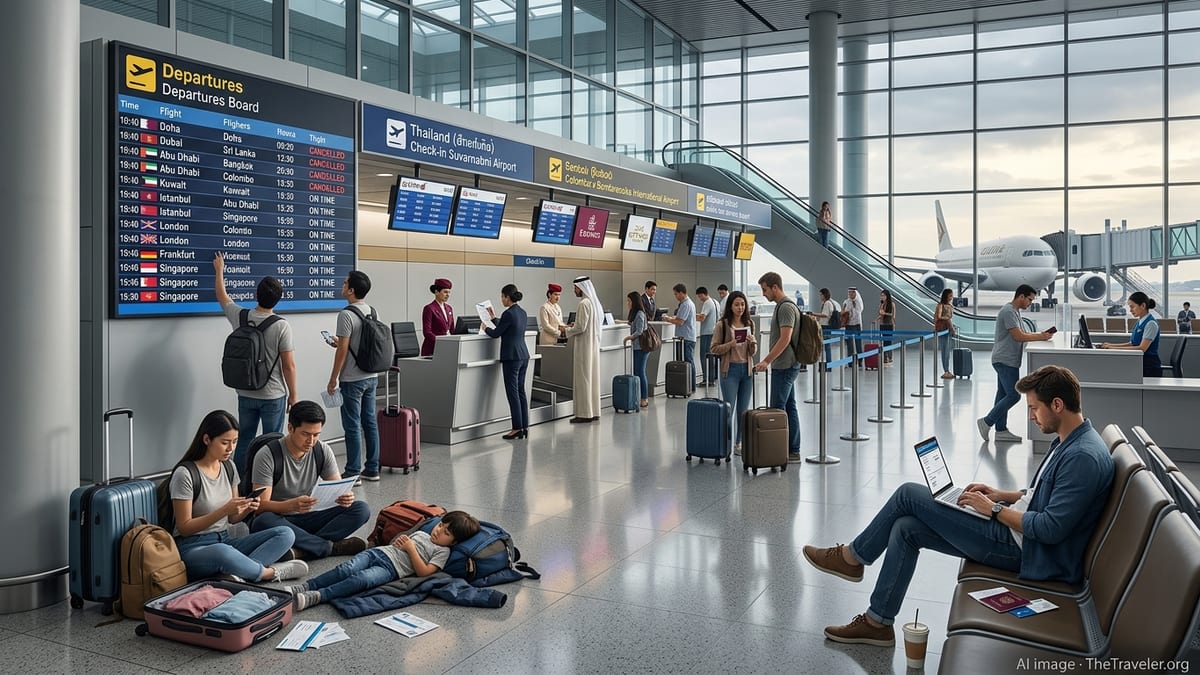
Regional Tensions Ripple Through Key South Asian Hubs
Recent upheaval in Middle Eastern airspace has triggered a fresh wave of schedule changes across major carriers serving Southeast and South Asia, and the impact is acutely visible at Suvarnabhumi Airport in Bangkok and Bandaranaike International Airport near Colombo. Publicly available airline notices and regional media reports describe a pattern of suspensions and cancellations on routes linking these hubs with Gulf transit points such as Doha, Dubai, Abu Dhabi and Kuwait, as carriers adjust to closed or restricted corridors.
In Sri Lanka, local newspaper coverage in early March 2026 highlighted that SriLankan Airlines and several foreign carriers temporarily halted or sharply reduced services on selected Middle Eastern routes, with dozens of departures and arrivals removed from the schedule in a short period. The changes were described as precautionary responses to heightened security risks along traditional flight paths rather than issues at Colombo’s own airport facilities.
Thailand’s main gateway has likewise experienced knock-on effects. While Suvarnabhumi continues to handle high volumes of regional and domestic traffic, international itineraries that rely on connections through the Gulf have been hit hardest. Travel forums and booking data shared publicly show multiple long-haul passengers being rebooked via alternative hubs in Europe or East Asia, or advised to shift onto indirect routings that avoid the most affected airspace.
The result is an uneven picture for travelers. Flights within Asia are, in many cases, operating close to normal, but journeys that once depended on rapid connections through Middle Eastern hubs now carry a higher risk of last-minute changes, extended layovers and route diversions.
Stranded Tourists Confront Long Delays and Costly Alternatives
For travelers already in Thailand or Sri Lanka, the most visible consequence has been unexpected days or even weeks added to their trips. Public posts from passengers attempting to depart Colombo describe flights canceled or marked as "not operating" with limited advance notice, followed by long waits for updates through airline call centers or online portals.
Many reports from Sri Lanka describe travelers weighing whether to trust their original carrier to reroute them via a different hub or to pay out of pocket for completely new tickets on unaffected airlines. Some accounts involve travelers spending several hundred to several thousand euros per person for new one-way itineraries via secondary hubs such as Istanbul, Mumbai or Singapore, often purchased just days before departure.
Similar stories are emerging from Bangkok, where tourists bound for Europe, the Middle East and North America report being advised to shift onto routes via East Asian or South Asian hubs when connections through the Gulf are disrupted. Those who booked on popular Middle Eastern carriers are in some cases being offered rebooking on later dates, but face uncertainty over whether subsequent services will operate as planned if airspace conditions change again.
The financial implications are also significant. Some stranded passengers recount situations in which refunds for canceled flights are promised but may take weeks to process, forcing travelers to cover new flights, extra accommodation and daily expenses while they wait for reimbursement. Others indicate they were offered rebooking at no additional fare but had to accept dramatically altered itineraries with much longer travel times.
Colombo’s Bandaranaike Airport: Operations Stable, Routes in Flux
At Bandaranaike International Airport, the disruption is largely concentrated on routes crossing affected Middle Eastern corridors rather than on the airport’s core infrastructure. Local news coverage in Sri Lanka during early March noted that airport operations, security and ground services remained broadly normal, even as airlines trimmed frequencies or temporarily suspended flights to specific destinations.
Officially published statements from SriLankan Airlines over this period refer to cancellations on select routes and the need to constantly reassess network planning as the regional situation evolves. Coverage in Sri Lankan media indicates that around several dozen flights were removed from schedules within just a few days during the height of the recent escalation, particularly services linking Colombo with Gulf destinations and onward European connections.
To maintain connectivity, carriers have begun to adjust routings rather than cancel entire markets where possible. Some SriLankan Airlines long haul flights to Europe have reportedly been operated on longer trajectories skirting sensitive airspace, resulting in increased flight times and, in some cases, temporary limits on baggage allowances due to higher fuel loads. Travelers are advised in public notices to monitor their booking status closely, as flight numbers and departure times may be revised even when a service is still scheduled to operate.
At the same time, anecdotal accounts from tourists in Colombo suggest that not all affected passengers are receiving proactive communication at the same pace. Several travelers report discovering cancellations only when checking their bookings online, then having to navigate busy customer service lines or digital forms to secure refunds or new dates.
Bangkok’s Suvarnabhumi Sees Patchy Impact by Route and Carrier
Suvarnabhumi Airport in Bangkok functions as both a major origin and a transfer hub, so any disruption to long haul corridors can quickly translate into crowded transfer desks and pressure on alternative routes. Publicly available flight tracking and consumer reports indicate that the effect of the current wave of cancellations is uneven, depending largely on the airline and destination.
For travelers connecting between Thailand and Europe or the Middle East on carriers that rely heavily on Gulf hubs, disruptions have included outright cancellations, equipment changes, or rerouting through partner hubs that avoid sensitive airspace. Some itineraries have been reconstructed via secondary points in South Asia or Eastern Europe, turning once straightforward one-stop journeys into multi-leg trips with longer overall travel times.
However, routes operated by airlines that overfly safer corridors or use hubs outside the most affected region appear to be less disrupted. Flights connecting Bangkok to East Asian cities, as well as services operated by carriers using alternative paths to Europe, are still operating in larger numbers, though schedules are subject to short-notice adjustments if demand spikes or operational requirements shift.
Travelers at Suvarnabhumi have reported long queues at airline service counters following sudden schedule changes, particularly during peak departure waves. In some cases, passengers are being given meal vouchers and hotel arrangements when overnight delays are unavoidable, consistent with airline obligations under local regulations and voluntary policies, though experiences vary widely by carrier and ticket type.
What Travelers Need to Know Before Flying Through Thailand or Sri Lanka
For anyone planning to transit Suvarnabhumi or Bandaranaike in the coming days and weeks, the unfolding situation underscores the value of careful preparation and flexible routing. Publicly available advisories from airlines and civil aviation bodies consistently emphasize that passengers should verify the real time status of their flights before heading to the airport, as same day cancellations and rerouting remain possible while regional airspace restrictions are in flux.
Travel experts commenting in news and industry outlets recommend, where feasible, booking itineraries that avoid reliance on a single high risk hub, especially for long haul journeys between Europe and Asia. Routes via South Asian, East Asian or European hubs that sit further from the current conflict areas are, at present, showing fewer large scale cancellations, although longer flying times and higher fares are common.
Travel insurance with robust trip interruption and cancellation coverage is also emerging as an important consideration. Policies that cover additional accommodation, rebooking fees and last minute ticket purchases can help mitigate the financial shock if an outbound or return flight from Bangkok or Colombo is suddenly removed from the schedule.
Finally, passengers already on the ground in Thailand or Sri Lanka who find themselves stranded are being encouraged, in publicly available guidance, to maintain close contact with their airline through official channels and to consider alternative routes via nearby hubs if they have the resources to do so. With schedules still being revised frequently, flexibility, early action and a clear understanding of airline and insurance terms are proving critical for getting home or onward with as little disruption as possible.