

More news on this day
Pattaya’s pivotal mass‑market tourism model is coming under strain as sharply higher airfares, Thailand’s flat 220 baht ATM fees for foreign cards and widespread currency conversion markups erode value for visitors before they even reach the resort city.
Get the latest news straight to your inbox!
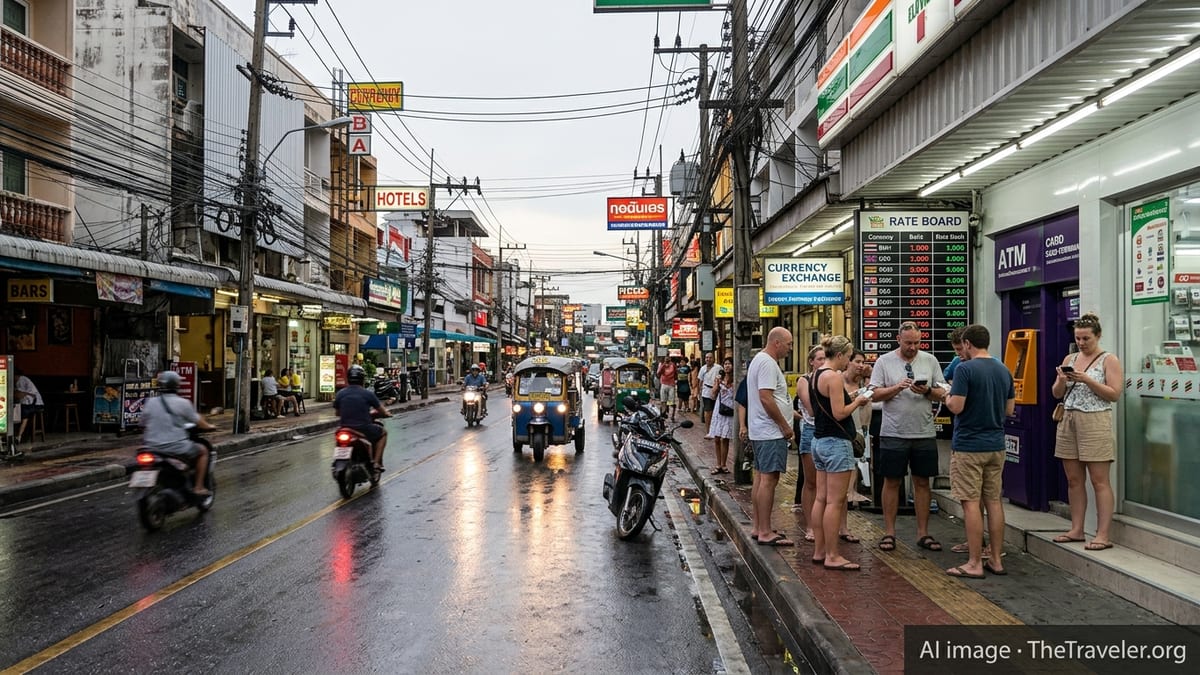
Resort City Caught Between Recovery and Rising Costs
Pattaya has rebounded strongly in headline visitor numbers since Thailand’s borders reopened, with local reports indicating more than 24 million arrivals in 2024 and a growing push toward “quality over quantity” tourism. At the same time, travel conditions facing many of those visitors have become materially more expensive, particularly for budget travelers from nearby Asian markets.
Regional air traffic has recovered at a rapid pace, but capacity on many Asia Pacific routes into Thailand remains tighter than before the pandemic. Industry data for 2024 show global passenger demand at record highs while seat growth has lagged, contributing to elevated fares on popular regional and long haul routes into Bangkok, the main gateway for Pattaya. For travelers pairing long flights with connecting buses or private transfers, the total transport bill is noticeably higher than five years ago.
Currency movements have added another layer of complexity. The Thai baht has been comparatively firm against several source market currencies, including the Chinese yuan, which reduces on the ground purchasing power for visitors arriving with pre set budgets. Travel analysts note that when air tickets are already absorbing a larger share of trip spending, any further erosion from fees and exchange spreads can quickly make a previously affordable destination feel out of reach.
This tension is especially acute for Pattaya, whose traditional appeal has relied on affordable nightlife, value hotels and inexpensive local services. While high spending segments from Russia and Europe are helping fill hotel rooms, smaller tour operators, bars and budget guesthouses increasingly depend on cost conscious travelers who are more sensitive to pre arrival costs.
Flat 220 Baht ATM Fees Hit Budget Travelers Hard
For foreign visitors who rely on cash withdrawals once they arrive, Thailand’s standardized 220 baht fee per withdrawal on most bank ATMs has become one of the most visible friction points. Public fee schedules from major Thai banks show that from late 2024 onward, a 220 baht local charge per transaction is applied to Visa, Mastercard, UnionPay and JCB cards issued overseas, regardless of the amount withdrawn.
Travel money guides tracking Thailand’s banking market describe the fee as a “local ATM usage” charge levied by the Thai bank, on top of any foreign transaction or out of network charges from the customer’s home bank. For visitors staying in Pattaya for several weeks who withdraw modest sums every few days, these fixed fees can add up quickly, effectively acting as a repeated surcharge on cash access.
The impact is particularly steep for travelers from neighboring countries and backpackers who tend to take out smaller amounts to manage day to day spending. A withdrawal of 4,000 baht, for example, attracts the same 220 baht local fee as a withdrawal of 20,000 baht, making low value transactions disproportionately expensive. Budget travelers posting on consumer forums frequently advise each other to withdraw larger sums less frequently or to rely more heavily on cards for point of sale payments to avoid repeated ATM hits.
In Pattaya’s cash oriented segments, from street food and local transport to smaller nightlife venues that still prefer banknotes, this creates a tension between minimizing bank fees and maintaining reasonable safety by not carrying excessive cash. For visitors already facing elevated airfare costs, the perception that they are paying a premium simply to access their own money can undermine the sense of value traditionally associated with Thailand’s seaside towns.
Dynamic Currency Conversion and Hidden Markups at the Point of Sale
Beyond ATM fees, foreign tourists in Pattaya are increasingly confronted with dynamic currency conversion at payment terminals and cash machines. This practice, widely documented by travel money commentators, offers visitors the option to be charged in their home currency rather than in Thai baht, often presenting itself as a convenience by displaying the exact amount in euros, pounds or dollars on screen.
However, public discussions of card payment practices in Thailand consistently highlight that the exchange rates applied through dynamic currency conversion tend to be significantly worse than network benchmark rates. The spread can exceed the headline margin advertised on screen, with an additional markup built into the rate itself. For an individual transaction at a bar, restaurant or mall in Pattaya, the difference may appear small, but over a week or two of holiday spending the total cost can rival or exceed the impact of the ATM fee.
At ATMs, similar conversion offers appear when foreign cardholders attempt to withdraw cash. Machines may propose a guaranteed home currency rate that embeds several percent in hidden margins while simultaneously charging the flat 220 baht local fee. Consumer advocates argue that many tourists accept these offers without understanding that declining the conversion and choosing to be charged in baht, while still paying the ATM fee, usually results in a significantly better overall rate.
The combination of opaque currency conversion and fixed withdrawal fees means that even before hotel bills, tours or nightlife are considered, visitors to Pattaya can lose a notable slice of their budget to financial frictions. For a destination that has long marketed itself as a place where modest savings go a long way, this erosion of perceived value may weaken its appeal compared to competing beach destinations in Vietnam, Malaysia or the Philippines.
Shift Toward “Quality Tourists” Risks Leaving Gaps
Thai tourism planners have increasingly articulated a strategy centered on attracting higher spending “quality tourists” rather than maximizing arrival numbers, and recent commentary suggests that this approach is becoming more visible in Pattaya. Reports indicate that hotel operators in the city are focusing on longer staying European and Russian guests who generate more revenue per room, even as overall foreign arrivals show signs of plateauing.
Analysts observing the local market note that this shift dovetails with structural factors such as higher airfares from key Asian markets and the financial friction created by banking fees. As thresholds for discretionary travel rise, middle class visitors from China, Malaysia and South Korea, once core segments for Pattaya, may opt for destinations perceived as cheaper or easier to navigate financially, while wealthier long haul guests remain willing to absorb the additional costs.
At the same time, publicly available tourism data and commentary emphasize that Chinese arrivals to Thailand, and particularly to Pattaya, remain well below 2019 levels. Combined with the drag from financial fees and currency movements, this leaves the city vulnerable to any downturn in European or Russian demand. Smaller businesses that previously relied on high volume, lower margin trade from coach tours and weekend city breakers may struggle to adapt to a model built around fewer but richer visitors.
Local travel businesses are already adjusting by experimenting with bundled packages that fold in transfers, some meals and excursions, in a bid to make pricing more predictable and reduce the irritation tourists feel when repeatedly confronted with unforeseen financial charges. Yet these efforts operate within a broader cost environment that the city itself does not directly control, from fuel driven airfare levels to banking fee structures set at the national level.
Growing Risk That Costs Deter Would-Be Visitors Before Booking
As information about Thai ATM fees, dynamic currency conversion pitfalls and rising ticket prices circulates widely through travel blogs, social platforms and consumer finance sites, potential visitors often encounter these cost warnings at the planning stage. Trip budget calculators and online discussions now routinely add several hundred baht in banking fees and a percentage buffer for exchange rate markups when estimating total costs for a week in Pattaya.
For many travelers, particularly those considering their first trip to Thailand, these pre trip calculations shape the decision of whether to book at all. If long haul tickets into Bangkok remain elevated and prospective visitors know they may lose additional value on every cash withdrawal and card payment, some will opt for destinations where such frictions are less pronounced. Industry observers caution that this dynamic could cap Pattaya’s growth even if headline visitor targets for Thailand as a whole are met.
The city’s tourism stakeholders face a delicate balancing act. Pattaya benefits from the national strategy of pursuing higher spending segments, but it also risks losing the diverse mix of budget minded regional visitors that helped sustain its economy for decades. Reports tracking Thailand’s tourism performance suggest that without addressing the combined pressure of airfares, banking fees and currency markups, Pattaya could see its reputation as an affordable, accessible resort eroded before visitors even step onto its beaches.