

More news on this day
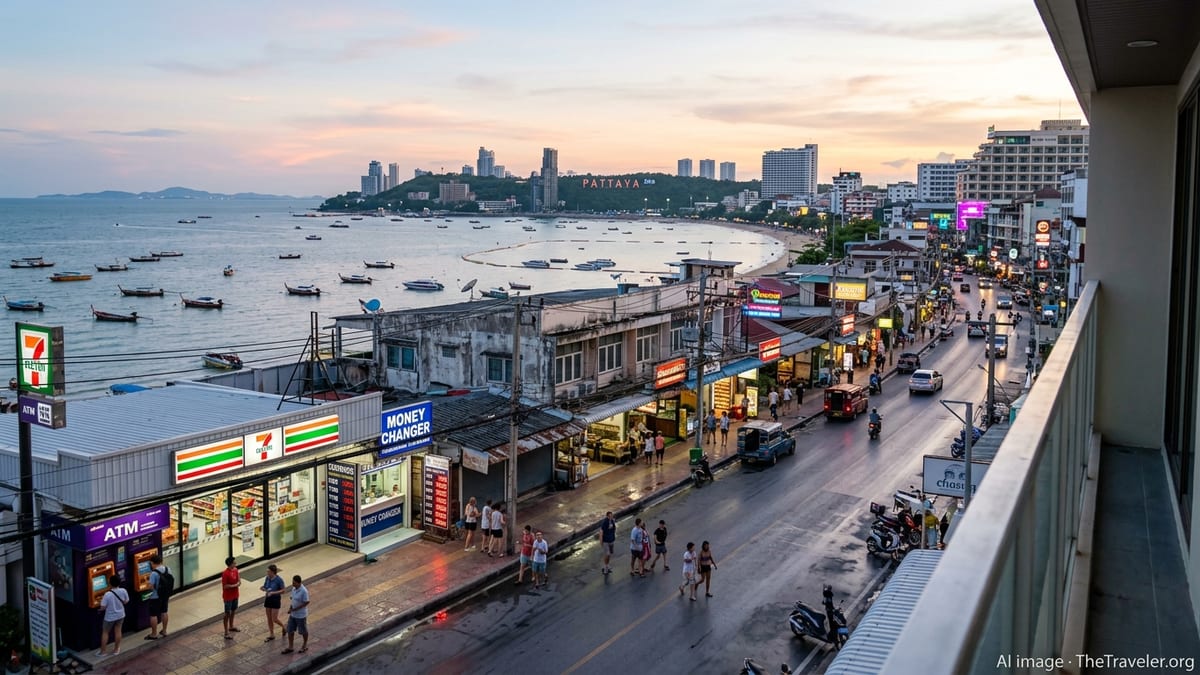
Pattaya’s reputation as one of Thailand’s most affordable beach playgrounds is under growing pressure, as high long-haul airfares, hefty ATM withdrawal charges and aggressive currency conversion markups combine to push up the real cost of a holiday before visitors even reach the city’s neon waterfront.
Get the latest news straight to your inbox!
Airfare Inflation Undercuts Thailand’s Value Proposition
Thailand’s tourism recovery has been framed around value for money, but travelers heading to Pattaya increasingly face higher costs long before they see a palm tree. Global airline capacity constraints, volatile fuel prices and strong demand for Asia routes have kept long-haul fares elevated into 2025 and 2026, particularly from Europe and North America. Industry and travel media reports describe Thailand-bound ticket prices that in many cases remain well above pre-pandemic levels in economy cabins, with premium cabins often out of reach for mainstream leisure travelers.
Regional coverage of Pattaya’s tourism outlook highlights that high airfares are now a central risk to Thailand’s visitor targets. Analyses focusing on Chonburi province, where Pattaya is located, note that air travel costs are eroding the spending power of key markets such as European holidaymakers, who traditionally stay longer and spend more per trip. At the same time, a weaker euro against the baht in recent seasons has further tightened budgets, amplifying the impact of each additional dollar or euro spent on getting to Thailand instead of in-destination.
These trends arrive at a delicate moment. Research on Pattaya’s hotel sector shows that average occupancy has recovered to healthy levels on paper, but operators are reporting more cautious spending patterns from guests. Industry commentary links this softness in on-the-ground spending partly to the burden of transport costs: the more money visitors sink into airfare, the less they have left for restaurants, nightlife and excursions in Pattaya itself.
Policy discussions within Thailand’s tourism and aviation communities, as reflected in published commentary, have floated solutions such as more competitive fares, additional direct routes into nearby U-Tapao airport and targeted promotions with airlines. Yet until such measures translate into tangible price relief, Pattaya remains exposed to an external cost shock that local businesses cannot directly control.
Rising ATM Fees Turn Cash Access into a Hidden Surcharge
For many foreign tourists, the price spiral does not end at Suvarnabhumi or Don Mueang airports. Once in Thailand, a growing share of visitors rely on ATMs to access cash, only to encounter some of the highest withdrawal charges in Southeast Asia. Up-to-date consumer guides and banking documents show that most Thai banks now levy a flat fee in the range of 220 to 250 baht per withdrawal when a foreign-issued card is used, regardless of the amount taken out.
Travel banking advisories note that these fees are often embedded directly in the transaction amount rather than itemized separately, making them less visible at first glance. For example, a traveler withdrawing 10,000 baht might see a charge of 10,250 baht debited to their home bank, with the 250 baht representing the local ATM operator’s fee. Frequent small withdrawals quickly add up, effectively adding tens of dollars in additional costs over a one or two week stay.
The burden is particularly pronounced for budget-conscious visitors who prefer to limit the amount of cash they carry at any one time. Guidance from travel finance specialists increasingly advises tourists to withdraw the maximum permitted amount per transaction to dilute the impact of the flat fee, but withdrawal caps and personal security concerns mean this is not always practical. Social media threads and travel forums are filled with frustration at what some users characterize as a “cash access surcharge” on top of existing bank charges at home.
These ATM costs, while technically optional, are functionally unavoidable for many visitors who still need cash for smaller businesses, markets and transport options that remain cash-centric. As a result, what was once a minor fee has become a meaningful factor in trip budgeting, further challenging Pattaya’s appeal as a low-friction, low-cost destination.
Currency Conversion Markups Quietly Erode Spending Power
Alongside ATM fees, tourists in Pattaya increasingly encounter dynamic currency conversion at ATMs, hotels and card terminals. This practice, often abbreviated as DCC, allows customers to see charges in their home currency rather than in baht. Consumer protection groups and travel money guides consistently warn that, while convenient, this feature frequently comes with unfavorable exchange rates compared with those offered by global card networks or specialist travel cards.
Investigations by travel bloggers and independent finance sites have documented spreads that can add several percentage points to each transaction. Over the course of a trip, repeated acceptance of such conversions at ATMs and payment terminals can quietly cost a traveler the equivalent of several nights’ accommodation or multiple restaurant meals. Warnings now routinely urge visitors to always choose charging in baht, not in their home currency, yet the on-screen prompts can be confusing or presented in a way that appears to recommend the higher-cost option.
Exchange counters in tourist-heavy areas of Pattaya also reflect this dual pricing reality. While some dedicated money changers in Bangkok and major malls are known for competitive rates, analysis and anecdotal comparisons indicate that airport booths, hotel desks and convenience locations in resort zones often quote weaker buy rates for foreign currencies. This effectively penalizes travelers who arrive without pre-arranged travel money solutions or who rely on on-the-spot cash exchanges close to their hotels.
For Pattaya, the cumulative impact of these markups is subtle but significant. Even if room rates and restaurant menus remain relatively competitive, each friction point in the payment chain chips away at perceived value. A destination long marketed on the promise of “affordable fun” risks being reclassified in the minds of repeat visitors as merely average value once all the hidden charges are tallied.
Tourist Numbers Recover, But Profitability and Perceptions Lag
Paradoxically, headline tourism statistics for Pattaya and the wider Chonburi region still point to robust visitor numbers. Real estate and hospitality research from late 2024 shows a strong rebound in arrivals and hotel occupancy, helped by policies such as temporary visa exemptions for certain markets and expanded flight connectivity within Asia. Pattaya has benefitted in particular from Russian, Indian and other non-Chinese markets stepping in to offset softer demand from China.
However, more granular surveys of hotel operators tell a more cautious story. Industry polling cited in regional business coverage indicates that a significant share of hotels expect revenue pressure to continue into 2025, despite relatively high occupancy. Operators report that guests are trading down in room category, cutting back on extras and being more selective with excursions and nightlife spending. Rising travel costs and global economic uncertainty are frequently cited as underlying drivers.
This disconnect between volume and value means that a full recovery in tourism earnings remains elusive. Pattaya’s extensive supply of mid-range rooms, combined with new hotel openings across Thailand, has intensified competition and put a ceiling on rates in some segments. When coupled with visitors arriving already financially stretched by airfares and bank charges, the result is a market where beds may be filled but margins are thin.
Local commentators also note that higher costs can subtly alter the composition of visitors. Travelers with flexible destination choices may opt for alternatives in Vietnam, the Philippines or Southern Europe if the total trip cost to Thailand no longer offers a clear advantage. Others might shorten their stays, spending fewer nights in Pattaya or splitting their time across multiple locations, which further dilutes the city’s share of tourist spending.
Policy Debates and Industry Responses to Mounting Cost Pressures
The accumulation of pre-arrival and on-the-ground costs has prompted growing discussion within Thailand’s tourism ecosystem about how to defend the country’s competitiveness. Publicly available policy commentary references proposals such as targeted airfare incentives, efforts to increase direct international connections to secondary airports and marketing campaigns designed to highlight Thailand’s relative affordability compared with long-haul rivals.
On the financial side, banks and the state-backed tourism card initiatives are experimenting with new tools aimed at visitors. One high-profile example is a prepaid digital card and payment app launched in cooperation between the national tourism agency and a major Thai bank, intended to give foreigners a more predictable, potentially lower-cost way to pay digitally without repeated ATM withdrawals. Travel money experts note that while such products may ease friction for some tourists, they do not yet fully eliminate the underlying ATM and conversion fee structures for all visitors.
Consumer advocates continue to push for clearer disclosures and better education rather than direct price controls. Updated travel guides increasingly dedicate space to explaining how Thai ATM fees work, how to decline dynamic currency conversion prompts and how to combine local cash exchanges with low-fee international cards. The hope is that more informed travelers will be better able to navigate the system, even if the official fee schedules remain unchanged.
For Pattaya, the outcome of these debates will help determine whether the city can maintain its image as a high-value escape or whether it will gradually be seen as another mid-priced resort destination. As global travelers grow more cost-sensitive and comparison-savvy, the invisible charges embedded in flights, ATMs and card terminals may prove as decisive as any beachfront redevelopment or new attraction in shaping the city’s future tourism fortunes.