

More news on this day
More than a decade after its television debut, Peaky Blinders is still reshaping UK travel patterns, as fans trace Tommy Shelby’s footsteps through Birmingham, Liverpool, Manchester and Yorkshire on a fast-growing circuit of filming locations, themed museum nights and guided tours.
Get the latest news straight to your inbox!
Birmingham’s New Role at the Heart of the Peaky Blinders Story
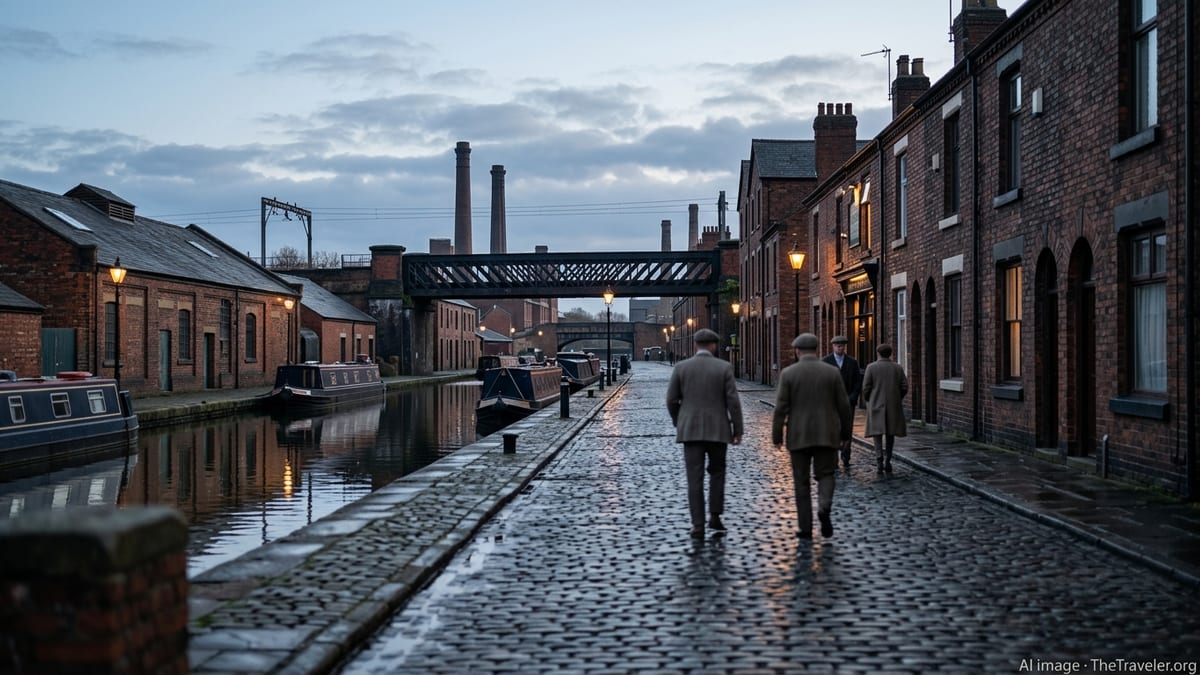
Although much of Peaky Blinders was filmed elsewhere, Birmingham is increasingly positioning itself as the narrative home of the show. Publicly available information on tourism trends indicates that interest in the city’s canals and industrial heritage has risen in step with the drama’s global reach. Visitors now arrive with specific scenes in mind, looking for bridges, warehouses and towpaths that evoke the post-war world of the Shelby family.
The development of Digbeth Loc Studios, described in local coverage as a major new production hub in the city’s historic industrial quarter, has strengthened this association. Reports indicate that principal photography on the new feature film Peaky Blinders: The Immortal Man began at the studios and along nearby canals, anchoring more of the franchise’s on-screen world in the West Midlands. That shift is expected to consolidate Birmingham’s place on Peaky-focused itineraries in the coming seasons.
While central Birmingham still offers fewer instantly recognisable backdrops than some northern cities, tourism bodies are promoting walking routes that connect the new studios district with long-established canal paths, Victorian architecture and public art that reference the city’s working-class history. For international visitors, these trails offer a way to match the series’ atmosphere with locations that speak to Birmingham’s real past rather than exact screen matches.
Travel advisors suggest that Birmingham also functions as a practical gateway for fans planning longer multi-city trips. Rail links from the city center make it relatively straightforward to reach the Black Country Living Museum in Dudley, as well as onward connections to Manchester, Liverpool and Yorkshire, where many of the most recognisable Peaky Blinders sets are found.
Black Country Living Museum: From Charlie Strong’s Yard to Night-time Events
The Black Country Living Museum in Dudley has emerged as one of the most important real-world locations for Peaky Blinders tourism. The open-air site, built around cobbled streets, canal arms and industrial buildings, doubled as Charlie Strong’s yard and sections of Small Heath throughout the series, according to production-focused articles and museum information. For many visitors, it offers the closest thing to stepping directly onto the show’s set.
The museum operates as a heritage attraction in its own right, with costumed interpreters and exhibits covering 250 years of regional history. In recent years it has leaned more visibly into its connection with the series, promoting Peaky Blinders as one of the flagship productions filmed on site. Travel and culture coverage notes that specific areas of the museum, including the boatyard and canal-side workshops, remain laid out much as they appeared on screen, making them key photo stops for fans.
In 2026 the museum is expanding its Peaky-themed programme with a new run of after-hours events. Local and national entertainment reporting highlights three dedicated Peaky Blinders nights scheduled across the year, featuring live music, costumed performers and food and drink designed to evoke the interwar period. Tickets for previous events have sold strongly, and the museum’s announcements describe the evenings as immersive experiences for visitors familiar with the show.
Because the museum is a working heritage site, practical travel advice stresses the importance of checking opening times and event calendars in advance. Recent visitor commentary shared on public forums indicates that weekends and special Peaky-themed dates can be particularly busy, with some fans choosing to dress in flat caps, tweed and long coats to mirror the series’ distinctive costume style.
Liverpool and the Mersey Waterfront: Standing in for Birmingham
Despite the story’s Birmingham setting, much of Peaky Blinders was shot in Liverpool and its surrounding coastline. Guides from national rail and tourism providers note that the city’s Victorian and Edwardian docklands, along with its Georgian streets, were repeatedly used to portray early twentieth-century Birmingham. For screen tourists, this means that several of the most familiar images from the series are, in fact, rooted on the Mersey.
Stanley Dock and the North Warehouse complex appear frequently as industrial backdrops, with exposed brick walls, cast-iron columns and warehouse windows that match the show’s gritty aesthetic. Features in travel and entertainment media identify these buildings as stand-ins for Tommy Shelby’s business premises and key meeting points for the gang. Nearby, Liverpool Cathedral has been singled out in location round-ups as the church visited by Tommy in some of the drama’s more introspective scenes.
Further afield, the coastline at Formby has become a pilgrimage point for dedicated fans. Location guides and fan-created maps reference the beach as the setting for a pivotal confrontation between Tommy Shelby and Alfie Solomons. Visitors report that, away from the cameras, the dunes and wide sands retain a tranquil character, offering a contrast to the tension of the scene many viewers recall.
Liverpool has also seen the growth of formal and informal Peaky Blinders tours. VisitBritain’s promotional material highlights a multi-hour walking route that threads together docklands, Georgian terraces and civic buildings used on screen. Independent travel blogs describe combining these walks with broader city sightseeing, positioning Peaky locations alongside Beatles heritage, maritime museums and the regenerated waterfront.
Manchester, Leeds and the Northern Street Grid
Manchester and Leeds feature heavily in the production history of Peaky Blinders, even if casual viewers might not immediately recognise them. According to destination marketing campaigns and press coverage, parts of inner-city Manchester repeatedly doubled for Birmingham’s Small Heath, while Leeds provided several of the grand interiors and exteriors associated with Tommy Shelby’s political career in later seasons.
In Manchester, red-brick terraces and former industrial districts were selected to recreate early twentieth-century working-class streets. Entertainment reports point to areas used for pub exteriors and back alleys where deals and confrontations unfold. While many of these streets function today as ordinary residential or mixed-use neighbourhoods, fans often pair location spotting with visits to nearby cultural venues and new hotels that promote their proximity to filming sites.
Leeds, by contrast, supplied a more formal backdrop. Leeds Town Hall, already popular in period dramas, has been cited in filming-location guides as a stand-in for key government buildings linked to Tommy’s role as an elected politician. In recent coverage aimed at film-inspired travelers, the building’s ornate interiors and civic steps are highlighted as recognisable from multiple episodes.
Regional tourism organisations in Yorkshire have begun to package these locations into broader screen heritage trails, positioning Peaky Blinders alongside other productions that have used the same streets, warehouses and civic halls. For visitors with limited time, travel writers often recommend focusing on one or two anchor sites in each city and using public transport to link them, rather than attempting to replicate the full shooting schedule in a single trip.
Planning a Multi-City Peaky Blinders Pilgrimage
As the franchise moves into its feature-film era, Peaky Blinders tourism is gradually coalescing into a recognisable itinerary that spans several English regions. Official tourism boards and commercial operators increasingly frame the experience as a linear journey, beginning in Birmingham and the Black Country before heading north to Manchester, Liverpool and Yorkshire. This mirrors the trajectory of the Shelby family story, which expands from local gang rivalries to national politics and international dealings.
Travel features suggest that visitors typically allow at least three to five days to explore the most prominent locations. One common pattern involves a start in Birmingham or Dudley for the Black Country Living Museum and canal walks, a transfer to Manchester for its urban backdrops and hospitality scene, and a final leg in Liverpool and along the Merseyside coast. Additional time in Leeds or Bradford can be added for enthusiasts interested in the show’s political and institutional settings.
Publicly available transport information shows that these cities are linked by frequent rail services, making it feasible to base in one hub and take day trips. However, some independent travel blogs argue that an overnight stay in at least two locations allows visitors to experience the evening atmosphere that many associate with the show’s smoky pubs and shadowed streets, even if the actual venues differ from those on screen.
Industry observers note that screen tourism for Peaky Blinders now sits alongside itineraries built around other major British series and films. With the release of the new feature and a packed programme of themed events at key heritage sites, the franchise appears set to remain a significant draw for international visitors, who continue to blend fandom with a broader exploration of the United Kingdom’s industrial and urban past.