

More news on this day
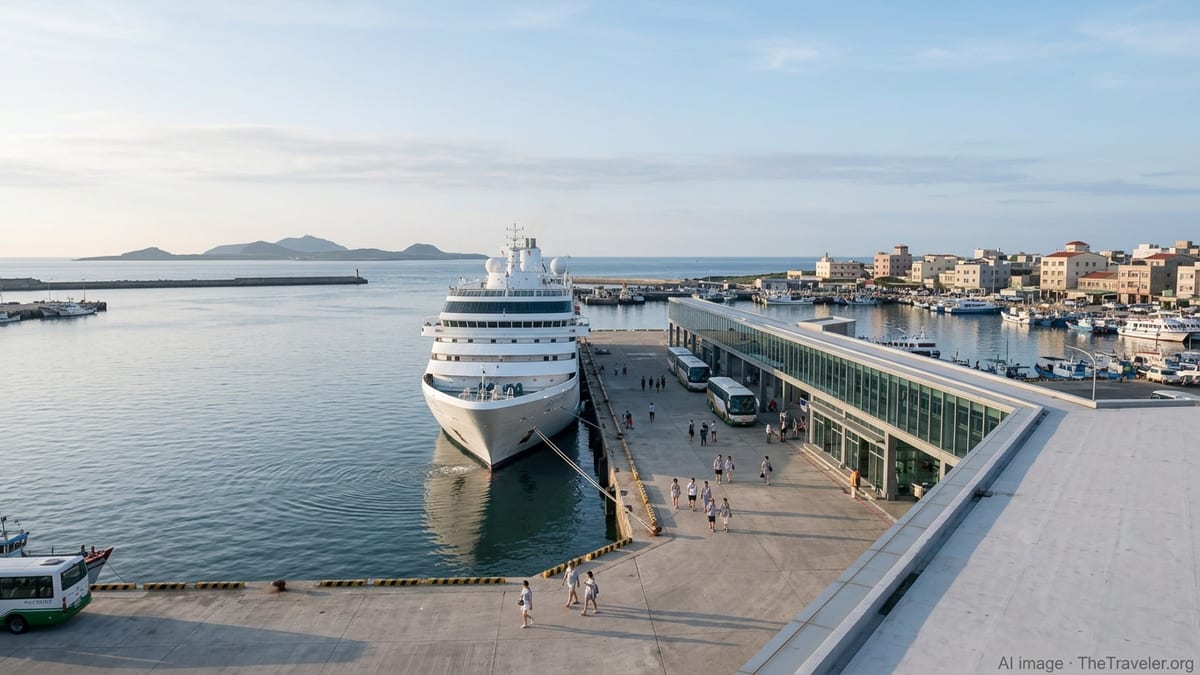
The Penghu archipelago in western Taiwan has marked a new milestone in its tourism journey with the maiden call of a large international cruise vessel, a symbolic first step in a broader strategy to position the island chain as a key node in Asia’s resurgent cruise network.
Get the latest news straight to your inbox!
A Strategic Port Comes of Age
Penghu’s latest cruise arrival caps years of investment in Magong Port and its dedicated cruise wharf. Publicly available information from Taiwan’s port authorities describes a multi-year program to extend berths, deepen channels, and build passenger facilities capable of receiving mid to large-size international ships, complementing earlier work to create a cruise-capable Penghu Pier at Magong Harbor.
Port development reports indicate that these upgrades are part of a wider plan to link Taiwan’s offshore islands more closely with the main island’s ports and with neighboring markets. Penghu, long known domestically for its beaches and fishing heritage, has been repositioned as an “archipelagic gateway” where cruise passengers can disembark for short in-depth stays rather than brief technical calls.
The enhanced infrastructure is designed to dovetail with national cruise strategy, which emphasizes dual homeports on Taiwan’s main island and a series of niche ports including Magong. Forecasts for 2025 and 2026 point to record cruise calls at Taiwanese ports, with Penghu highlighted in industry commentary as one of the standout emerging stops on regional itineraries.
For Penghu, the maiden large-vessel call signals that the technical threshold has been crossed: the port can now reliably host ships carrying well over a thousand passengers while maintaining safe maneuverability in the relatively constrained waters around Magong.
New Horizons for Island Tourism
Tourism planners see cruise development as a way to balance Penghu’s visitor mix. Historically, the islands have depended heavily on seasonal domestic travel tied to summer beach vacations and the popular Penghu International Fireworks Festival. Cruise calls, by contrast, can distribute arrivals more evenly across the year and introduce a more diverse international clientele.
Industry coverage of Taiwan’s cruise rebound notes that operators are increasingly confident about including Penghu alongside major ports such as Keelung and Kaohsiung. Regional cruise lines already marketing island-hopping sailings from southern Taiwan have begun to cast Penghu as a core stop, highlighting scenery, heritage districts in Magong City, and marine excursions that can be completed within a standard shore-visit window.
The maiden call also serves as a live test of local capacity to handle larger tour flows. Travel trade reports describe coordinated efforts between port authorities, local transport operators and tourism businesses to manage passenger movements from the terminal into town, onward to beaches and cultural attractions, and back to the ship on tight turnaround schedules.
If successful, this pattern could help anchor Penghu more firmly on multi-day circular routes in the Taiwan Strait and northern South China Sea, with the islands serving as a bridge between metropolitan ports and smaller coastal communities.
Infrastructure Investments Reshape the Waterfront
The transformation of Magong’s waterfront has been gradual but significant. Earlier investments focused on creating cruise-capable facilities at Penghu Pier and improving harbor geometry so that modern vessels could berth alongside existing fishing and inter-island ferry operations. Subsequent phases prioritized passenger comfort and efficiency, including terminal buildings, check-in areas and luggage handling systems.
Port development briefings highlight Penghu as one of the principal beneficiaries of central-government funding aimed at turning Taiwan’s ports into multi-functional hubs. In Penghu’s case, this has included both hard infrastructure such as wharfs and breakwaters and softer elements such as landscape design, public spaces and traffic management around Magong’s harbor district.
The pending completion of an international passenger terminal complex at Penghu Port, expected to further streamline cruise and ferry flows, is described in sector reports as a cornerstone of the archipelago’s long-term tourism vision. Once fully operational, the facility is designed to segregate cruise passengers from cargo traffic, improving safety while presenting a more polished first impression of Penghu.
These changes are reshaping the relationship between Magong’s historic core and its working waterfront. Areas once dominated by purely functional port uses are being reimagined as mixed zones where travelers can move quickly from gangway to city streets, with easier access to museums, seafront promenades and local dining.
Experiences Beyond the Gangway
For cruise visitors, Penghu’s appeal lies in what awaits beyond the terminal. Travel features and destination guides frequently spotlight the islands’ volcanic landscapes, basalt columns, clear-water bays and traditional fishing villages. Magong City, the main entry point, offers a compact cluster of temples, old streets and small museums that can be covered on half-day walking or coach tours.
Nature-focused excursions are likely to be central to the experience of new cruise arrivals. Operators have promoted island-hopping boat trips, snorkeling, and visits to scenic bridges and headlands, capitalizing on Penghu’s reputation among domestic travelers as one of Taiwan’s premier marine playgrounds. The archipelago’s strong winds and open seascapes also appeal to photography enthusiasts, adding to its potential as a distinctive stop compared with larger urban ports.
Cultural programming continues to be an important draw. Events such as the Penghu International Fireworks Festival, which has been extended in duration in recent years and increasingly incorporates drone shows and pop-culture collaborations, provide added seasonal hooks that cruise planners can integrate into itineraries when schedules align.
Local businesses are adapting accordingly, with more cafes, guesthouses and specialty shops opening in Magong’s old quarters and near waterfront promenades. While many of these establishments primarily serve overnight visitors, the rise of cruise arrivals may prompt further adjustments in operating hours and services to match ship schedules.
Penghu’s Role in Taiwan’s Cruise Future
The timing of Penghu’s maiden large-ship arrival aligns with broader momentum in Taiwan’s cruise sector. Recent industry forecasts suggest that cruise calls across Taiwanese ports could surpass pre-pandemic levels by the mid-2020s, supported by stronger partnerships with regional operators and the introduction of new vessels in Asian waters.
Within this context, Penghu is emerging as a strategic complement rather than a competitor to major homeports. National cruise planning documents outline a dual-homeport approach centered on Keelung in the north and Kaohsiung in the south, with Penghu and other outlying islands providing distinctive intermediate stops that diversify itineraries and spread tourism benefits beyond major cities.
Analysts note that success will depend on careful management of environmental and social impacts. Penghu’s ecosystems, including coral reefs and sensitive coastal zones, are already under pressure from climate variability and seasonal visitor peaks. Cruise growth strategies discussed in public forums emphasize the need for carrying-capacity assessments, shore-power adoption where feasible, and closer coordination between maritime, tourism and conservation agencies.
Even so, the symbolic weight of the first major cruise arrival is difficult to miss. For Penghu, it signals a shift from being an out-of-the-way beach escape for domestic travelers to becoming an integrated stop on regional sea routes. For Taiwan’s cruise ambitions more broadly, the image of an international vessel berthing at Magong underscores how outlying islands are being woven into a national push to capture a larger share of Asia’s growing cruise market.