

Connecticut may be one of the smallest states in the United States, but on the road it feels surprisingly big. Rugged coastline, historic river towns, colonial greens, forested hills and compact, culture-rich cities all sit within a few hours of one another. With thoughtful planning, you can thread them together into a road trip that feels like a cross section of New England in one compact loop.
How Long You Need and When To Go
For a relaxed Connecticut road trip that does not feel rushed, plan on five to seven days. The state is compact enough that you could technically drive the main loop in two or three days, but the pleasure of this itinerary lies in wandering village streets, lingering at the shoreline and allowing time for short hikes or museum visits. A week lets you add an extra night in a favorite spot such as Mystic or the Litchfield Hills without sacrificing other stops.
Connecticut works as a year-round road trip destination, but the experience changes with the seasons. From late May through early September, coastal towns like Madison, Old Saybrook and Mystic hum with summer energy and long evenings by the water. Autumn, typically late September through early November, is peak time for foliage drives through the Litchfield Hills and the Quiet Corner, when state tourism officials report color slowly rolling from north to south across the state over roughly six weeks. Winter can be quiet and atmospheric in river and hill towns, but some seasonal attractions shorten their hours, so check ahead.
Spring, from April into early June, is an underrated time to visit. Trees leaf out along the Connecticut River, roadside farm stands reopen, and popular drives such as Route 169 between Norwich and Woodstock or the Merritt Parkway in Fairfield County are mostly free of summer and fall foliage crowds. Roads are generally in good condition statewide, but allow extra time during foliage season and summer weekends, especially near coastal interstates and around New Haven and Hartford.
This itinerary starts and ends in New Haven, a convenient gateway on the Boston to New York corridor, but you can easily adapt it to begin in Hartford, Stamford or any of the coastal towns. Distances between stops are short, usually one to two hours, so even on your “driving” days you will spend more time exploring than staring through the windshield.
Day 1: New Haven and the Connecticut Shoreline
Begin your trip in New Haven, where college-town energy meets historic architecture and a working harbor. Park the car and explore on foot around the central green and Yale’s campus, where museums hold collections that rival much larger cities. Weathered stone facades, shaded courtyards and art galleries provide a pleasant contrast to the more rural and coastal scenery that lies ahead on the route.
By midday, head for the water. A classic shoreline drive east from New Haven follows smaller local roads toward towns such as Branford, Guilford and Madison, where salt marshes, rocky outcrops and Long Island Sound frame the route. Just east of Branford, Route 146 winds past tidal inlets and the village of Stony Creek, where small islands scatter across the bay. Continuing into Guilford and Madison, you reach historic town greens, clapboard houses and Connecticut’s largest stretch of public beach at Hammonasset Beach State Park, which takes on a softer, more reflective mood in spring and fall once summer crowds thin out.
Plan to overnight in one of the shoreline towns between Madison and Old Saybrook. This keeps driving distances short on your first day and lets you settle into the relaxed coastal rhythm. An evening stroll along a beach boardwalk, a muted sunset over the Sound and the sound of distant buoys or train whistles create a sense of place that anchors the start of your journey.
If you have extra time before moving on, short detours along U.S. Route 1 between Old Saybrook and New London reveal more classic coastal scenes. State parks like Rocky Neck and Harkness Memorial on this stretch offer sandy beaches, marsh boardwalks and lawns sweeping down to the water, all easily accessible from the main highway yet often quiet outside midsummer.
Day 2: The Connecticut River Gateway and Mystic Country
On day two, the road bends inland along the lower Connecticut River, an area known for compact, postcard-perfect towns and broad tidal reaches. From Old Saybrook or Old Lyme, follow local routes north along the river through Essex, Deep River and Chester. These settlements grew up as shipbuilding and trading ports, and today they blend Federal-era homes with modest marinas, small inns and cafes. The views are particularly appealing in autumn, when hardwood forests paint the hillsides above the river in reds and golds.
Several state-designated driving loops use these same roads to showcase scenery between the river and the shore. A popular one begins near Middletown and heads south on Route 9 to the village of Haddam, then uses Route 154 and Route 148 to connect riverfront parks, historic ferries and quiet backroads before rejoining the highway. The Chester–Hadlyme ferry, which typically operates from April through November, offers one of the more unusual ways to cross the river in a car, with just a few minutes of open-deck cruising but a sense of stepping back into an earlier era of travel.
By afternoon, continue east toward Mystic Country, the cluster of coastal and inland communities around New London, Mystic and Stonington. U.S. Route 1 and parallel backroads carry you past salt ponds, coves and small beaches to Mystic, one of Connecticut’s best known tourist towns. Here, a drawbridge spans the Mystic River, tall ships often sit at the museum wharves and narrow streets hold a concentration of restaurants, inns and small shops.
Spend the night in or near Mystic so you can enjoy the town both in the evening, when day-tripper traffic ebbs, and in the early morning, when working boats and soft river light take center stage. If time allows, a short additional drive to Stonington Borough reveals another side of the coast. The compact peninsula, with its stone cottages and views of the harbor and open Sound, feels more like a lived-in fishing village than a resort town, especially outside high summer.
Day 3: The Quiet Corner and Route 169
Leaving the sound of waves behind, day three carries you inland to the Quiet Corner, the rural northeastern quadrant of Connecticut where roads wind past farms, stone walls and forested hills. From Mystic or New London, head north and pick up Route 169 somewhere between Norwich and Lisbon. This two-lane road, designated a National Scenic Byway, runs roughly 32 miles between Norwich and Woodstock and is one of the state’s most celebrated drives.
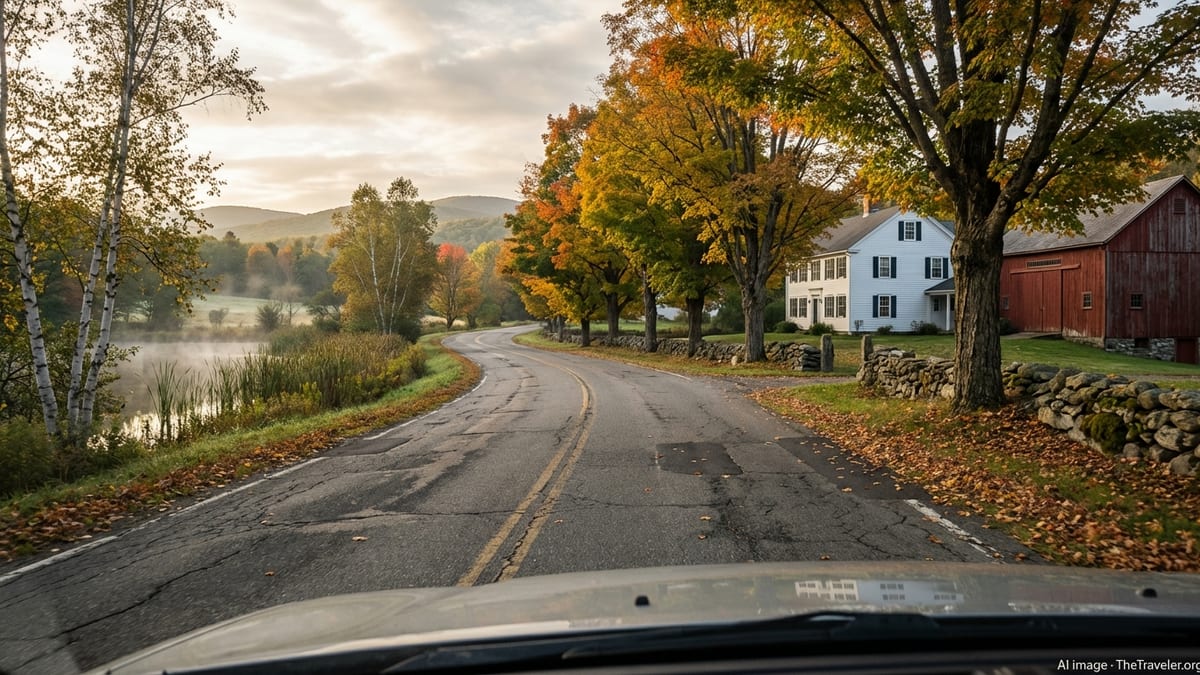
Along Route 169 you will pass white-steepled churches, classic town greens and weathered barns that feel far removed from the interstate corridor. In autumn it becomes a tunnel of color, with hardwoods arching overhead and views opening briefly to reveal patchwork hillsides. Small towns such as Canterbury, Brooklyn and Pomfret invite short stops, whether to walk around a historic district, browse a general store or simply stretch your legs along a stone wall lined with fallen leaves.
This region is light on large hotels but rich in country inns, farm stays and bed-and-breakfasts, which adds to its appeal for travelers looking to slow the pace. Many local tourism agencies highlight loops that connect Route 169 with other scenic roads such as Route 44 to the west or Route 6 to the south, so if you have an extra day you can build out a more extensive exploration of the Quiet Corner’s covered bridges, mill villages and forest preserves.
Overnight either in Woodstock near the Massachusetts border or swing west toward the town of Putnam or the small city of Willimantic, depending on how much driving you want to tackle the next morning. Wherever you land, the night skies tend to be darker here than on the coast, with fewer streetlights and a more pronounced sense of rural quiet.
Day 4: Litchfield Hills and Covered Bridge Country
From northeastern Connecticut, your path arcs west toward the Litchfield Hills, a region that concentrates many of the state’s classic New England images into a relatively compact area. Expect winding roads, church steeples, lake views and a succession of town greens framed by white houses and low stone walls. Routes often follow old Native American and colonial paths, which explains the irregular curves and occasional steep grades.
One of the best-loved corridors in this region uses Route 7 along the Housatonic River, connecting towns such as New Milford, Kent and Canaan. Tourism and travel writers frequently single out this drive in autumn, when the riverbanks and surrounding hills carry dense color and mist rises from fields early in the morning. Near Kent, Kent Falls State Park offers a short but steep hike to multiple tiers of waterfalls, and Bulls Bridge provides a chance to see or cross a historic covered bridge spanning a rocky section of the river.
From the river, spur routes such as Route 341, Route 45 and Route 118 link lakes, farm country and additional small towns. Lake Waramaug near Washington is a favorite stop for its ring road views of water, hillsides and shoreline inns, especially in late afternoon light. To the east, the town of Litchfield itself serves as a natural base, with restaurants, small shops and accommodations clustered around one of the most picturesque greens in the state.
Plan to spend the night somewhere in Litchfield County, ideally leaving time for a late-day or early-morning drive on a quiet backroad when traffic is minimal. Many travelers time their visit for October, when state foliage trackers often report the Litchfield Hills as among the first places in Connecticut to reach peak color, but the region is also attractive in summer for hiking and kayaking and in winter for cross-country skiing and snowshoeing.
Day 5: Hartford and the Connecticut River Valley
After several days on backroads, the fifth day loops you toward Connecticut’s capital and the broad valley of the Connecticut River. From Litchfield County, use a combination of Routes 4, 118, 44 or 202 to wind east toward Farmington and Hartford, enjoying views of rolling farmland and low ridgelines along the way. The approach into the metro area can be busy at rush hours, so consider timing your arrival for mid-morning or early afternoon.
Hartford offers a different flavor from the rest of the itinerary. Here, your focus shifts from scenery to history and culture. The city holds important literary sites, a riverfront promenade, and museums that span fine arts to regional history. Tree-lined neighborhoods to the west and south of downtown showcase late 19th and early 20th century homes, while the compact core remains oriented toward the state government and insurance industries that historically shaped Hartford.
Depending on your interests, you might spend the full afternoon in museums and historic homes, or use Hartford primarily as a gateway back to the river. South of the city, smaller communities like Wethersfield and Middletown present quieter streets and river views, and local orchards in the surrounding countryside often welcome visitors in season for apple picking and farmstand browsing.
Choose whether to overnight in Hartford for an urban interlude or continue a short distance south to one of the river towns for a more low-key stop. Either option sets you up for your final day’s drive back to New Haven along backroads that avoid the interstate for as long as you wish.
Day 6: Backroads to New Haven via Merritt Parkway or New Haven County Hills
For your return to New Haven, you have two primary options: angle back to the coast and follow one of the state’s historic parkways, or trace a more inland path along hills and reservoirs before dropping into the city. Each choice has its own character and works in any season, provided you avoid local rush hours and exercise extra caution in heavy rain or snow.
If you prefer a direct but scenic return, aim for the Merritt Parkway in Fairfield County, officially Route 15. Recognized as a National Scenic Byway, this 1930s-era limited access highway is famous for its Art Deco and Art Moderne bridges and its continuous canopy of trees. It runs roughly 37 miles between Greenwich and Stratford, with landscaped medians and gently curving lanes that feel distinctly different from modern interstates. Many drivers consider it one of Connecticut’s most beautiful commuter routes, although for a road trip it is best appreciated on weekends or outside peak travel times.
Alternatively, from the Hartford area you can take a more relaxed southern route through smaller New Haven County towns such as Cheshire, Wallingford and Hamden. Local roads parallel segments of the historic Farmington Canal rail trail and pass reservoirs tucked between low ridges. As you approach New Haven from the north, rocky outcrops such as West Rock and East Rock rise above the city, offering short hikes with broad views if you have remaining time and energy.
Regardless of the route you choose, try to arrive in New Haven with enough daylight to revisit any favorite spots from the start of the trip or sample one more restaurant or neighborhood. Doing so brings the itinerary full circle and highlights how varied the state feels despite its modest size on a map.
Practical Tips for Driving in Connecticut
Although driving distances on this itinerary are short, planning ahead improves the experience. Traffic can be heavy on Interstates 95 and 91 and around Hartford and New Haven during weekday commuting hours, so aim to schedule longer drives for mid-morning or early afternoon. Many of the most rewarding roads, including Route 169, the Litchfield Hills backroads and shoreline routes like 146, are narrow and winding. Give yourself more time than navigation apps might suggest so that you can pull off safely at viewpoints and avoid feeling rushed.
Fuel and services are widely available near major highways and in larger towns, but in rural corners of Litchfield County or the Quiet Corner gas stations may be more widely spaced, especially late at night. Keep the tank from dropping too low and carry water and snacks in the car so that you can be flexible about where and when you stop for meals. Seasonal farm stands can be a pleasant way to pick up fresh fruit, baked goods or local specialties, particularly from late spring through fall.
Weather can change quickly, especially in shoulder seasons. Autumn storms can bring heavy rain and wet leaves to road surfaces, making curves more slippery than they appear. Winter storms sometimes affect higher elevations in the northwest and northeast sooner than the coast. Before setting out each day, check statewide travel advisories and local forecasts, and be prepared to adjust the plan if a particular region is experiencing poor conditions.
Finally, remember that many of the most scenic drives in Connecticut pass directly through residential neighborhoods and working farm country. Observe posted speed limits, watch for pedestrians and cyclists on shoulderless roads and resist the temptation to stop in the middle of the lane for photographs. Look instead for designated pull-offs, town greens and park entrances where you can safely get out and enjoy the view.
The Takeaway
A well planned Connecticut road trip strings together shoreline villages, historic river towns, rural byways and lively small cities into one coherent route. Instead of treating the state as a corridor between larger destinations, this itinerary invites you to slow down and treat Connecticut itself as the goal, discovering how varied the landscapes and communities can be over relatively short distances.
By starting on the coast, bending inland to the Quiet Corner and Litchfield Hills, and looping back through the Connecticut River Valley, you see different faces of New England without long days behind the wheel. Short daily drives leave time for museums and markets, ferries and trails, beach walks and coffee on small town greens. Each night brings a slightly different setting, from harbor-front inns to hillside B&Bs and downtown hotels.
Whether you time your visit for peak foliage, the height of summer or the first soft days of spring, the same core ingredients remain: winding roads, layered history and the sense that around almost any bend a new village, view or backroad awaits. With a bit of flexibility and curiosity, Connecticut rewards road trippers who trade speed for a slower, more detailed look at this compact corner of New England.
FAQ
Q1. How many days do I need for this Connecticut road trip?
Most travelers will be comfortable with five to seven days for this itinerary. That allows one night each in the shoreline, Mystic, the Quiet Corner, the Litchfield Hills and the Hartford or river valley area without overly long driving days.
Q2. What is the best time of year to drive this route?
Autumn, typically late September through early November, is the most popular because of foliage in the Litchfield Hills and along Route 169. Summer is ideal for beach time and ferries, while spring offers quieter roads and blooming landscapes. Winter can be charming but requires more caution due to potential snow and ice.
Q3. Is this itinerary suitable for families with children?
Yes, the relatively short distances between stops make it family friendly. Coastal towns offer beaches and aquariums, while hill towns provide easy hikes and open spaces to explore. Planning one or two kid-focused stops each day, such as a museum or park, helps keep younger travelers engaged.
Q4. Do I need a four wheel drive vehicle for this trip?
No, a standard car is sufficient for the paved routes described here in normal conditions. Four wheel drive or all wheel drive can be helpful in winter or on unpaved side roads, but the main roads between New Haven, Mystic, Route 169, the Litchfield Hills and Hartford are all conventional paved highways.
Q5. Can I do this road trip using public transportation instead of a car?
Major hubs like New Haven, Hartford and some shoreline towns are served by trains and buses, but the most scenic backroads, river ferries and hill towns are not easily linked without a car. For the full flexibility and access described in this itinerary, driving your own car or a rental is strongly recommended.
Q6. How busy are the roads during fall foliage season?
Key corridors such as Interstates 95 and 84, the Merritt Parkway and popular foliage routes in the Litchfield Hills can be noticeably busier during October weekends. Traffic usually lessens on weekdays and on smaller secondary roads. Starting drives early in the day and building in extra time for congestion helps manage the crowds.
Q7. Are there toll roads on this itinerary?
Connecticut removed most highway tolls decades ago, and the routes in this guide, including the Merritt Parkway, Route 169 and the Litchfield Hills roads, do not currently charge tolls. However, neighboring states may have tolls on approaches into Connecticut, so check your full route if you are driving from farther away.
Q8. Is it easy to find accommodations without advance reservations?
Outside of peak foliage weekends and midsummer along the coast, it is often possible to find same day accommodations in larger towns. In small villages and during popular periods, rooms at inns and B&Bs can sell out. Booking key nights in Mystic, the Litchfield Hills and along the shoreline ahead of time provides peace of mind.
Q9. What should I pack for a Connecticut road trip?
Pack layers, as temperatures can vary between the coast and hills and from day to night. Comfortable walking shoes, rain gear, a light jacket even in summer, and warmer layers for spring and fall are useful. A small daypack, reusable water bottle and basic car safety kit add extra convenience and security.
Q10. Can I modify this itinerary for a shorter three day trip?
Yes. For three days, focus on either the coast and Mystic with a brief inland detour, or combine the Litchfield Hills with a day in Hartford and nearby river towns. You will cover less ground, but still experience a meaningful slice of Connecticut’s scenery and small town life.