

More news on this day
Thousands of travelers were left scrambling across Peru this week after a cluster of short notice flight cancellations by United Airlines, Sky Airline, LATAM and other carriers disrupted key connections linking Lima and Cusco with cities including Houston, Arequipa, Trujillo and Bogotá, according to airport data and industry reports.
Get the latest news straight to your inbox!
Four Major Cancellations Trigger Wider Travel Shock
The disruption began on March 11 at Lima’s Jorge Chávez International Airport, Peru’s main air hub, where at least four key flights were canceled in quick succession. Industry site Travel And Tour World reported that affected services included a United Airlines long haul departure to Houston, a LATAM Peru regional service to Arequipa, and additional domestic links that connect onward to cities across South America and the United States.
The sudden loss of those flights snarled schedules for both origin and connecting passengers. Lima functions as a primary transfer point for travelers heading between North America and secondary Peruvian cities such as Cusco, Arequipa and Trujillo, meaning that cancellations on a handful of trunk routes can ripple across the country’s air network within hours.
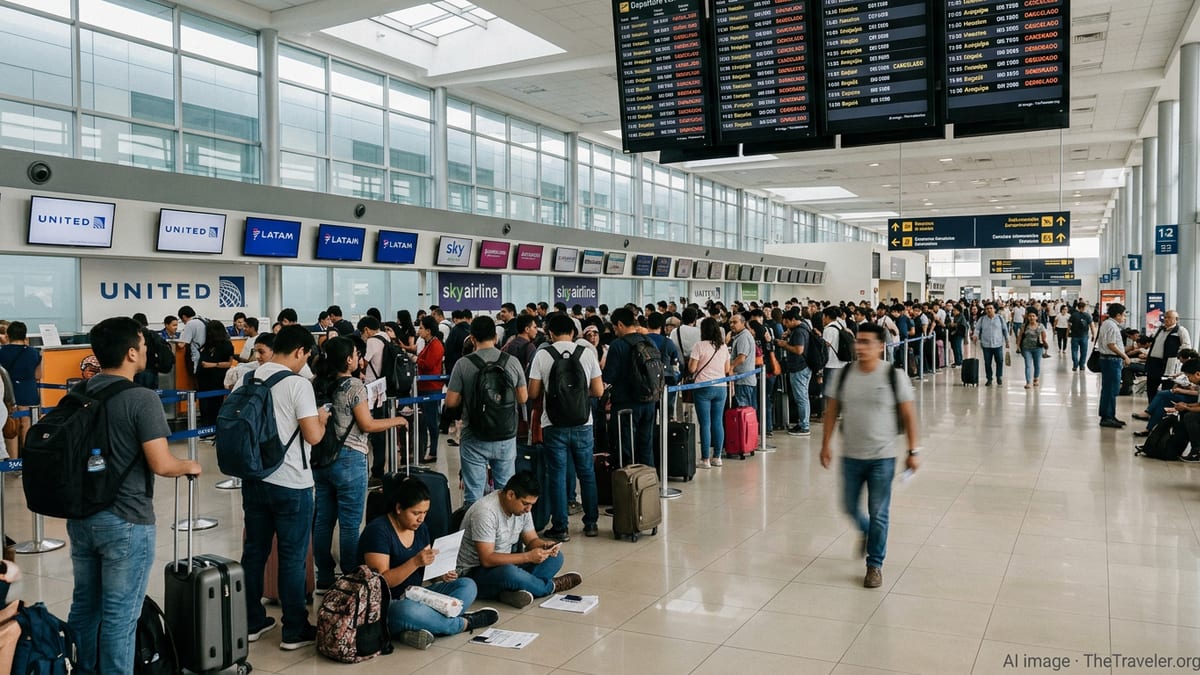
Separate monitoring by air passenger rights platforms has shown a spike in cancellations and delays across South America this week, with Peru and Colombia among the hardest hit. The result in Lima on Tuesday and Wednesday was a familiar scene of crowded departure halls, long queues at airline counters and passengers making frantic calls to rearrange tours, hotel stays and onward flights.
While most of the immediate attention focused on outbound flights from Lima, travelers flying into the capital from regional gateways such as Cusco and Arequipa also encountered missed connections and rebookings, often requiring overnight stays at their own expense while airlines worked through the backlog.
Routes from Lima and Cusco to Houston, Arequipa and Bogotá Affected
Among the highest profile cancellations was United’s service between Lima and Houston, a crucial link for both tourism and business travel between Peru and the southern United States. The route also serves as a key connection for Americans heading to Cusco and Machu Picchu via Lima, particularly during the shoulder months of March and April when weather in the Andes can already complicate schedules.
Regional connectivity also took a hit. LATAM Peru’s cancellations included a Lima flight that was scheduled to continue to Bogotá, interrupting northbound itineraries for passengers connecting onward to Central America, the Caribbean and North America. Travelers reported being offered reroutes through alternative hubs or next day services where space allowed, while others were advised to seek refunds and rebook independently.
On the domestic front, Sky Airline and LATAM adjustments impacted flights from Lima to secondary cities such as Arequipa and Trujillo, both important jump off points for Peru’s coastal and highland attractions. Even when only a single frequency was canceled, reduced capacity forced some passengers onto later departures and triggered missed same day connections back to Lima, amplifying the disruption.
Operators also warned that knock on effects could be felt on heavily trafficked Lima Cusco routes, where tight turnarounds and afternoon weather issues in the Andes already leave little margin for delay. Any rolling rescheduling in and out of Lima can quickly cause capacity constraints on those popular tourist corridors.
Airlines Cite Operational Adjustments as Passengers Queue for Answers
Carriers involved in the latest wave of cancellations have largely attributed the disruption to operational and scheduling adjustments rather than a single technical incident or safety issue. In recent months, both LATAM and Sky Airline have publicly flagged cost pressures linked to new airport fee structures in Lima, along with the broader challenge of balancing capacity across South American networks that are still recalibrating after the pandemic.
United has not issued a detailed public breakdown of the reasons for its canceled Lima Houston departure this week, but analysts note that long haul operations into South America remain vulnerable to aircraft rotation constraints, crew availability and demand swings tied to seasonal tourism. When one flight on such a route is pulled from the schedule at short notice, alternative same day options are often limited.
For passengers on the ground, however, the explanations matter far less than clear and timely information. Travelers at Lima on March 11 and 12 described long waits at customer service desks and a heavy reliance on airline apps and social media for updates. Some reported that they learned of flight cancellations only after arriving at the airport, underscoring persistent communication gaps between operations centers, travel agencies and end customers.
The situation has reignited debate in Peru about airline reliability on domestic and regional routes, particularly during the rainy season when Cusco and other Andean airports are prone to weather related disruptions. Frequent flyers have urged first time visitors to build in longer connection windows in Lima and to avoid tight same day links between international arrivals and domestic departures.
What Stranded Travelers in Peru Need to Know Now
Passenger rights advocates stress that travelers affected by cancellations in Peru should immediately check whether they are entitled to rebooking, vouchers, meals or accommodation, depending on the airline’s policy and the reason for the disruption. While Peruvian regulations differ from those in the European Union, major carriers operating at Jorge Chávez typically provide at least a rebooked itinerary at no extra cost when a flight is canceled for operational reasons.
Experts recommend that passengers document everything, including boarding passes, receipts and written communications from airlines, to support later claims. Those who booked through online travel agencies may need to work through the intermediary to secure changes, which can slow the process on busy days when phone and chat queues are already stretched.
Travel planners also advise checking the real time status of both departing and connecting flights before leaving for the airport, rather than relying solely on original itineraries. In Peru’s dynamic domestic market, same day schedule changes are not uncommon, and a confirmed seat on a morning Lima Cusco rotation may not guarantee an on time arrival if low clouds move into the Andes.
For visitors heading to bucket list destinations such as Machu Picchu, contingency planning is essential. That means scheduling extra buffer days at the beginning and end of a trip, considering travel insurance that covers missed connections, and keeping accommodations and tours as flexible as possible to absorb last minute timing shifts.
Outlook for Peru’s Busy Autumn Travel Season
The latest wave of cancellations comes just as Peru moves into the transition from peak rainy season toward drier conditions in the highlands, a period when international arrivals typically begin to climb. Airlines have been ramping capacity back into Lima and Cusco, buoyed by strong demand from North America and Europe, but the recent turbulence highlights the fragility that still exists in regional aviation.
Industry observers expect carriers to continue fine tuning their schedules through March and April to manage aircraft utilization, costs and changing airport charges. That could mean further last minute adjustments on selected routes, even as overall seat capacity trends upward compared with previous years.
For now, the message for travelers is to stay alert and flexible. Peru remains one of South America’s most compelling destinations, and most journeys still operate without major incident. Yet the events of this week serve as a reminder that a handful of cancellations on key links between Lima, Cusco, Houston, Arequipa and Bogotá can quickly cascade across itineraries, turning a carefully planned adventure into an unexpected test of patience at the airport.
As airlines, regulators and airport authorities in Peru review the causes and handling of this week’s disruption, passengers will be watching closely for signs that communication, contingency planning and on the ground support can keep pace with a rapidly recovering travel market.