

More news on this day
Set on the rim of an extinct volcano in Thailand’s Buriram province, Phanom Rung Historical Park is emerging as one of Southeast Asia’s most compelling alternatives to the region’s better known Khmer temple sites.
Get the latest news straight to your inbox!
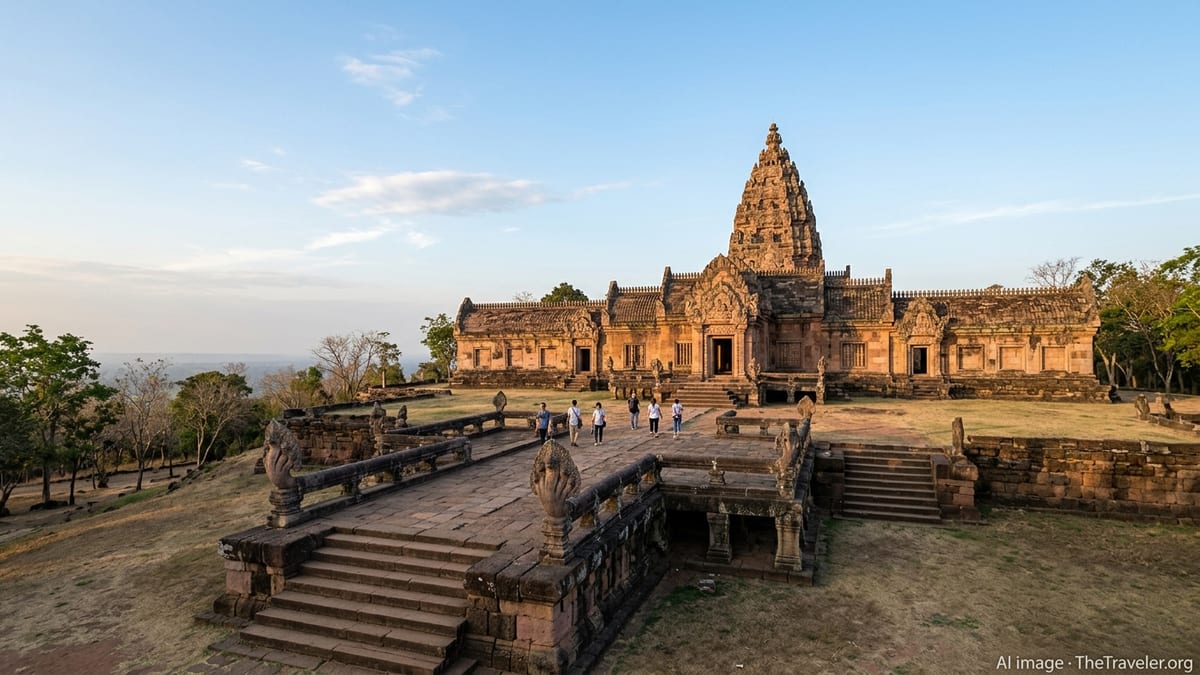
An Ancient Khmer Sanctuary Above the Isan Plains
Phanom Rung Historical Park preserves one of the most complete Khmer temple complexes in Thailand, with origins dating from roughly the 10th to 13th centuries. Publicly available information describes the site as a former Hindu sanctuary dedicated to Shiva, later incorporating Buddhist elements as regional religious practice evolved. The temple crowns the rim of an extinct volcano at about 400 metres above sea level, giving visitors sweeping views across Buriram’s countryside.
The complex is laid out along a processional axis that begins at the lower gate and rises via a sandstone causeway, naga balustrades and staircases to the central sanctuary. Architectural details, including lintels, pediments and carved door frames, are frequently cited by researchers as among the finest Khmer stonework found in Thailand, with scenes from Hindu epics such as the Ramayana and Mahabharata still clearly visible.
Conservation work over several decades, coordinated by Thailand’s Fine Arts Department, has stabilised the main structures and reassembled many of the collapsed elements. The result is a site that feels both atmospheric and legible to visitors, with clear sightlines that reveal how processions once moved from the outer terraces to the sanctuary at the summit.
Phanom Rung, together with nearby Muang Tam and Plai Bat sanctuaries, is currently on Thailand’s tentative list for future UNESCO World Heritage nomination. Heritage documentation highlights the ensemble as a key example of how the Khmer Empire projected political and spiritual influence across what is now northeastern Thailand.
Celestial Light Phenomena Draw Global Attention
Phanom Rung’s growing profile on the regional travel map is due in part to its unusual solar alignments. On several days each year, the rising or setting sun shines directly along the temple’s main axis, illuminating all 15 doorways of the central sanctuary. Tourism-focused coverage notes that these events occur around early April and early September for sunrise, and around early March and early October for sunset, attracting domestic visitors and international photographers.
The phenomenon has become a signature image for Buriram, regularly featured in destination marketing and regional travel reporting. Recent event listings and tourism advisories continue to promote sunrise viewings at Phanom Rung as a highlight of the provincial calendar, with extended opening hours and cultural performances during key alignment periods.
Alongside the light events, the Phanom Rung Festival typically brings costumed processions, traditional dance and handicraft markets to the temple’s lower grounds, offering travelers a way to connect the site’s ancient ritual function with contemporary local culture. Travel writers who have attended in recent years describe intense crowds during peak hours but also note quieter intervals early in the morning and late in the afternoon, when the ruins can still feel remarkably serene.
Outside the festival windows, the park remains comparatively calm. Many trip reports emphasise that even in the high season, visitor numbers rarely approach the levels seen at Angkor in Cambodia, allowing more time to appreciate the carvings and vistas without heavy congestion.
Practical Information: Getting There, Hours and Fees
For visitors planning a trip in 2026, the latest publicly available guidance indicates that Phanom Rung Historical Park opens daily from 6.00 a.m. to 6.00 p.m., including public holidays. The Fine Arts Department lists a standard entrance fee for foreign visitors at around 200 Thai baht, with separate, modest charges for vehicles using the upper access road. Combined tickets that include nearby Muang Tam are reported in some travel guides, so it can be useful to confirm current options on arrival.
The park lies in Chaloem Phra Kiat district, roughly 60 kilometres from Buriram city and close to the town of Nang Rong. Travel guides and recent visitor accounts generally describe the approach roads as paved and in good condition. Private car or hired driver remains the most straightforward way to reach the site, with the journey from Buriram city taking about one hour. Some visitors base themselves in Nang Rong, slightly closer to the park, where local guesthouses can arrange transfers.
Public transport options exist but require more time and flexibility. Typical advice suggests taking a bus from Buriram to Nang Rong and then using local songthaews or pre-arranged taxis to reach the park. There is no rail connection directly to Phanom Rung, although Buriram city is on the northeastern train line and has a small airport with domestic flights from Bangkok, making it a viable starting point for overland excursions into the surrounding countryside.
In addition to standard travel logistics, regional observers continue to track developments along the Thai Cambodian border, including past tensions that have occasionally affected parts of Buriram province. While Buriram city and the main tourist circuit, including Phanom Rung, have been described in recent commentary as operating normally, international travelers are being encouraged to check current government advisories for their home country and review local news before travelling near any frontier areas.
What Makes Phanom Rung Different From Other Khmer Sites
Travel analysts increasingly position Phanom Rung as a complement rather than a rival to major Khmer sites such as Angkor or Vat Phou. The hilltop location on an extinct volcano gives the temple a distinctive setting, with cool breezes and long views across rice fields that change colour with the seasons. The approach, rising through successive terraces and ceremonial avenues, creates a strong sense of procession that many visitors find memorable.
Compared with cross-border temple complexes that sit in more contested or heavily regulated zones, Phanom Rung is relatively straightforward to access under Thailand’s domestic heritage framework. Recent tourism reports suggest that visitor facilities, such as parking, rest areas and basic interpretive signage, have been upgraded in the last few years, while the immediate surroundings remain largely agricultural, preserving a rural atmosphere around the ruins.
The site also offers detailed close-up encounters with Khmer carving. Conservation teams have left many lintels and pediments in situ, allowing visitors to examine the craftsmanship at eye level. Photography-focused coverage frequently highlights the texture of the pinkish sandstone at different times of day, noting how early morning and late afternoon light pick out fine chisel marks and bring out warm hues in the stone.
For travelers who have already visited Thailand’s coastal destinations or northern temple circuits, Phanom Rung provides a different narrative thread, tying the country’s story to the wider history of the Khmer Empire. Its inclusion on Thailand’s UNESCO tentative list further underlines its perceived cultural significance and is expected to keep the temple in the spotlight as the nomination process continues.
Planning a Visit: Timing, Crowds and Nearby Attractions
Current travel guides generally recommend early starts at Phanom Rung. Arriving close to opening time helps visitors avoid midday heat and share the terraces with fewer tour groups. Many recent itineraries suggest walking up from the lower gate along the full processional route, then descending by the same path in late afternoon when the light softens and the park begins to empty.
Weather patterns in Buriram follow a typical Isan rhythm, with a hot season roughly from March to May, a rainy season from about June to October and cooler, drier months from November to February. The temple remains open year-round, but those sensitive to heat may prefer the cooler months, while photographers often favour the transitional periods around the rains, when skies can be dramatic and the surrounding fields turn lush green.
Many visitors pair Phanom Rung with a stop at Muang Tam, a smaller but atmospheric Khmer site on the plains below. The two can comfortably be seen in a single day, especially with a private vehicle. Some travelers also add Buriram city’s football stadium complex and Khao Kradong Forest Park to their route, underscoring how the province now combines heritage tourism with contemporary sports and nature attractions.
As with travel across Thailand, observers continue to advise standard precautions: checking up-to-date local guidance, allowing extra time for overland journeys and monitoring any changes in regional security advice. For those willing to venture beyond the country’s headline destinations, though, Phanom Rung Historical Park is widely regarded in current coverage as one of the most rewarding and distinctive day trips in northeastern Thailand.