

More news on this day
Travelers moving through Philadelphia International Airport on April 5 faced a cascade of delays and cancellations that left thousands stranded, as disruption across American Airlines, Southwest and United rippled through key routes to New York, Boston and other Northeast cities.
Get the latest news straight to your inbox!
Philadelphia Hub Buckles Under 124 Delays and 6 Cancellations
Publicly available flight-tracking data for Saturday indicate that operations at Philadelphia International Airport (PHL) deteriorated through the day, with at least 124 flights running late and 6 cancellations recorded across multiple carriers. The disruptions were concentrated among major U.S. operators, including American Airlines, Southwest Airlines and United Airlines, which collectively account for a large share of departures at the airport.
The scale of the disruption meant that domestic routes along the busy Northeast Corridor were hit particularly hard. Services linking Philadelphia with New York-area airports and Boston experienced rolling delays, forcing many passengers to miss connections or abandon same-day travel plans altogether. Compounding the problem, the relatively small number of outright cancellations masked the wider operational strain as late-arriving aircraft and crews triggered knock-on delays across the schedule.
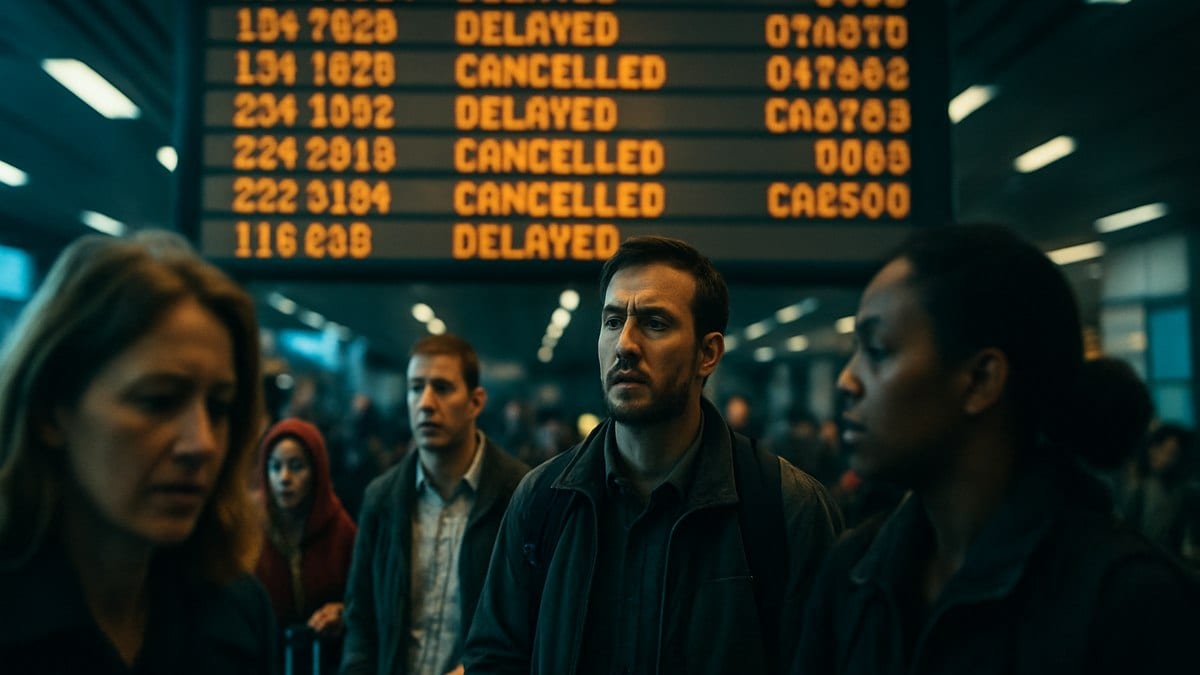
Reports from aviation and travel outlets describe departure boards dominated by orange and red status indicators for much of the afternoon and evening, with delay intervals stretching from 45 minutes to several hours in some cases. While only a fraction of flights were canceled outright, the clustering of late departures and arrivals sharply reduced the airport’s effective capacity and extended queues at check-in counters, security checkpoints and gate areas.
The Philadelphia disruption added fresh pressure to a U.S. aviation system already dealing with elevated delay levels in early April. Recent nationwide tallies have shown several thousand delayed flights per day as spring weather systems, tight airline scheduling and chronic staffing challenges converge to test major hubs from Chicago and Atlanta to Boston and New York.
Northeast Corridor Routes to New York and Boston Hit Hard
The latest problems at Philadelphia landed squarely on one of the country’s most heavily traveled air corridors. Flights between Philadelphia and the New York metropolitan area, along with services to Boston Logan International Airport, form a crucial bridge for business travelers, connecting passengers and short-hop commuters who rely on high-frequency schedules to keep tight itineraries.
On Saturday, those routes effectively became choke points. Delays on Philadelphia departures bound for New York and Boston quickly spilled over into the broader Northeast network, as missed inbound connections left aircraft flying with reshuffled passenger loads and rebooking queues lengthened. Travelers who had planned straightforward one-stop journeys to or through New York and Boston instead faced lengthy holds on the tarmac, aircraft swaps and, in some cases, overnight stays.
The stress on Northeast operations did not arise in isolation. In recent days, Boston Logan itself has experienced a spike in delays and cancellations, with more than 160 flights delayed and double-digit cancellations recorded on April 3. Separate national snapshots for early April show hundreds of cancellations and over 5,000 delays across U.S. airports, underscoring how quickly localized weather systems, airspace constraints or staffing gaps can reverberate along the East Coast corridor.
For passengers, the result was a familiar pattern: crowded terminal seating, long lines at customer service counters and limited alternative options once the day’s schedule began to unravel. Even when flights to New York and Boston continued to operate, extended departure times and congestion at arrival airports made it increasingly difficult for travelers to rely on tight connection windows.
American, Southwest and United Grapple With Operational Strain
The heaviest operational burden at Philadelphia fell on American Airlines, which uses PHL as a key hub, alongside significant activity from Southwest and United. All three carriers appear across delay tallies for the day, reflecting the vulnerability of high-utilization networks when even modest disruptions arise at one or two critical nodes.
Industry data and federal air travel reports for recent months show that major U.S. airlines have been walking a narrow line between efficiency and resilience. Schedules at many hubs have been built around tight aircraft and crew rotations, leaving less spare capacity to absorb irregular operations caused by storms, air traffic control constraints or technical issues. When something goes wrong, a single delayed aircraft can cascade into multiple late departures across the day.
Historical performance snapshots for American, Southwest and United highlight recurring challenges with extended ground delays and tight connection banks, particularly at congested airports along the East Coast. While on-time performance has improved in some periods, episodes like the current Philadelphia disruption illustrate how quickly gains can erode when weather systems or airspace programs reduce arrival and departure rates.
Aviation analysts have repeatedly pointed to structural factors that make the Northeast corridor especially fragile. Dense airspace around New York, Philadelphia, Boston and Washington, combined with limited runway capacity and complex arrival procedures, means that any slowdown can force airlines to hold or reroute large numbers of flights. The events at PHL on April 5 fit a pattern in which airlines operating in this region must manage frequent, sometimes abrupt schedule adjustments.
Knock-On Effects for Passengers Across the U.S. Network
Although the worst of Saturday’s disruption was visible at Philadelphia itself, the impact extended well beyond the city’s limits. Passengers connecting through PHL to the Midwest, South and West Coast encountered missed onward flights, involuntary overnight stays and, in some cases, multi-day itinerary changes, as already-full services left limited room for rebookings.
The Philadelphia situation unfolded against a broader backdrop of elevated disruption across the United States in early April. Nationwide figures from flight-tracking services in recent days point to around 460 cancellations and roughly 5,500 delays in a single 24-hour window, with hubs such as Chicago, Dallas, Denver, New York and Boston each reporting meaningful operational strain. When one major connecting point like PHL begins to falter, that national backdrop leaves carriers with fewer spare aircraft and open seats to ease the backlog.
Travel industry reports indicate that some passengers departing smaller regional airports were advised to rebook through alternative hubs or even delay nonessential trips rather than risk tight connections in the Northeast. Others opted to switch to rail or road for shorter legs between cities such as Philadelphia, New York and Boston once same-day flight options narrowed.
For airlines, the aftermath of such a disruption typically extends for several days. Crews and aircraft that end up out of position must be repositioned, maintenance schedules reworked and connection patterns rebuilt. Passengers affected by the April 5 delays and cancellations at PHL are therefore likely to feel ongoing effects in the form of limited seat availability and altered schedules on subsequent days.
What Travelers Can Expect in the Short Term
With spring weather patterns unsettled and demand for air travel rising toward the peak summer season, travelers using Philadelphia and other Northeast hubs can expect continued periods of volatility in the weeks ahead. Recent episodes at Boston Logan, Palm Beach International and major Midwest and West Coast hubs show that disruption is rarely confined to a single airport, especially when storms, congestion and staffing constraints coincide.
Publicly available airline and airport advisories emphasize the importance for passengers of monitoring flight status closely, using carrier apps and notification services to track gate changes and departure times, and allowing extra time when making connections through high-pressure hubs. Same-day rebooking, where possible, tends to be easier to secure early in a disruption before later flights fill up with displaced passengers.
Travel planners suggest that passengers with critical same-day commitments consider building in longer connection windows when routing through Philadelphia, New York or Boston during the spring and summer months, when convective storms and air traffic control programs are more frequent. Flexible tickets and a willingness to reroute through alternative hubs can also provide additional options when primary corridors become congested.
For now, the Philadelphia episode serves as another reminder of the tight margins under which the U.S. air travel system operates. Even a handful of cancellations, when paired with triple-digit delays at a major hub, can strand thousands of travelers and reshape travel plans up and down the East Coast within a matter of hours.