

More news on this day
The Philippines is emerging as one of Southeast Asia’s fastest-rising cruise destinations, with surging passenger numbers and new itineraries that place Boracay, Palawan and Cebu alongside the region’s marquee ports.
Get the latest news straight to your inbox!
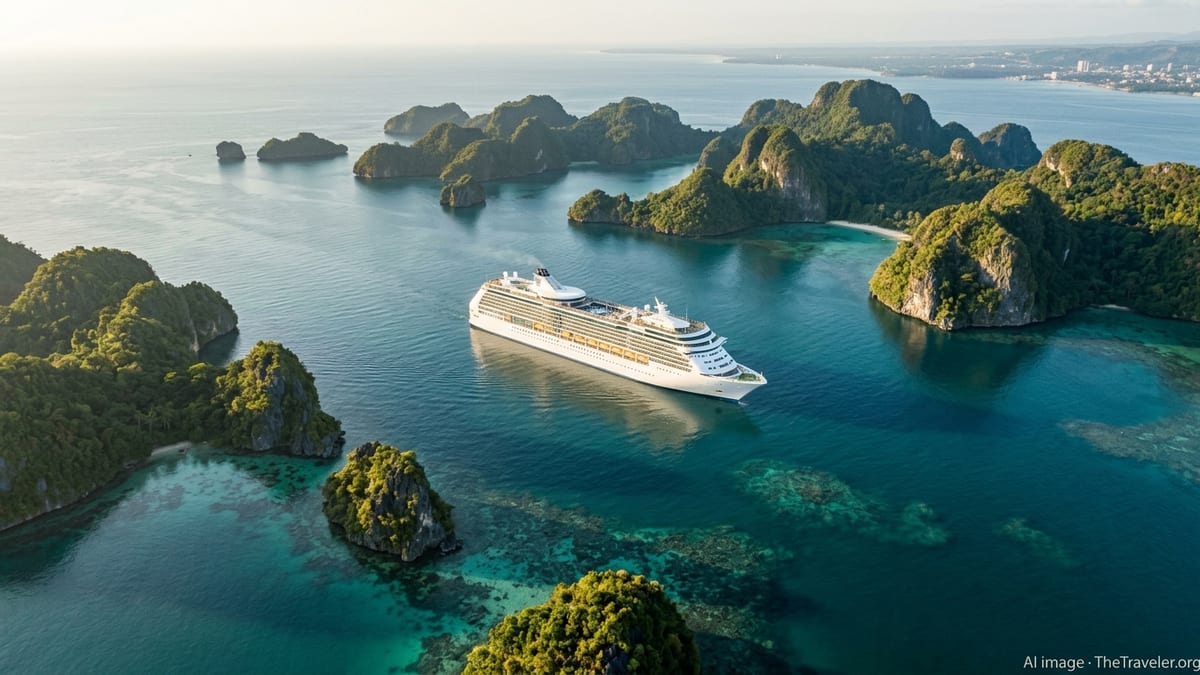
Cruise Arrivals Surge as New Ports Open to Global Fleets
Recent data from Philippine port and tourism authorities indicate that cruise tourism is expanding far more rapidly than the broader visitor market. Cruise passenger arrivals climbed from roughly 88,000 in 2023 to about 142,500 in 2024, an increase of more than 60 percent, supported by a growing roster of international vessels calling at Philippine ports. Early figures for 2025 suggest that volumes could exceed 185,000 passengers if scheduled deployments materialize.
Passenger growth is being matched by an uptick in ship calls. Publicly available port statistics point to more than 120 cruise calls across more than 30 Philippine destinations in the 2023 to 2024 seasons, with additional port calls lined up for 2025. Industry reports describe this as the strongest performance for Philippine cruise tourism since before the pandemic, signaling that the country is firmly back on the radar for global cruise planners.
Government tourism performance updates show that overall international arrivals to the Philippines reached about 5.4 million in 2023 and continued to climb in 2024 and 2025, with cruise passengers forming a small but fast-growing segment. The cruise rebound has become an important contributor to visitor spending, complementing air arrivals and helping diversify access to secondary islands that previously relied on limited domestic flights and ferries.
Regional tourism analyses from Asia-Pacific organizations also highlight the Philippines as part of a broader post-pandemic cruise recovery in Asia. Forecasts for the wider Asian cruise market point to passenger volumes potentially surpassing pre-2019 records before the end of the decade, and the Philippines is positioning itself to secure a larger share of that flow through targeted port development and marketing.
Boracay, Palawan and Cebu Anchor Emerging Cruise Corridors
Within this national upswing, Boracay, Palawan and Cebu have become the flagship cruise destinations that operators are using to anchor new Southeast Asian routes. Itinerary brochures and cruise-tracking data for the 2023 to 2025 seasons show these three areas appearing with increasing frequency on voyages that also feature regional hubs such as Singapore, Hong Kong, Bangkok-area ports and Vietnam’s coastal cities.
Boracay, long known to international travelers for its white-sand beaches, has reappeared on the schedules of premium and upscale cruise brands after several years of environmental rehabilitation and capacity controls. Ships tend to anchor offshore and tender passengers directly to the island, enabling day visits that concentrate on the main beach areas, water sports and short excursions while staying within the island’s revised tourism limits.
Palawan, particularly the areas around Puerto Princesa, Coron and El Nido, has emerged as a high-value call for expedition and small-ship lines focused on nature and soft adventure. Industry coverage notes that operators market these stops as gateways to limestone cliffs, lagoons and protected marine parks, framing Palawan as a less crowded alternative to some of Southeast Asia’s better-known bays and karst landscapes.
Cebu has consolidated its role as both a port of call and a regional hub, supported by an international airport and an urban tourism base. Cruise itineraries often highlight Cebu City’s historic quarter, religious landmarks and nearby diving and island-hopping sites. The city’s improving connectivity allows cruise guests to combine sea and land stays, with some visitors extending their holidays elsewhere in the Visayas or flying onward to other Asian cities.
Port Investments and Visa Reforms Aim to Capture More Routes
To support this surge, Philippine authorities have been investing in port infrastructure and regulatory changes. Recent port authority reports describe upgrades at key terminals to handle larger vessels, expand berthing capacity and streamline passenger movements. Manila, Cebu and selected gateway ports are being promoted as potential homeports, while smaller islands are being equipped to function as boutique ports of call.
Tourism policy updates for 2024 note that the government introduced a cruise visa waiver arrangement for certain itineraries, making it easier for foreign passengers to disembark for short visits without complex individual visa processing. Publicly available information indicates that this measure coincided with the arrival of larger ships in late 2024 and helped boost overall tourism receipts in that period.
Port development plans also emphasize integration with local transport and tour services. Authorities have highlighted the need for better road access, visitor facilities and crowd management in cruise-adjacent areas, particularly in already popular destinations such as Boracay and parts of Palawan. The goal is to spread cruise spending into communities while avoiding congestion and overuse of fragile sites.
Industry observers point out that these investments are taking place within the framework of the Philippines’ National Tourism Development Plan for 2023 to 2028, which prioritizes connectivity and diversification of tourism products. Cruise tourism is being positioned as a niche where the country can compete on its strengths in island landscapes, marine biodiversity and cultural attractions scattered across an extensive archipelago.
Philippines Alters Competitive Balance in Southeast Asia Cruise Market
The rapid expansion of cruise activity around the Philippines is beginning to reshape how Southeast Asian itineraries are designed. Traditionally, regional cruises have been dominated by circuits centered on Singapore, Malaysia, Thailand and Vietnam, with only occasional calls to Philippine ports. Recent deployment patterns show more lines experimenting with loops that swing deep into the Philippine archipelago before returning to regional hubs.
Some itineraries now feature back-to-back calls at Cebu, Boracay and Palawan, creating multi-day Philippine segments that rival established routes through the Gulf of Thailand or along Vietnam’s coastline. This has the potential to redistribute passenger flows and encourage lines to deploy additional capacity in the region, especially in the cooler and drier months when conditions in Philippine waters are most favorable.
Analysts following cruise deployment in Asia note that the Philippines offers a distinct product mix compared with neighboring countries. The combination of resort islands, UNESCO-listed natural sites and Spanish-era urban heritage allows cruise planners to design varied shore experiences over relatively short distances. This variety is particularly attractive to expedition, luxury and premium lines that seek new narratives beyond conventional city-and-temple tours.
At the same time, stronger Philippine participation in Southeast Asian cruise circuits increases the region’s overall resilience. Operators can adjust itineraries in response to weather, geopolitical developments or port congestion by substituting ports within the Philippine archipelago, helping to keep ships deployed in Asia rather than redeploying them to other continents.
Opportunities and Pressures for Local Communities and Ecosystems
The cruise boom is creating new economic opportunities for communities in and around Boracay, Palawan and Cebu. Local tour operators, transport providers, guides and small businesses such as restaurants and souvenir vendors benefit from compressed bursts of demand when ships are in port. Tourism officials have highlighted these arrivals as a catalyst for small and medium enterprise development in coastal municipalities.
However, the rapid increase in calls has also raised questions about environmental impact and carrying capacity. Boracay’s previous experience with overdevelopment, which led to a nationally mandated closure and rehabilitation several years ago, is frequently cited in local media discussions about how to manage renewed cruise interest. Conservation groups and academic experts have called for careful monitoring of reef health, waste management and anchor damage around sensitive marine areas.
In Palawan, environmental advocates emphasize that many cruise-accessible sites lie within or near protected areas and ancestral domains. They recommend limiting the number of ships in specific bays at any one time, encouraging the use of mooring buoys instead of anchors, and ensuring that tourism revenues support local conservation and community projects. These recommendations echo broader regional debates over how to balance cruise growth with long-term sustainability.
For Cebu, the primary concerns revolve around urban congestion and infrastructure strain. City planners and transport authorities have been studying traffic patterns around the port on heavy-call days and assessing how to distribute visitors across different attractions to avoid overcrowding. There is also ongoing discussion about how to ensure that cruise-driven development, such as new retail and entertainment complexes near the waterfront, benefits surrounding neighborhoods and not only large investors.
Collectively, these debates indicate that the Philippines’ ascent as a cruise destination is entering a more complex phase. The integration of Boracay, Palawan and Cebu into major global cruise routes is reshaping Southeast Asia’s tourism map, but long-term success will depend on whether the country can pair rapid growth with effective environmental safeguards and inclusive local development.