

More news on this day
A widening travel crisis triggered by the escalating conflict involving Iran and Gulf states has prompted a growing list of governments, now including the Philippines, to quietly roll out emergency visa extensions and overstay fine waivers for thousands of tourists stranded across Southeast Asia and the Middle East.
Get the latest news straight to your inbox!
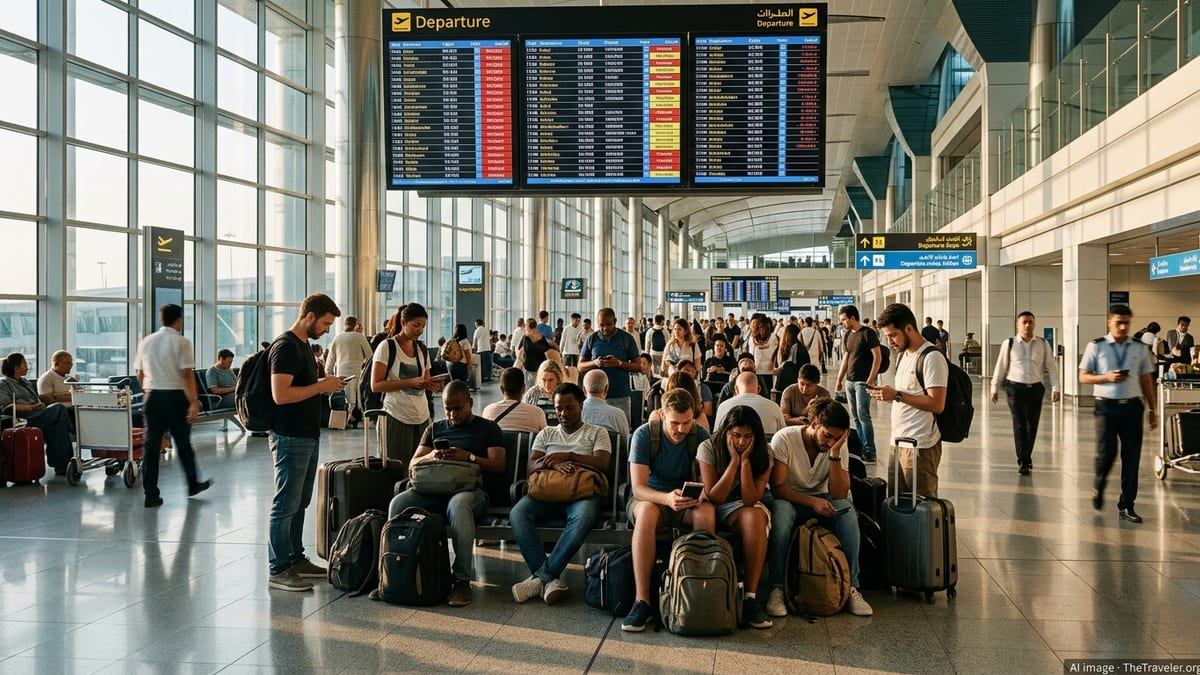
Conflict Fallout Leaves Tourists Stranded Across Key Hubs
Since late February 2026, the rapid escalation of hostilities centered on Iran and the Gulf has reshaped global air corridors, forcing airlines to reroute or suspend flights through key Middle Eastern airspace. Publicly available airline and aviation data show that tens of thousands of services have been delayed or cancelled, particularly on routes linking Europe, Asia and Australia via Gulf hubs.
Hub airports in the United Arab Emirates, Saudi Arabia, Bahrain, Kuwait, Qatar and Jordan have absorbed much of the disruption. Limited airport access, temporary terminal closures, and shifting security restrictions have combined to leave transit passengers unable to continue their journeys, with many stranded in cities such as Dubai, Abu Dhabi, Doha and Manama after their onward flights disappeared from departure boards.
The ripple effects are clearly visible farther east. Tourism-dependent destinations including Thailand and Indonesia report declines in long-haul arrivals and a spike in travellers requesting emergency stays. Local coverage in Bali and Bangkok describes visitors whose return itineraries via Gulf carriers collapsed overnight, leaving them to navigate unfamiliar immigration rules while monitoring constantly changing flight schedules.
Industry analysis suggests that if the current pattern of cancellations and diversions persists into April, the financial impact on regional tourism could run into billions of dollars. At the same time, the human cost is being felt most acutely by budget-conscious travellers facing unexpected accommodation, insurance and visa-related expenses.
UAE, Qatar, Bahrain and Neighbours Move to Ease Visa Burden
Against this backdrop, several Middle Eastern governments have begun softening immigration rules for visitors who suddenly find themselves unable to depart. Reports from regional media and traveller advisories highlight new measures in the United Arab Emirates, Qatar, Bahrain, Kuwait, Jordan, Egypt and Turkey aimed at shielding stranded tourists from punitive overstay penalties.
In the UAE, recent public information from government-affiliated channels and local press describes a waiver of overstay fines for visitors whose return flights were cancelled after February 28. Visitors on tourist and visit visas who can document disrupted itineraries are being allowed to remain until flights resume, with immigration authorities recorded as treating the situation as an exceptional circumstance rather than a normal overstay.
Qatar has adopted a similar stance. Coverage in regional news outlets notes that Doha joined other Gulf capitals in extending the validity of existing visit visas for travellers unable to exit due to airspace closures. Official advisories cited in that coverage explain that the policy is framed as a temporary humanitarian response designed to prevent tourists from falling into irregular status while airlines recalibrate their schedules.
Reports from Bahrain, Kuwait and Jordan indicate that those governments are also providing latitude on visa expiries linked directly to the crisis. In some cases, visitors are being granted automatic grace periods; in others, fast-tracked renewals or fee waivers are being made available through immigration offices and online portals, provided travellers can show evidence of cancelled or rerouted flights.
Philippines Aligns With Regional Trend on Emergency Extensions
The Philippines has now aligned itself with this wider regional trend, emerging as one of the latest governments in Asia to offer a relief mechanism for visitors stranded by the conflict-driven travel turmoil. Publicly available guidance on the country’s visa policy shows broader flexibility for temporary visitors whose onward travel has been disrupted during the current emergency period.
Immigration notices and travel advisories referencing a temporary policy window through mid-2026 indicate that foreign nationals already in the Philippines on short-term stays can seek extensions without facing the usual layers of fees or penalties when their inability to depart is tied to cancelled flights through Middle Eastern hubs. While core entry rules remain in place, the application of overstay fines appears to have been relaxed where travellers can document that rerouting out of the country has become significantly more complex or costly because of the conflict.
The move brings the Philippines into an emerging coalition of transit and leisure destinations easing formalities in response to what is increasingly viewed as a systemic aviation shock. Regional observers note that this stance also aligns with the Philippines’ economic interest in maintaining a reputation as a visitor-friendly gateway at a time when confidence in long-haul travel is under pressure.
Tourism operators in Manila and Cebu have publicly welcomed the more flexible approach, arguing that the absence of punitive penalties for unavoidable overstays helps preserve goodwill among tourists who may otherwise hesitate to book future trips involving Asian stopovers.
Southeast Asian Destinations Balance Security and Hospitality
Beyond the Philippines, several Southeast Asian governments are recalibrating the balance between border control and hospitality as the conflict continues to disrupt established flight corridors. Travel advisories and policy summaries show Indonesia, Thailand and other regional players adjusting their operational practices to cope with both stranded visitors and softer forward bookings from Europe and the Middle East.
In Indonesia, local reporting from Bali describes immigration offices processing a surge in applications for emergency stay permits from tourists whose homebound flights via Gulf carriers were abruptly cancelled. While not all of these extensions are fee-free, officials are portrayed as taking a more accommodating view of short overstays directly linked to the conflict, often encouraging visitors to regularize their status rather than risk accumulating fines.
Thailand’s tourism and business coverage highlights a different pressure point: the prospect of significant revenue losses if long-haul arrivals from affected markets do not recover quickly. Industry representatives quoted in local media have called for clear, traveller-friendly guidance on visa options for those caught in transit, arguing that flexible rules and transparent communication can help offset some of the damage to Thailand’s global image as an accessible hub.
Throughout the region, publicly available commentary from travel associations suggests that governments are watching each other’s responses closely. The emerging consensus appears to be that leniency on visas for genuinely stranded travellers is preferable to rigid enforcement, which risks not only reputational harm but also contentious legal disputes with tourists and insurers.
Travellers Navigate Patchwork Rules Amid Uncertain Outlook
For individual travellers, the evolving policies add a layer of complexity to an already stressful situation. Airspace closures, rolling cancellations and shifting airline rebooking rules mean that many tourists are now piecing together multi-stop journeys home using a patchwork of available routes that may no longer pass through their originally planned Gulf hubs.
Consumer-rights organisations and travel advisories urge stranded visitors to document everything, from airline cancellation notices to updated itineraries and accommodation receipts, in case they need to demonstrate that an overstay or visa extension request is directly tied to the conflict. Public guidance also emphasises the importance of checking official immigration channels and reputable local media, as rules may differ significantly between destinations even when they share similar humanitarian aims.
Analysts following the crisis note that the coordinated decision by countries such as the UAE, Qatar, Bahrain, Kuwait, Jordan, Egypt, Turkey and now the Philippines to cushion stranded visitors from financial penalties could help stabilise traveller sentiment once air routes normalise. By treating tourists as unintended victims of geopolitics rather than violators of immigration law, these governments may be laying the groundwork for a faster rebound in confidence.
For now, however, the atmosphere across affected airports and resort towns remains one of cautious improvisation. With the trajectory of the conflict uncertain and airline schedules changing by the day, the emergency visa extensions and fee waivers emerging from Gulf and Southeast Asian capitals have become an essential lifeline for thousands of travellers waiting for a safe route home.