

Phnom Penh is a city of palimpsests, where the wounds of the 20th century sit beside gilded pagodas, glassy condo towers and busy café terraces. For many travelers it is a gateway to Angkor or Cambodia’s southern islands, yet the capital rewards those who stay longer and look deeper.
Understanding Phnom Penh is to understand modern Cambodia itself: its ancient Khmer heritage, its trauma under the Khmer Rouge, its rapid urban transformation and its youthful, outward-looking population. Today, as tourism rebounds and new infrastructure reshapes the skyline, Phnom Penh stands at a pivotal moment between memory and reinvention.
From Royal Hamlet to Mekong Metropolis
Phnom Penh’s story begins long before its official designation as Cambodia’s capital. According to legend, a wealthy widow named Daun Penh found four Buddha statues inside a floating koki tree on the banks of the Mekong in the 14th century. She built a small shrine on a nearby hill to enshrine the statues, giving the city its name: Phnom (hill) Penh. Over time a settlement grew around the hill, positioned on a strategic bend where the Tonle Sap, Bassac and Mekong rivers converge, forming a natural hub for river trade.
The city became Cambodia’s royal capital in the mid 15th century, but its fortunes rose and fell with regional politics and shifting royal courts. For centuries it was a modest riverside town of wooden houses on stilts, Buddhist monasteries and busy markets. Its modern form emerged only in the 19th century, after King Norodom accepted French protection in 1863 and Phnom Penh became the administrative center of French Indochina’s Cambodian protectorate.
Under French rule the city was remodeled into what colonial officials called the Pearl of Asia. Wide boulevards, drainage canals, villas, shophouses and civic buildings were laid out on a grid around the Royal Palace and Wat Phnom. French architects and Khmer craftsmen left a distinctive legacy still visible today in ochre-fronted mansions, Art Deco markets and the subdued elegance of the National Museum. By the 1920s Phnom Penh had become one of Southeast Asia’s most fashionable small capitals.
Independence in 1953 ushered in a new phase of Cambodian nation-building. Under King Norodom Sihanouk, Phnom Penh became a showcase of modernity and culture, hosting international festivals, building new infrastructure and experimenting with a confident architectural style that blended Khmer motifs with modernist forms. This cosmopolitan chapter, however, would be violently interrupted in 1975 when the Khmer Rouge entered the city and forced its entire population into the countryside.
War, Trauma and the Long Road to Recovery
On April 17, 1975, Phnom Penh fell to the Khmer Rouge after years of civil war. Within days, its population of around 2 million residents and refugees was expelled at gunpoint. Hospitals were emptied, monks defrocked and factories abandoned. The capital, once a vibrant urban center, was transformed into a ghost city and later repurposed as an administrative hub for Democratic Kampuchea’s radical agrarian revolution.
During the Khmer Rouge period from 1975 to 1979, many of Phnom Penh’s schools and public buildings were converted into prisons, interrogation centers and offices for the regime. The most infamous was S-21, a former high school turned into a security center where thousands were detained, tortured and executed. Today, it is preserved as the Tuol Sleng Genocide Museum, a stark memorial to the estimated 1.7 million Cambodians who died nationwide from execution, starvation and forced labor.
Vietnamese forces entered Phnom Penh in January 1979, ending the Khmer Rouge regime but leaving behind a devastated city with shattered infrastructure and traumatized survivors. Throughout the 1980s, many buildings remained derelict and urban life returned slowly, driven as much by necessity as by any grand reconstruction plan. Families reclaimed empty houses, markets reopened, and Buddhist temples painstakingly resumed religious life in a country where many monks had been killed.
The 1991 Paris Peace Accords and subsequent United Nations peacekeeping mission marked a turning point. Elections, international aid and a new constitution set the stage for reconstruction and economic opening. Phnom Penh began to refill and expand, its street grid once more humming with commerce and traffic. The scars of the past remained visible, but they now coexisted with new shops, hotels and government ministries. For contemporary visitors, this recent history is not a distant chapter; it is a living memory that shapes how Cambodians talk about politics, identity and the future.
City of Temples, Palaces and Everyday Devotion
Despite its modern skyline, Phnom Penh remains a deeply spiritual city shaped by Theravada Buddhism. Monks in saffron robes are a daily sight at dawn, collecting alms along narrow streets while traffic swirls around them. Wats function as religious centers, community meeting places and schools, and they occupy some of the city’s most valuable real estate without losing their role as sanctuaries of quiet reflection.
At the heart of the capital stands the Royal Palace complex, residence of King Norodom Sihamoni. Its manicured gardens, gilded rooflines and airy pavilions symbolically anchor the monarchy in the nation’s life. Nearby, the Silver Pagoda houses sacred statues and ceremonial objects that embody centuries of Buddhist practice and royal patronage. Visiting these sites is not only a matter of sightseeing but also an immersion into the interplay of monarchy, religion and state that still shapes Cambodian public life.
Wat Phnom, the small but significant temple on the hill where Daun Penh once built her shrine, remains both a spiritual and symbolic focal point. Locals come to light incense, ask for good fortune in business or exams, and make offerings to the protective spirits believed to dwell there. Around the hill, the atmosphere feels almost village-like despite its central location, with shaded paths, fortune-tellers and vendors creating a microcosm of traditional urban life.
Beyond the major monuments, countless small shrines and spirit houses dot doorways, markets and street corners. These everyday expressions of belief coexist with more formal ceremonies such as Pchum Ben, the festival honoring ancestors, and the exuberant Water Festival, when illuminated boats and fireworks transform the riverside. For travelers, taking time to observe these quieter rituals can be as revealing as visiting the grand temples.
Everyday Culture: Food, Neighborhoods and River Life
Phnom Penh’s culture is felt most strongly not in grand narratives but in the textures of daily life. The city’s markets are a good starting point. Psar Thmei, the Central Market built in the 1930s, remains an architectural and cultural icon with its yellow Art Deco dome and radial wings filled with jewelers, fabric sellers and food stalls. Russian Market in the south of the city offers a more labyrinthine experience, where souvenir stalls coexist with hardware vendors, tailors, mechanics and a famously atmospheric wet market.
Cambodian cuisine reveals another layer of the city’s character. Classic dishes such as amok (a fragrant coconut curry often steamed in banana leaves), kuy teav (rice noodle soup) and prahok-based stir-fries reflect the interplay of river fish, rice and herbs that have sustained the country for centuries. Street-side grills send up clouds of smoke scented with lemongrass, while busy breakfast stalls serve bowls of rice porridge or noodles before the heat of the day sets in. In recent years, young chefs have opened contemporary Khmer restaurants and cafés that reinterpret traditional recipes while using local ingredients.
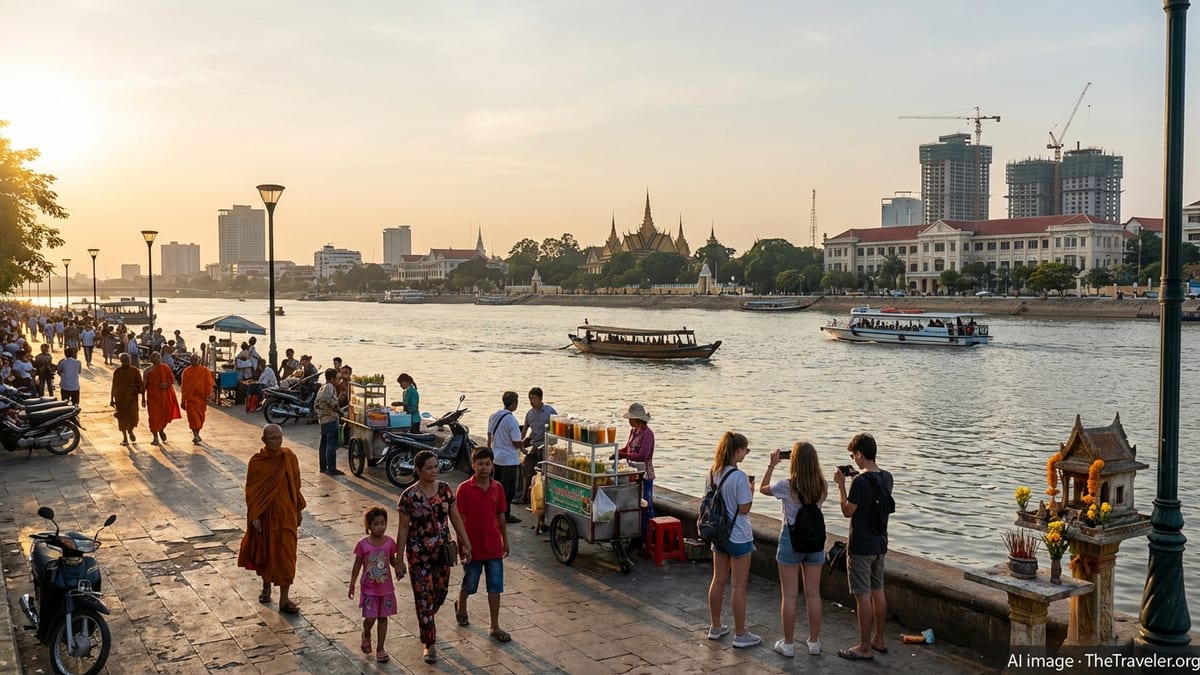
Phnom Penh is fundamentally a river city, and the Sisowath Quay along the Tonle Sap remains its social spine. In the early morning, joggers, tai chi groups and coffee vendors share the promenade. At sunset, families stroll, teens take selfies and food carts line the pavements. The annual Water Festival in November, tied to the dramatic reversal of the Tonle Sap’s flow, fills the waterfront with colorful longboat races, music and fireworks, embodying Cambodia’s intimate relationship with its rivers.
Neighborhoods across the city showcase different facets of Phnom Penh’s evolving identity. The historic quarter around the palace and Riverside displays a mix of colonial-era shophouses and newer hotels. Tonle Bassac and BKK1 have become hubs for expatriates, creative businesses and nightlife, with a proliferation of coffee shops, rooftop bars and boutique hotels. Farther out, districts once seen as peripheral now house malls, gated communities and garment factories, highlighting the economic and social shifts reshaping the city’s fabric.
Modern Cambodia: Politics, Youth and Rapid Change
To understand Phnom Penh today is to grapple with the contradictions of modern Cambodia. Politically, the country is dominated by the Cambodian People’s Party, led by Prime Minister Hun Manet, who took office in 2023 after his father, Hun Sen, stepped down following nearly four decades in power. While officials emphasize stability and economic growth, rights groups and independent observers describe a climate where opposition parties, activists and critical journalists face legal and administrative pressure.
The capital sits at the center of these dynamics. Government ministries, party headquarters, foreign embassies and international organizations coexist within a compact urban core. Political events, from elections to court cases involving opposition figures, regularly play out in Phnom Penh’s streets and courtrooms, even if visible public protest is limited. Travelers may not encounter these tensions directly, but they underlie conversations about land development, labor rights and environmental protection.
At the same time, Phnom Penh is a city of youth and restless ambition. A majority of Cambodians are under 30, and in the capital they are increasingly university educated, digitally connected and outward looking. English-language cafés double as coworking spaces. Local tech start-ups, creative studios and social enterprises share office towers with banks and real estate firms. The city’s art and music scenes, though still modest compared with some regional neighbors, reflect growing experimentation and global influences filtered through Khmer sensibilities.
Economic growth, propelled by garment manufacturing, construction, real estate and tourism, has transformed Phnom Penh into a construction site on a grand scale. High-rise condominiums, office towers and commercial complexes have mushroomed, often financed by regional investors. This building boom has created jobs and improved infrastructure but also sparked debates over inequality, urban planning and the displacement of long-standing communities. For visitors seeing the city for the first time, the cranes and concrete can be as striking as the temples and palaces.
Urban Transformation: Infrastructure, New Airport and Tourism Boom
Phnom Penh’s recent trajectory is closely tied to Cambodia’s broader tourism and infrastructure push. After the pandemic slump, visitor numbers have rebounded strongly, with millions of international arrivals contributing several billion dollars to the national economy. The capital has emerged as both a transit point and a destination in its own right, a shift confirmed by record crowds on the riverside during major festivals and New Year celebrations.
One of the most significant developments shaping the city’s future is the opening of Techo International Airport, located outside Phnom Penh and designed to replace the aging Phnom Penh International Airport for most commercial flights. With an initial capacity in the tens of millions of passengers per year and ambitious expansion plans, the new airport positions the capital as a regional hub and reflects the government’s strategy of pairing tourism growth with large-scale infrastructure projects.
Within the city, new bridges, improved roads and upgraded drainage systems are changing how people move and how districts connect. Expressways linking Phnom Penh with regional centers, alongside updated bus routes and plans for more organized public transport, are gradually reducing travel times that once discouraged both residents and visitors. Shopping centers, entertainment complexes and mixed-use developments springing up in outer districts signal a metropolitan region that is pushing far beyond its former boundaries.
These changes bring opportunities and challenges. Tourism supports jobs in hospitality, retail and services, and infrastructure upgrades make travel more comfortable than in the past. Yet rapid development also places strain on heritage buildings, green spaces and traditional neighborhoods. For travelers, this means Phnom Penh is a city in flux, where new cafés and hotels open frequently and entire districts can feel transformed between visits.
Memory, Heritage and Ethical Travel
Phnom Penh’s most visited sites include places of profound suffering, and engaging with them thoughtfully is part of understanding modern Cambodia. The Tuol Sleng Genocide Museum, located in the former S-21 prison, and the Choeung Ek killing fields on the outskirts of the city tell the story of the Khmer Rouge period through testimony, photographs and preserved sites of mass violence. These memorials are emotionally demanding but central to grasping the scale and intimacy of the country’s trauma.
Visitors are encouraged to approach these places with respect: dressing modestly, keeping voices low, and allowing local guides and survivors’ accounts to frame the experience. Many Cambodians visiting alongside foreign tourists are there to remember lost relatives or learn more about a history not always fully covered in school curricula, making these spaces both national memorials and active classrooms. Taking time afterward to reflect, rather than rushing to the next attraction, honors the weight of what is on display.
Beyond sites of atrocity, Phnom Penh’s heritage extends to its colonial and modernist architecture. A growing number of local researchers, photographers and architects are documenting endangered buildings and advocating for their conservation, from early 20th century villas to mid-century social housing projects. Some have been converted into boutique hotels, galleries or cafés, offering travelers a chance to experience these spaces in a living context rather than as static monuments.
Ethical travel in Phnom Penh also involves awareness of social and environmental issues. Choosing locally owned accommodations, restaurants and tour operators helps spread tourism benefits beyond a narrow elite. Supporting organizations that provide vocational training, fair work conditions or arts education can amplify positive impacts. Paying attention to how communities talk about development projects, land disputes or pollution can deepen a visitor’s understanding of the trade-offs embedded in the city’s rapid modernization.
Experiencing Phnom Penh Today
For many travelers, Phnom Penh is initially defined by its sensory intensity. The soundscape blends temple bells with construction noise, motorcycle engines, loudspeakers advertising promotions and the calls of street vendors. The air carries aromas of grilled meat, blooming frangipani and, in the rainy season, the earthy scent after an afternoon downpour. Navigating this environment can feel overwhelming at first, but patterns quickly emerge, and the city reveals itself as surprisingly navigable and hospitable.
Accommodation options range from guesthouses and heritage hotels near the riverside to modern high-rise properties in business districts. In recent years, a wave of mid-range boutique hotels has catered to travelers seeking character and comfort without international chain prices. Many feature rooftop pools or bars overlooking the river or city skyline, reflecting how verticality has become part of Phnom Penh’s identity.
Food and drink culture is one of the city’s great strengths. In addition to traditional Khmer eateries and street stalls, Phnom Penh now boasts specialty coffee shops, bakeries, craft beer bars and international restaurants reflecting regional and global influences. Young Cambodians and returning members of the diaspora play a central role in this culinary evolution, experimenting with local ingredients and contemporary presentation while preserving familiar flavors from home cooking.
As night falls, the city takes on a different mood. The riverfront glows with fairy lights and the reflection of the Royal Palace, while side streets fill with evening markets, music and the chatter of families gathered over iced coffee or sugarcane juice. Rooftop venues offer views over the Mekong, and small live-music bars give space to local bands experimenting with rock, hip-hop and traditional instruments. Travelers who linger beyond the typical day of sightseeing often find that these evenings become their most vivid memories.
The Takeaway
Phnom Penh is not a perfectly preserved historical city, nor a polished showcase of futuristic development. It is something messier and more compelling: a living capital where history, trauma, resilience and aspiration intersect in every neighborhood. From the hilltop shrine of Wat Phnom to the new international airport, from the silent classrooms of Tuol Sleng to crowded New Year fireworks on the riverside, the city embodies Cambodia’s journey from monarchy to war to reconstruction and, now, to assertive participation in a globalized region.
For travelers willing to engage with its complexities, Phnom Penh offers far more than a convenient stopover. It invites questions about how societies remember violence, how spiritual traditions adapt to urban life, how young populations reshape inherited systems and how development can be both transformative and unequal. Walking its streets, eating at family-run stalls, visiting its memorials and talking with its residents turns an abstract narrative of modern Cambodia into lived experience.
In the end, Phnom Penh is best approached not as a checklist of sights but as a conversation: between past and present, between river and concrete, between local life and global currents. That conversation is still unfolding, and visitors who come with curiosity and humility will find a city ready to share its story.
FAQ
Q1. Is Phnom Penh safe for travelers?
Phnom Penh is generally safe for visitors who take normal urban precautions such as keeping valuables secure, using registered taxis or ride-hailing services at night and staying aware of traffic when crossing streets. Petty theft and bag snatching can occur in crowded areas, but violent crime against tourists is relatively uncommon. Political demonstrations are rare and usually tightly controlled, so it is wise to avoid any large gatherings that do occur.
Q2. How many days should I spend in Phnom Penh?
A stay of two to three full days allows time to visit key historical sites such as the Royal Palace, National Museum, Tuol Sleng and Choeung Ek, while also exploring markets, riverside promenades and emerging neighborhoods. Travelers interested in contemporary culture, food and art may prefer four or more days to move at a slower pace and include day trips to nearby silk islands or craft villages.
Q3. When is the best time of year to visit Phnom Penh?
The most comfortable months are typically from November to February, when temperatures are relatively cooler and humidity is lower. The hot season from March to May can be intense, while the rainy season from June to October brings regular showers but also greener landscapes and fewer crowds. Major festivals such as the Water Festival and Khmer New Year offer rich cultural experiences but also draw large crowds and higher demand for accommodation.
Q4. How has Phnom Penh changed in recent years?
In the past decade Phnom Penh has seen rapid construction of high-rise buildings, new shopping centers and large infrastructure projects including a new international airport. Tourist numbers and domestic travel have grown, bringing more hotels, restaurants and entertainment options. At the same time, older neighborhoods have faced pressure from development, sparking concerns about displacement, loss of heritage architecture and rising living costs for local residents.
Q5. What are the must-visit historical sites for understanding modern Cambodia?
To grasp Cambodia’s recent history, most visitors prioritize the Tuol Sleng Genocide Museum and the Choeung Ek killing fields, which document the Khmer Rouge period. Complementing these are the Royal Palace and Silver Pagoda, which represent the continuity of the monarchy, and the National Museum, which showcases ancient Khmer art and sculpture. Exploring colonial-era streets and surviving examples of 1960s modernist architecture adds further depth to an understanding of the country’s complex past.
Q6. How important is Buddhism in daily life in Phnom Penh?
Buddhism is central to social and cultural life in Phnom Penh. Monasteries serve as religious centers, community spaces and informal welfare networks. Many Cambodians make regular offerings at pagodas, invite monks to bless new homes or businesses, and observe key religious holidays. Even as younger generations embrace global culture and digital life, Buddhist values and rituals continue to shape family decisions, ceremonies and attitudes toward generosity and merit-making.
Q7. What role does Phnom Penh play in Cambodia’s economy?
Phnom Penh is the country’s primary economic engine, concentrating government institutions, financial services, manufacturing headquarters, logistics firms and much of the tourism sector. Construction, real estate and retail are particularly visible in the capital, and many rural Cambodians migrate to the city for work in factories, service industries or informal trades. As infrastructure improves, Phnom Penh’s influence increasingly extends into surrounding provinces and regional trade routes.
Q8. How can travelers explore Phnom Penh responsibly and ethically?
Responsible travelers can support locally owned businesses, choose accommodations and tours that treat staff fairly and avoid activities that exploit vulnerable people or wildlife. Visiting genocide memorials with respect, asking permission before photographing individuals and learning a few basic Khmer phrases all help build more meaningful connections. When discussing sensitive topics like politics or the Khmer Rouge era, it is important to let Cambodians decide what they are comfortable sharing.
Q9. What is the food scene like for visitors with dietary preferences?
Phnom Penh offers a growing range of options for different dietary needs. Traditional Khmer food is rice- and vegetable-based, with many dishes that can be prepared without meat if requested. In the capital, travelers will also find vegetarian and vegan cafés, international restaurants and markets with fresh fruits and snacks. Those with allergies or strict requirements should communicate clearly and, when possible, show key phrases written in Khmer to avoid misunderstandings.
Q10. How does visiting Phnom Penh help me understand Cambodia beyond Angkor Wat?
While Angkor Wat showcases the grandeur of medieval Khmer civilization, Phnom Penh reveals how Cambodians live, work and remember today. The capital’s markets, temples, universities, government offices and memorial sites bring together past and present in a way that highlights both continuity and change. Spending time in Phnom Penh offers insight into contemporary politics, economic development, youth culture and spiritual life, providing a fuller picture of the country than a temple-focused itinerary alone.