

Phnom Penh can feel chaotic at first glance. The capital of Cambodia is a low-rise sprawl along three rivers, punctuated by glittering temple roofs, construction cranes and traffic that never quite stops. Yet beneath the apparent disorder there is a discernible pattern.
Each neighborhood offers a different slice of the city: royal boulevards and embassies, leafy café districts, gritty markets, riverside promenades and emerging satellite cities. Understanding this layout is one of the best ways to decide where to stay and how to move around the city in 2026.
Understanding Phnom Penh’s City Layout Today
Phnom Penh lies at the confluence of the Mekong, Tonle Sap and Bassac rivers, and those waterways still define its shape. The historic heart runs along the Tonle Sap, with the Royal Palace, Wat Phnom and the old French quarter all set back a short walk from the river. Radiating south and west from this cluster are a series of numbered “Khans” or districts that blend into one another with no clear visual boundary, but which locals know by a mix of old market names and new development brands.
For visitors, the practical city divides into a few main zones. The riverside and the streets just behind it form the most familiar tourist strip, thanks to their density of hotels, bars and backpacker hostels. Slightly inland, BKK1 and the surrounding central neighborhoods have become the city’s café and expat hub. Further out, Russian Market and Tuol Tom Poung retain a more local feel while still drawing travelers for food and shopping. To the north and across the rivers, areas such as Tuol Kork, Chroy Changvar and Koh Pich showcase the new Phnom Penh of malls, gated communities and high-rise towers.
The city is largely flat and easy to navigate on a map, but infrastructure is evolving fast. Techo International Airport, which replaced Phnom Penh International Airport as the capital’s main gateway in September 2025, sits about 19 kilometers south of the center. A growing ring-road system, including the prominent Xi Jinping Boulevard on the third ring road, is pushing urban growth outward. Inside this expanding frame, you will find an eclectic patchwork of colonial-era shophouses, concrete villas, Buddhist pagodas and glass-fronted condominiums.
The Historic Core: Riverside, Royal Palace and Wat Phnom
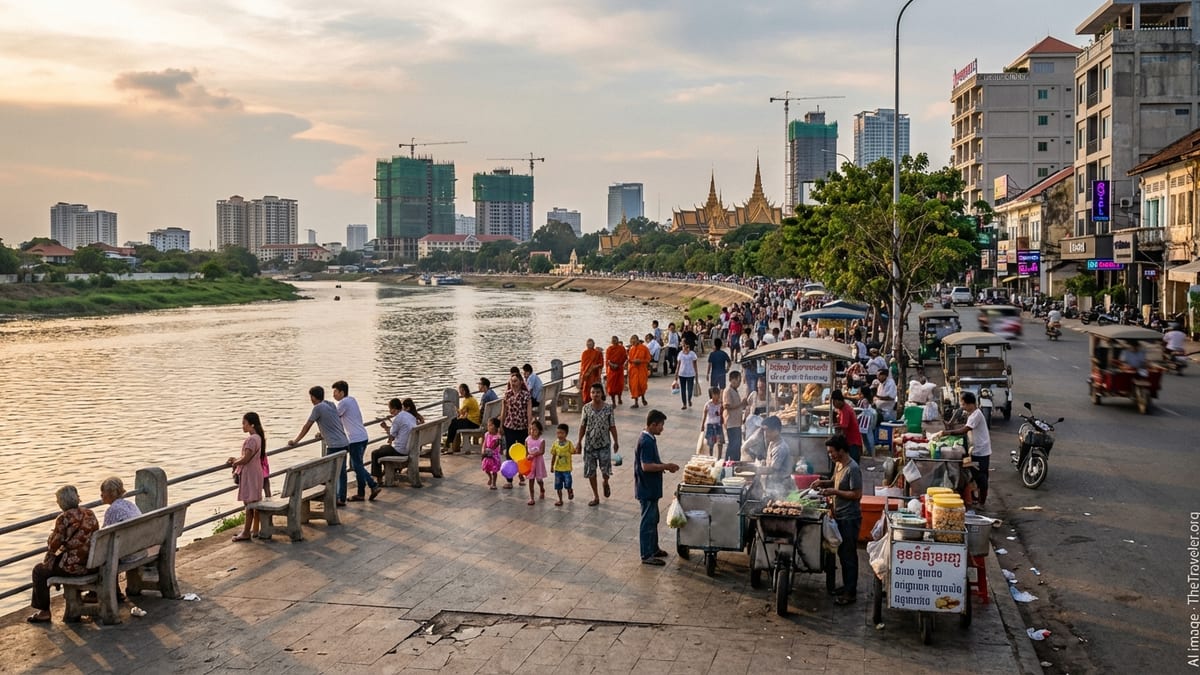
The classic introduction to Phnom Penh begins along Sisowath Quay, the main riverside boulevard that runs for about three kilometers beside the Tonle Sap. This waterfront strip is lined with hotels, bars, cafés and travel agencies, and remains one of the most popular places in the city for a first stay. From many guesthouses you can simply cross the road to stroll the promenade, watch monks and families gather at sunset, and look across to the green banks of Chroy Changvar on the far side of the water.
Just south of the busiest bar cluster, the Royal Palace complex and the Silver Pagoda anchor the city’s ceremonial and historical center. The broad lawns and gilded roofs are set back a short walk from the river, with neat streets of government buildings and older villas surrounding them. Nearby, the National Museum presents an elegant red-roofed courtyard packed with Angkor-era sculpture. While much of the day-to-day business of Phnom Penh has shifted outward to newer corporate districts, this quarter still feels like the symbolic heart of the nation.
North along the same axis, Wat Phnom stands on a low hill that breaks the otherwise flat skyline. This small temple, surrounded by a leafy park and a busy roundabout, gives the city its name and functions as both a religious site and a convenient landmark. Streets around Wat Phnom transition into what was once the French colonial quarter, with surviving shophouses, civic buildings and older hotels. Some have been carefully restored, others left to crumble, but together they help visitors imagine how the city looked in the early twentieth century.
In practical terms, this historic core works well for travelers who prioritize atmosphere and heritage over cutting-edge comfort. Accommodation here ranges from budget hostels to boutique riverside properties. You are within walking distance of major sights, short tuk-tuk rides from most central neighborhoods, and always close to the liveliest informal nightlife. The trade-off is noise, some lingering tout culture, and increasingly congested roads during peak hours and major festivals such as the Water Festival, when boats race along the river beside the Royal Palace.
BKK1 and the Central Grid: Cafés, Embassies and Urban Comfort
Just a few minutes south of the palace and Independence Monument, the district popularly known as BKK1 has become the preferred address for many expatriates, non-governmental organizations and younger, urban Cambodians. Technically part of Boeung Keng Kang commune, BKK1 and its neighboring blocks are laid out in a simple grid of numbered streets, with low- to mid-rise apartment buildings, international schools, language centers and co-working spaces packed into a relatively walkable area.
This central grid is where Phnom Penh feels most cosmopolitan. Streets fill with cafés offering specialty coffee and air-conditioned brunch menus, Japanese and Korean restaurants, plant-based eateries and small craft beer bars. Western-style supermarkets and international pharmacies sit alongside Cambodian bakeries and street food stalls. Sidewalks are inconsistent and often obstructed by parked cars or food carts, but compared with much of the city, BKK1 is one of the easiest neighborhoods to navigate on foot.
For visitors, BKK1’s appeal lies in comfort and convenience. Hotels, serviced apartments and guesthouses cater to longer stays, often with reliable internet, better soundproofing and more modern fixtures than similarly priced places by the river. Many offer rooftop pools or small gyms. From here, tuk-tuk rides to the riverside, Russian Market or the main museums are short and inexpensive. The area is well served by ride-hailing and food delivery apps that now operate widely in Phnom Penh, making it simple to organize transport and meals without much Khmer language.
The character of BKK1 continues to evolve as older villas are replaced by glass and concrete towers. Construction noise and dust can be part of daily life, and some visitors miss the sense of history they find closer to the palace or Wat Phnom. Yet for travelers who want a base that feels more like a modern Asian city neighborhood, with easy access to both local culture and international comforts, BKK1 and the surrounding central grid are the most practical choice.
Russian Market and the Southern Neighborhoods
South of the central grid, the district informally centered on Russian Market, or Tuol Tom Poung, offers a different flavor of urban Phnom Penh. The market itself is a dense warren of stalls selling everything from souvenirs and textiles to motorbike parts and household goods. It gained its nickname during the 1980s, when it was frequented by Russian expatriates, and today it remains one of the city’s most visited markets for both locals and tourists.
Streets around Russian Market feature a mix of older shophouses, low-rise apartment blocks and boutique guesthouses, with an increasingly lively food scene. Small bars, casual bistros and coffee shops cluster on side streets, drawing a younger crowd in the evenings. Compared with BKK1, prices for accommodation and dining can be lower, and the area still retains a more traditional urban texture, with morning wet markets, family-run eateries and narrower lanes.
Nearby, the Tuol Sleng Genocide Museum occupies the former S-21 prison and stands as one of Cambodia’s most important memorial sites. Many visitors choose to stay in the southern neighborhoods specifically to be close to both Tuol Sleng and Choeung Ek, the Killing Fields site reachable by tuk-tuk outside town. This part of the city provides a sobering counterpoint to the glitz of new malls and towers, grounding any visit in the country’s relatively recent history of conflict and recovery.
Traffic can feel slightly more chaotic in these southern neighborhoods, and sidewalks are often non-existent or blocked. However, their central position still allows for easy tuk-tuk connections to the riverside, BKK1 and the newer commercial hubs further south along the Bassac River. For travelers seeking a balance of affordability, local life and access to key historical sites, Russian Market and its neighboring streets remain a compelling base.
Northern Phnom Penh and Tuol Kork: Local Living and Emerging Hubs
Turn north from the palace and Wat Phnom and the city broadens into largely residential neighborhoods that see far fewer tourists. Tuol Kork, in particular, has become known as a suburban-style district of villas, international schools and growing commercial strips. Here, tree-lined streets conceal large homes and small apartment blocks, many set behind high walls. A handful of shopping centers, cafés and restaurants cater mainly to local families and long-term residents.
Accommodation options in Tuol Kork are more limited from a short-stay perspective, but a small number of boutique hotels and serviced apartments cater to business travelers and returning Cambodians. This is not a nightlife hub, and streets can feel quiet after dark compared with the riverfront or BKK1. For visitors who value a more local, low-key atmosphere and do not mind longer tuk-tuk rides to major sights, Tuol Kork offers a glimpse of how middle-class Phnom Penh lives away from the tourist circuits.
Further north, beyond the older Khmer and Chinese shop rows, large-scale developments like Camko City illustrate how Phnom Penh is expanding into planned satellite districts. Conceived as a mixed-use urban project with residential towers, offices, schools and a hospital, this northern expansion reflects the city’s aspirations as a regional business and services hub. While still primarily residential and business focused, these emerging zones hint at where future hotels, leisure spaces and retail complexes are likely to cluster.
For now, the main advantage of staying in northern Phnom Penh is quieter streets and relative proximity to the routes leading out of town toward Siem Reap or the Thai border. Travelers who are passing through on overland journeys, or those working with local organizations based in these districts, may find it convenient to base themselves away from the more touristed center, then commute inward for sightseeing as needed.
Across the Water: Chroy Changvar and Koh Pich
Phnom Penh’s geography is increasingly shaped by what lies across its rivers. To the northeast, the Chroy Changvar peninsula stretches between the Mekong and the Tonle Sap, with broad river views back toward the palace and the downtown skyline. Long considered somewhat peripheral, Chroy Changvar has seen a wave of development in recent years, with new bridges, residential projects and leisure complexes drawing more residents and visitors across the water.
Chroy Changvar now mixes older riverside villages with modern gated communities and mid-rise condominiums aimed at Cambodians and foreign buyers alike. Broad boulevards and a growing number of parks, sports facilities and family attractions give the area a more spacious feel than much of central Phnom Penh. For travelers, a limited but growing stock of hotels and serviced apartments offers an alternative base with calmer streets, better air and expansive views, especially appealing for long stays and families.
Closer to the historical core, and just across a short bridge from the south of the city center, Koh Pich or Diamond Island has become one of Phnom Penh’s most emblematic new districts. Once a low-lying sandbar at the confluence of the Bassac and Mekong rivers, it has been transformed into a zone of exhibition halls, condominiums, malls and themed architecture. Today it functions as both an events destination and a residential enclave, with wide roads, promenades and nighttime lighting that showcase the city’s modern aspirations.
Neither Chroy Changvar nor Koh Pich offers the dense street life of the traditional markets or the riverside bar strips, but both form a key part of the city’s layout for future travelers. They are integral to smart city pilot projects that focus on traffic management, flood control and digital signage, and they host many of the fairs, conferences and entertainment events that bring domestic tourists to the capital. Staying here places visitors at the intersection of river views, new infrastructure and the next phase of Phnom Penh’s urban story.
Transport, Connectivity and the New Airport Era
One of the most significant changes to Phnom Penh’s travel geography is the opening of Techo International Airport in September 2025, which replaced the older Phnom Penh International Airport as the city’s main air gateway. Located roughly 19 kilometers south of the center in Kandal Province, this large, purpose-built facility is designed to handle over 13 million passengers annually in its first phase, with capacity slated to increase steadily through 2030 and beyond. For visitors, this means more flight options, smoother arrivals and a more spacious terminal, but also a longer journey into town.
Airport transfers now trace new patterns on the city map. Most travelers will reach central Phnom Penh by taxi, ride-hailing car or prearranged hotel transfer, following expressways and new radial roads that skirt the expanding urban fringe. Travel times vary with traffic but generally range from 40 minutes to more than an hour for the busiest riverside neighborhoods. The shift southward has also given a boost to areas along the Bassac River and ring roads, where new logistics hubs, industrial parks and residential projects are taking shape to serve the airport corridor.
Within the city, traffic remains one of Phnom Penh’s defining challenges, especially at morning and evening peak hours. However, the expansion of bus routes, smart traffic-light systems and ride-hailing platforms has made it easier for travelers to move between neighborhoods without needing their own vehicle. Tuk-tuks, both traditional and electric, are still the most flexible mode for short hops between the riverside, BKK1, Russian Market and the main museums. For trips to outer districts, most visitors rely on app-based cars, which provide upfront pricing and navigation support.
Longer-term, large infrastructure projects such as the Funan Techo Canal, set to link the Bassac River near Phnom Penh with the coast, and the extension of ring roads and bridges will continue to reshape how the city connects internally and to the rest of Cambodia. Travelers arriving in 2026 will already encounter a more integrated transport network than before the pandemic, with better road surfaces on key arteries, improved lighting and signage, and growing digital tools such as mapping and ticketing apps that help demystify the city’s sprawl.
Choosing Where to Stay: Matching Neighborhoods to Travel Styles
With so many distinct districts, the question for most visitors is not whether Phnom Penh is worth a stop, but rather which neighborhood best fits their priorities. Those seeking a classic introduction, heavy on atmosphere and easy access to landmarks, often gravitate toward the riverside and streets around the Royal Palace and Wat Phnom. This area suits first-time visitors, budget travelers and anyone who enjoys being able to walk from their hotel to the main promenade in a few minutes.
Travelers who value reliable amenities, quieter nights and a concentration of global food options usually prefer BKK1 and the central grid. Here, you can start your day in a coffee shop with fast internet, walk or tuk-tuk to museums or markets, then return to a base that feels somewhere between Phnom Penh and a generic modern Asian city. Digital nomads, remote workers and business travelers often find this blend of local and international particularly appealing.
If you want to stay close to the Tuol Sleng Genocide Museum, shop in a busy local market and enjoy a more lived-in urban ambiance, the southern neighborhoods around Russian Market provide that balance. These streets are ideal for travelers who have already visited the city once and want to go a bit deeper, or for those who plan to take multiple day trips out to the Killing Fields and other sites but still return to a central base each evening.
Meanwhile, Chroy Changvar, Koh Pich and the northern suburbs suit visitors who prioritize space, views and relative calm over immediate access to nightlife. Families, conference delegates and long-stay guests may particularly appreciate the quieter environment and more residential character. Regardless of where you stay, distances are not vast compared with larger capitals, and a combination of tuk-tuks and ride-hailing services keeps all of these neighborhoods within easy reach for day and evening outings.
The Takeaway
Phnom Penh is not a city of a single center but of overlapping layers. The royal and colonial core by the river tells the story of the kingdom and its French-era urbanism. BKK1 and the central grid showcase the city’s contemporary, globally connected side. Russian Market and the southern streets remind visitors that everyday markets and modest shophouses still anchor local life. Across the rivers, new districts rise on reclaimed land and peninsulas, pointing toward a future of planned communities, conference centers and smart city infrastructure.
For travelers in 2026, understanding this mosaic is the key to a rewarding stay. Choosing the right neighborhood means more than just picking a hotel; it shapes how you experience the city’s history, food culture, traffic rhythms and changing skyline. Whether you base yourself on the riverside promenade, in a leafy side street of BKK1, beside the stalls of Russian Market or on a quiet stretch of Chroy Changvar, Phnom Penh will reveal a different face.
The city’s new airport and transport projects are pulling its map outward, but its essential character still resides in its streets: monks walking past construction sites, families picnicking by the river, office workers on motorbikes weaving between markets and malls. Take time to walk, look up at the evolving skyline and cross the bridges that link the old and new. In a capital where every neighborhood is in motion, exploring the layout of Phnom Penh is itself one of the most interesting journeys you can make.
FAQ
Q1. What is the best neighborhood to stay in for first-time visitors to Phnom Penh?
For a first visit, most travelers choose the riverside area around Sisowath Quay or the streets near the Royal Palace and National Museum. You are within walking distance of major sights, close to the river promenade and surrounded by a wide range of hotels, guesthouses, restaurants and tour agencies. It can be busy and noisy, but it offers the most immediate sense of place.
Q2. How does BKK1 compare to the riverside area?
BKK1 tends to feel more modern and residential, with embassies, international schools, cafés and co-working spaces concentrated in a compact grid of streets. Accommodation in BKK1 often offers more contemporary comforts and quieter nights than the riverside, but you lose some of the historic atmosphere and easy access to the river promenade. Tuk-tuk rides between the two areas are short and inexpensive, so many visitors move back and forth freely.
Q3. Is Russian Market a good base for travelers?
Russian Market and the surrounding Tuol Tom Poung neighborhood are excellent for travelers who want a more local, lived-in feel while still staying fairly central. The market itself is a major draw for shopping and food, and nearby streets have a growing selection of cafés and small bars. You will be slightly farther from the river and palace than in BKK1, but still within a short tuk-tuk ride of most attractions.
Q4. Are Chroy Changvar and Koh Pich worth considering for accommodation?
Yes, for certain travel styles. Chroy Changvar offers broad river views, newer residential complexes and a quieter, more spacious environment. Koh Pich, or Diamond Island, is more about modern condominiums, event halls and promenades. Both areas are less atmospheric than the old quarters but can be appealing for families, conference visitors or long stays, especially if you value calm streets and newer buildings.
Q5. How long does it take to reach the city from Techo International Airport?
Travel time from Techo International Airport to central Phnom Penh usually ranges from about 40 minutes to more than an hour, depending on traffic and your exact destination. The riverside and palace area typically take slightly longer than southern districts, while BKK1 and Russian Market sit somewhere in between. Most visitors use taxis, ride-hailing services or hotel transfers to make the journey.
Q6. Is it easy to move between neighborhoods without speaking Khmer?
Yes. Ride-hailing and delivery apps operating in Phnom Penh allow you to set destinations on a map without needing much spoken Khmer. Tuk-tuk drivers in central areas are also used to dealing with tourists and can usually understand hotel names, landmarks and simple addresses. Having your destination written down or pinned on a map app makes moving between neighborhoods straightforward.
Q7. Which area is best for nightlife in Phnom Penh?
Most nightlife that appeals to visitors is clustered around the riverside and the central grid including parts of BKK1. Here you will find rooftop bars, live music venues, casual pubs and late-opening restaurants. Russian Market has a smaller but growing evening scene centered on a few key streets. Chroy Changvar and Koh Pich tend to be quieter after dark, with more focus on family promenades and occasional events.
Q8. Are there safety differences between the main neighborhoods?
Central Phnom Penh is generally safe for travelers who take normal urban precautions, but experiences can differ. The riverside area is busy and well lit, yet attracts more petty crime such as bag snatching, particularly late at night. BKK1 and Russian Market are lively but feel more residential. Chroy Changvar, Koh Pich and Tuol Kork are relatively calm, with fewer crowds. Wherever you stay, use licensed taxis or ride-hailing at night, keep valuables secure and avoid poorly lit side streets when alone.
Q9. Where should I stay if I am visiting Tuol Sleng and the Killing Fields?
If your focus is on Cambodia’s recent history and you plan to visit both the Tuol Sleng Genocide Museum and the Killing Fields memorial at Choeung Ek, staying near Russian Market or in the southern part of the central grid is practical. You will be close to Tuol Sleng, and it is easy to hire a tuk-tuk or car for the longer trip out to Choeung Ek while still having quick access back to restaurants and services in the evening.
Q10. How will Phnom Penh’s rapid development affect where I should stay in the next few years?
New infrastructure such as Techo International Airport, expanded ring roads and large urban projects across the rivers are steadily shifting Phnom Penh’s center of gravity outward. In the near term, riverside, BKK1 and Russian Market will remain the most convenient bases for sightseeing, while Chroy Changvar, Koh Pich and emerging suburbs will grow in appeal for long stays and business travel. As projects mature, expect more hotel options and better transport links in these newer districts, giving travelers a wider range of neighborhood styles to choose from.