

More news on this day
Phoenix Reisen’s MS Amadea has begun a 146-night world cruise from Bremerhaven, with publicly available itineraries showing a marquee stretch through Japan that includes calls at Tokyo, Kobe and Hiroshima alongside a broader route across Europe, the Caribbean, the Pacific and Africa.
Get the latest news straight to your inbox!
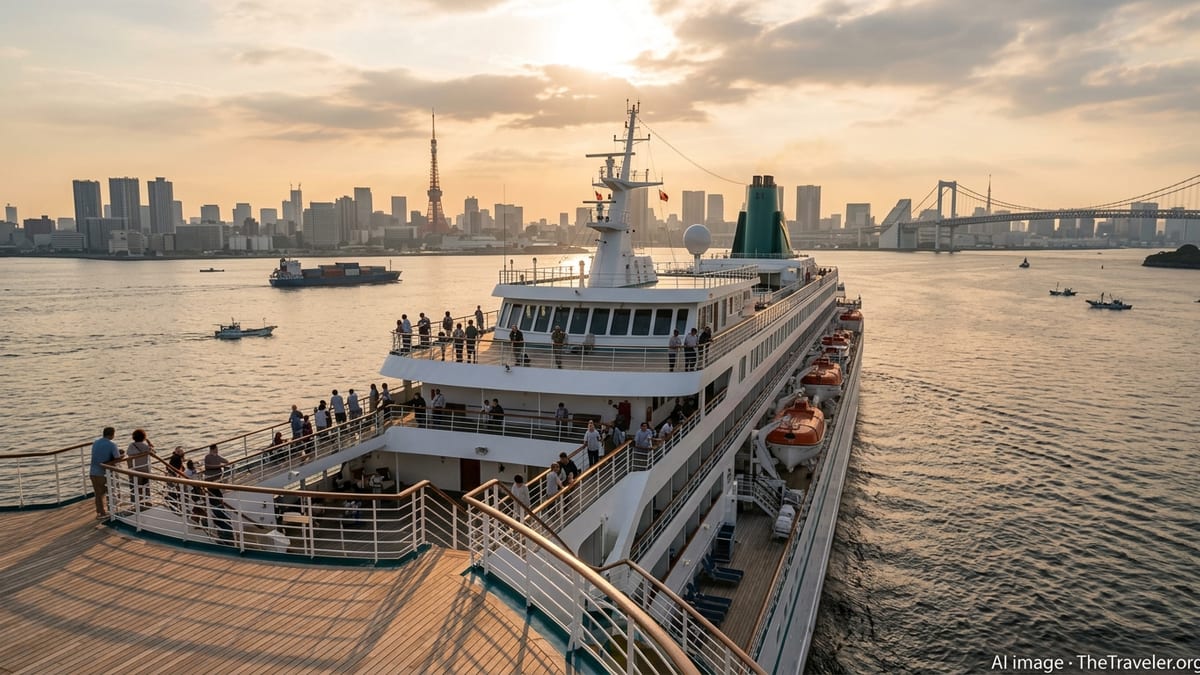
German-Based Amadea Departs on Extended Global Voyage
The German-market cruise ship Amadea, operated for Phoenix Reisen, is now sailing one of the company’s longest world voyages, following departure from Bremerhaven in mid-December. Reports indicate the ship is on a 146-night itinerary that is scheduled to circle the globe, combining classic Atlantic segments with a Pacific crossing and a return to Europe via southern waters.
Coverage in cruise industry publications describes the voyage as a centerpiece of Phoenix Reisen’s long-haul program, aimed at guests who prefer smaller, traditionally styled ships over the newest mega-vessels. The Amadea typically carries around 600 passengers, positioning the world cruise as an intimate alternative in a sector increasingly dominated by very large ships.
According to published schedules, the itinerary initially traces familiar routes through Europe and the Atlantic before reaching the Caribbean and Central America. From there, the ship is set to continue west into the Pacific, visiting island destinations ahead of its arrival in East Asia, where Japan becomes a major focus.
Japan Segment Highlights Tokyo, Kobe and Hiroshima
Japan features prominently in Phoenix Reisen’s current Amadea deployment, with information from cruise brochures and port schedules showing days allocated in Tokyo, Kobe and Hiroshima, among other Japanese ports. These calls form part of a wider sequence that presents what the line markets as some of “Japan’s most beautiful sides,” combining large urban centers with coastal and historical cities.
Tokyo is expected to serve as a key gateway port, with the Amadea scheduled to dock at the city’s international cruise facilities. Publicly available shore program descriptions emphasize panoramic city tours, visits to major landmarks such as the Tokyo Tower area and Meiji Shrine, and optional excursions to nearby Yokohama, Kamakura or the Hakone region, offering guests a sample of the capital’s mix of modern architecture and traditional districts.
The itinerary then turns west along Honshu toward Kobe, often promoted in cruise materials in connection with the wider Kansai region. From Kobe, guests can access Osaka’s neon-lined entertainment quarters, the temples and shrines of Kyoto, and the historic monuments of Nara. Port call outlines reference panoramic drives, individual exploration of downtown Osaka, and visits to nearby mountains and sake breweries, reflecting the city’s reputation for food and nightlife as well as its industrial waterfront.
Hiroshima provides a contrasting tone, with schedules indicating a call that allows time at the city’s peace memorial sites and the surrounding urban waterfront. While specific excursions vary by sailing, typical cruise programs in Hiroshima include visits to the Peace Memorial Park and Museum, as well as options to travel toward Miyajima Island, conditions permitting, to see the coastal setting and the famous shrine area.
Seto Inland Sea and Wider Asian Route
Beyond individual ports, the Amadea’s Japanese leg is designed to showcase the Seto Inland Sea region. Itinerary descriptions note scenic cruising between Kobe and Hiroshima, with the ship navigating among islands and coastal settlements that line this sheltered waterway. This scenic segment is marketed as a highlight for guests who prefer long periods on deck watching landscapes rather than focusing only on city sightseeing.
Additional Japanese ports on the program include Shimizu, linked to Mount Fuji views, Kochi on Shikoku, Moji-ku in Kyushu’s north, Nagasaki and Naha on Okinawa. Together, they present a range of experiences from industrial harbors and castle towns to subtropical island scenery. The pattern mirrors broader trends in Japan cruising, where lines increasingly combine major urban gateways with smaller, regional ports to spread visitor traffic and offer more varied shore excursions.
Public information indicates that after Japan, Amadea is scheduled to continue south and west, calling at Taiwan, China and Hong Kong before eventually turning toward the Indian Ocean and Africa. Earlier planning documents had shown a return to Europe via the Red Sea and Suez Canal, but subsequent reports point to adjustments that favor a route around Africa, in line with wider industry shifts away from certain Middle East transits in recent seasons.
Adjustments to World Cruise Itinerary Reflect Wider Market Conditions
Earlier reporting on Phoenix Reisen’s 2025 to 2026 world cruise program for Amadea highlighted itinerary changes implemented ahead of departure, particularly on the homeward leg back to Europe. Cruise news outlets have noted that the company replaced Red Sea and eastern Mediterranean calls with an African routing and additional days at sea, while retaining the overall length of the voyage.
These alterations are consistent with changes announced by other operators, which have redirected ships around Africa in response to evolving conditions along key shipping lanes. For Amadea, the revisions mean that the Japanese and broader Asia-Pacific segments retain their prominence within the voyage, while the return to Europe focuses more heavily on southern Atlantic and African ports and prolonged ocean passages.
Publicly available summaries show that, despite route adjustments, Japan remains one of the marquee clusters of calls on the itinerary, marketed alongside the South Pacific and select African stops as a principal draw for world cruise guests. The combination of iconic cities like Tokyo with ports such as Kobe and Hiroshima is positioned to appeal to passengers seeking both headline destinations and deeper cultural context.
Growing Appeal of Japan Within Global Cruise Patterns
The prominence of Japanese ports on Amadea’s current world cruise reflects a broader shift in global deployment toward East Asia. In recent years, Japan has attracted increased attention from cruise lines that traditionally focused more heavily on Europe and the Caribbean, with a growing number of ships calling at Tokyo, Yokohama, Kobe, Hiroshima and smaller regional ports.
Port statistics and industry commentary point to Japan’s blend of reliable infrastructure, strong domestic tourism appeal and distinctive cultural offerings as drivers of this trend. For German-speaking markets in particular, operators such as Phoenix Reisen promote Japan segments as once-in-a-lifetime experiences, highlighting spring and early-year sailings that coincide with relatively mild weather and, in some years, the cherry blossom season in parts of the country.
As Amadea progresses through its four-and-a-half-month journey, the Japanese stretch of the world cruise stands out as a central narrative element, combining major-city energy in Tokyo, gateway access to Kansai from Kobe and the reflective atmosphere of Hiroshima. For travelers looking at future seasons, the ship’s current itinerary provides a clear indication that Japan is set to remain a core component of Phoenix Reisen’s long-distance cruise programming.