

More news on this day
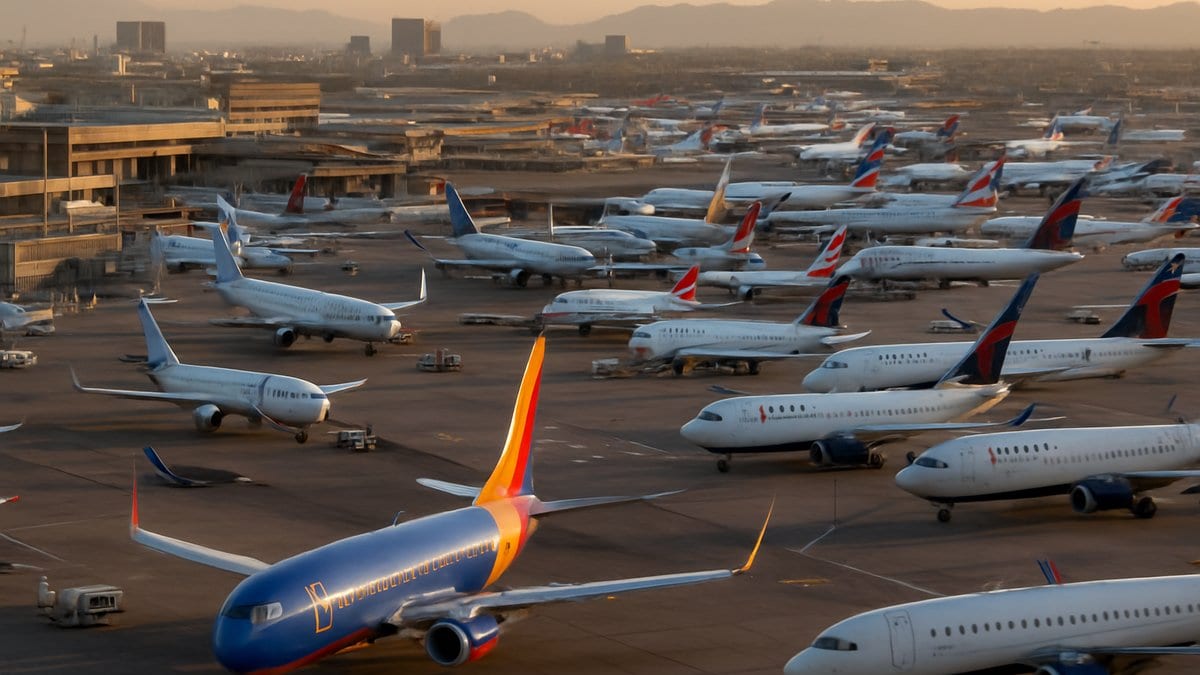
Phoenix Sky Harbor International Airport has become a focal point in the latest wave of U.S. air travel turmoil, with publicly available tracking data showing more than 160 combined delays and cancellations in a single sprawling disruption event.
Get the latest news straight to your inbox!
A Desert Hub Brought to a Standstill
The disruption at Phoenix unfolded as part of a broader pattern of spring instability across the U.S. air network, but the scale of the gridlock at Sky Harbor stood out even against that turbulent backdrop. According to published coverage and aggregated flight-status tallies, departures and arrivals on early April schedules stacked up until well over 160 flights were either significantly delayed or canceled, leaving concourses crowded and departure boards dominated by red delay markers.
Publicly available data indicate that American Airlines, Southwest Airlines and JetBlue were among the airlines most affected at Phoenix, with dozens of delayed departures on routes to major domestic hubs such as Dallas, Chicago, Denver, Los Angeles and New York. Separate national counts for the same period showed several thousand delays and hundreds of cancellations across the United States, underscoring how events at a single desert hub fed into a much larger network shock.
Earlier travel analysis has highlighted that Phoenix, while not the largest U.S. hub, plays an important connective role for flows between the West Coast, the Mountain West and the rest of the country. When operations at Sky Harbor slow, the effect can cascade into smaller regional airports that rely on Phoenix for onward connections, compounding the impact well beyond Arizona.
Reports from tracking services and travel outlets suggest that the latest event in Phoenix did not stem from one single cause but rather from a convergence of factors, including residual weather impacts in other regions, tight aircraft rotations and heightened spring demand. That combination left airlines with little margin to absorb even routine schedule hiccups before they escalated into widespread disruption.
How 160 Delays Spiral Across the National Grid
Industry observers have long noted that large disruption counts rarely remain confined to a single airport. The Sky Harbor gridlock illustrated that dynamic in stark terms. When dozens of outbound flights leave late or are canceled, aircraft and crews that should be cycling onward to later legs in other cities fall out of sequence, forcing airlines to delay subsequent departures or substitute smaller aircraft.
Publicly available nationwide data from early April show that delays at Phoenix coincided with elevated disruption levels at other major hubs, including Chicago, Dallas and New York. Reports indicate that American Airlines alone recorded more than 800 delays and several dozen cancellations across its network during the broader disruption period, while other major carriers logged hundreds of affected flights of their own. In that context, the 160-plus disruptions concentrated at Phoenix became one visible node in a lattice of network stress stretching across the country.
Operational analysis from previous seasons has emphasized that a small number of high-impact days can account for a disproportionate share of annual delays and cancellations. The Sky Harbor event fits that pattern. Once early-day departures began to slip, recovery became increasingly difficult, particularly when aircraft arriving from already disrupted airports brought additional late arrivals into the Phoenix schedule.
For travelers, the result was a familiar yet frustrating chain reaction. Missed connections, rolling departure-time revisions and aircraft swaps rippled through the day and into the evening. Even passengers whose flights ultimately departed close to schedule often faced crowded gate areas and longer lines at customer service desks as airlines attempted to rebook those who were stranded.
Strain on Terminals, Staff and Surface Access
As the disruption deepened, the pressure on Sky Harbor’s physical infrastructure and staffing became more apparent. Public accounts and prior case studies from similar events in Phoenix describe concourses where nearly every seat is taken for hours at a time, with passengers camping out near charging stations and food outlets reporting extended queues.
Airport planning documents and recent city reports highlight that Sky Harbor has been preparing for sustained traffic growth, investing in terminal upgrades, airfield improvements and ground transportation links. However, those projects are typically calibrated to steady increases in throughput, not the sudden peaks created when more than 160 flights fall out of their normal rhythm in a single day. In such moments, even well-designed concourses can feel undersized.
Surface access into and out of the airport also tends to come under strain during major disruptions. Local traffic reports and community discussions in recent weeks have described long waits to reach terminal curbs and extended exit times from Sky Harbor’s road system when flight schedules bunch together late into the evening. Ride-hailing, parking shuttles and rental car returns all draw from the same constrained roadway network, magnifying the effect of heavy, irregular passenger flows.
Staffing adds another layer of complexity. Airlines and airport concessionaires often schedule workers around forecast flight banks and historical demand patterns. When disruption events distort that pattern, some shifts become overwhelmed while others are relatively quiet. Publicly available guidance from labor and industry groups notes that quickly adding staff on short notice is difficult, which can leave existing teams managing unusually high passenger volumes for prolonged periods.
Why Phoenix Keeps Getting Caught in Systemwide Turbulence
Although the latest episode was notable for its scale, Phoenix Sky Harbor is no stranger to disruption. Historical coverage points to repeated operational challenges tied to the region’s intense summer heat, seasonal monsoon storms and dust events. In recent years, dust storms and heavy rain have temporarily reduced runway capacity, while extremely high temperatures have forced some aircraft to operate with weight restrictions, cutting into scheduling flexibility.
In addition to local weather, Phoenix sits at a crossroads of routes linking California, the Mountain West and central and eastern states. Published analyses of U.S. air traffic patterns describe Sky Harbor as both an origin-and-destination market and a connecting hub within several airlines’ networks. That dual role can amplify its vulnerability. When weather or airspace constraints affect other parts of the country, aircraft that would typically feed into or out of Phoenix may be delayed or canceled, leaving gaps in the local schedule that are difficult to fill quickly.
Recent research on the National Airspace System has also underscored the growing sensitivity of airline operations to tight schedules and high utilization of aircraft and crews. Carriers have sought to maximize efficiency, but the trade-off is reduced slack when extraordinary events occur. The latest Phoenix gridlock appears to reflect that tension: a system optimized for normal conditions but exposed when multiple stressors arrive at once.
Local planning documents indicate that the city and airport are moving ahead with multiyear projects to expand capacity and improve resilience, including terminal enhancements and transportation links. However, those long-term investments cannot eliminate the kinds of nationwide weather systems and airspace disruptions that helped set the stage for the current wave of delays and cancellations.
What Travelers Can Expect After the Gridlock
Experience from previous disruption waves suggests that recovery from a day with 160 or more affected flights at a single hub does not happen instantly. Even after weather improves or immediate constraints ease, aircraft and crews may remain out of position, leading to lingering delays and occasional cancellations on following days.
Guidance from consumer advocates and government agencies emphasizes that traveler options depend heavily on the cause of the disruption and each airline’s published policies. In many cases, airlines attempt to rebook passengers on the next available flight, but high spring demand can mean that the “next” flight with open seats is many hours, or even a full day, away. Some carriers provide hotel or meal support in certain scenarios, while in others passengers may need to make their own arrangements.
Publicly available advice from travel experts encourages passengers transiting through Phoenix and other major hubs during this volatile period to monitor flight status closely, build longer connection times into itineraries and consider early departures when schedules permit. Same-day schedule changes can cascade quickly during nationwide disruptions, and having extra buffer can reduce the risk of missed connections.
As the peak spring and early summer travel seasons approach, the recent gridlock at Phoenix Sky Harbor offers a preview of the challenges that can arise when an already busy air travel system collides with fast-changing weather and tight operational margins. For now, passengers and airlines alike are contending with the reality that a single day of 160-plus disruptions in the desert can reverberate across the entire national grid.